The Bhutanese Leading the way.
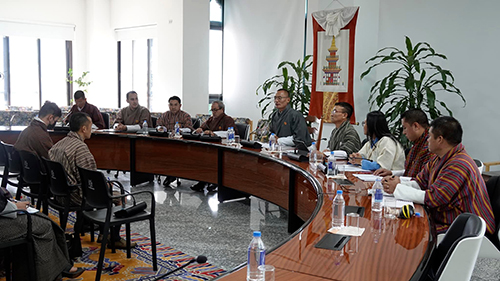
During the Meet-the-Press session, the Education Minister mentioned that despite encountering some concerns and varied reactions from parents, the ministry’s primary focus lies in the personalized attention students could receive at such schools.
Prime Minister Dasho Tshering Tobgay also added on to what Lyonpo Yeezang De Thapa stated, as PM said the education minister was being too soft while giving responses to the question.
PM mentioned that the youth are increasingly succumbing to substance use, often due to peer pressure or parents’ failure to shield their children from addiction.
“This special school is of utmost importance. Parents should support us. Just as in a tray full of eggs, if there’s a rotten egg, we discard it instead of showing mercy. Lyonpo Yeezang mentioned the ministry’s intention to put fencing around the special school, it is not fencing: We are going to build walls to ensure the students’ security.”
Lyonchhen mentioned that the students are not being taken to prison but to a school and said, “A child’s failure solely depends on his/her parents as they fail to advise their children. Some parents despite knowing that their children are into drugs pretend not to know, once caught the parents plead to find another alternative than to send their children to the special school.”
PM mentioned that if the child’s parents want another alternative, students will be expelled from schools or sent to prison, if their concern is the special school will stigmatize the students.
The government considers the special school as the optimal solution.
However, there’s a perception among some that the public opposes government action against drugs. Thus, PM assured that the youth shall not be freed in a way that only causes harm to themselves.
The Bhutanese recently highlighted both the advantages and disadvantages of a Specialized School for individuals dealing with substance use disorders (SUDS). The National Drug Task Force (NDTF) instructed the Ministry of Education and Skills Development (MoESD) to establish such a school.
The paper highlighted the Education Minister’s statement regarding the school’s structure, emphasizing the need to ensure that students’ regular schooling remains uninterrupted, allowing them to seamlessly return to their usual school routine after receiving treatment.
Nevertheless, consolidating all students struggling with drug-related issues into a single institution might inadvertently perpetuate stereotypes and hinder their integration into mainstream education and society.
A research conducted by the National Institute on Drug Addiction (NIDA) in USA found that stigma significantly impacts individuals with SUDs by diminishing their willingness to seek treatment. This stigma often evokes feelings of pity, fear, anger, and a desire for social distance from individuals with SUDs, perpetuated by prevailing stereotypes.
The article emphasizes that recovery schools can provide specialized curricula and resources customized to meet the needs of students in recovery, focusing on areas, such as relapse prevention and the development of essential life skills.
However, the research also highlights a potential drawback: attending a recovery school might exacerbate the stigma surrounding individuals with SUDs. Some individuals may feel isolated or stigmatized by attending a specialized recovery school, potentially missing out on opportunities for social integration and interaction with peers who are not in recovery.
Another research article by The Inquirer highlights that Recovery Schools help students struggling with co-occurring mental health and substance use disorders. During their enrollment, students pledge to maintain sobriety as part of the program, though exceptions may be considered for individuals fully committed to adhering to the school’s regimen.
Mainly the paper states “The success of a recovery school depends on students’ commitment to sobriety, and exceptions made for individuals who are not fully committed may impact the overall effectiveness of the program.”
As recovery schools aim to put all people suffering from SUDs in the same area, Wendy Manwarren, in her research about group therapy, says that such type of therapy helps individuals to make themselves present in therapy sessions and can also help them to interact with each other about their issues.
However, as addiction is a mental illness there are potential chances for violence or conflict.
Depending on the dynamics and circumstances, conflicts or violence could arise in a room filled with individuals struggling with addiction.
There can also be a negative influence, where in a room full of people suffering from SUDs, there is a risk of negative peer influence where Individuals may share drugs or encourage each other to continue using hindering the recovery process.
SUD is a disease that affects a person’s brain and behavior and leads it is an inability to control the use of a legal or illegal drug or medicine. When a person is addicted, they may continue using the drug despite the harm it causes.
It is essential to remember that individuals struggling with SUDs should not be stigmatized. Addiction is a complex disease that affects people from all walks of life, and it is crucial to approach it with empathy and understanding.