The Bhutanese Leading the way.

After much delay, Bhutan and India have officially announced the tariff at Nu 5.10 per unit for the Punatsangchu (P) II project, which will be effective for five years and then gradually increase.
The levelized tariff, or average tariff over the 35-year period, will be Nu 5.67 per unit.
This was included in the Protocol to the Agreement between the Royal Government of Bhutan and the Government of India, signed for the P-II Project Export Tariff on 9th April 2026 in Thimphu, Bhutan.
The protocol defines the tariff agreed between the two sides.
The annual revenue from P II at full generation at Nu 5.10 per unit is expected to be around Nu 20 billion (bn) plus a year, of which the loan repayment is Nu 8 bn and Operation and Maintenance (O&M) costs are expected to be Nu 2 bn a year.
The project is expected to generate 4,575 mn units of electricity annually.
The 1020 MW P-II Hydroelectric Project was jointly inaugurated by His Majesty The King and Shri Narendra Modi, Prime Minister of India on 11th November 2025 and commenced export of surplus power to India from 19th September 2025 at a mutually agreed starting tariff.
The project took 14 years and Nu 88.5 bn to complete.
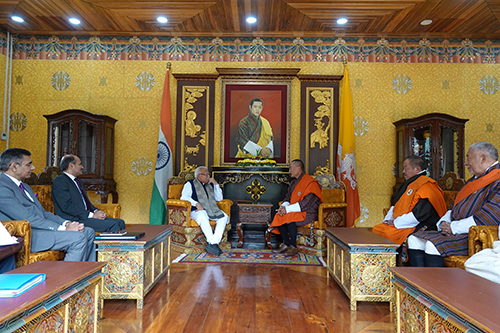
The signing happened in the presence of the Minister for Power, Housing & Urban Affairs, Government of Republic of India, Manohar Lal, who is on an official visit to Bhutan from 9th to 12th April 2026 at the invitation of Lyonpo Gem Tshering.
The next step will be the signing of the Power Purchase Agreement, which will happen later between DGPC and NVVN, an Indian government-owned power trading company.
The Indian Power Minister witnessed the first concrete pour ceremony at the Punatsangchhu-I Hydroelectric Project dam on 10th April 2026. This marks a momentous occasion for the people of both the nations to witness the commencement of dam works at the 1200 MW P-I Hydroelectric Project.
RGoB and GoI also signed the methodology for accounting of the reactive power exchange between Bhutan and India, which will be effective from 1st May 2026.
This will contribute to enhancing grid stability, ensure fair and transparent accounting of power flows, and further strengthen cross-border interconnections between the two countries.
An official explained that reactive power is not the useful power that can be converted into electricity, but it exists in the grid and system. The official said when the Indian grid has high demand and hence low voltage then reactive power from Bhutan may be welcome to stabilize the grid, but it is not welcome in an opposite situation.
So, Bhutan is paid when its reactive power helps stabilize the Indian grid, and Bhutan has to pay when it destabilizes the grid. This addition and subtraction was already happening earlier but solely on the Indian side and based on their methodology.
The agreement now ensures a mutually agreed and transparent methodology.
A press release said the Bhutan-India partnership is built on long-standing energy cooperation, deep understanding and friendship across all economic and developmental areas of cooperation.
The visit will further strengthen multi-faceted energy collaboration between the two countries encompassing power generation, electricity trade, transmission connectivity, equipment, training and technical collaboration.