The Bhutanese Leading the way.
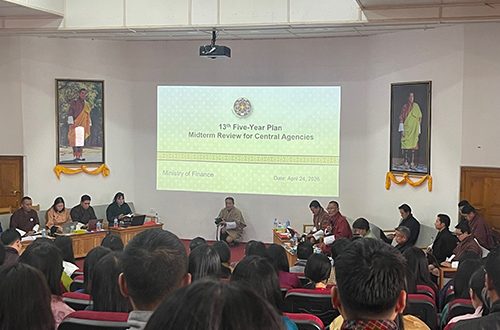
The Ministry of Finance has proposed a revision to the 13th Five-Year Plan (FYP), dropping a key performance indicator (KPI) that aimed to increase the tax-to-GDP ratio from 13 percent to 15 percent. In its place, the ministry has introduced a new target focused on enhancing domestic revenue collection through improved compliance and digital systems.
Under the approved 13th FYP, the baseline target for domestic revenue collection was Nu 327 billion. This has now been proposed for revision to Nu 380 billion, reflecting a shift in how revenue performance will be measured and strengthened over the plan period.
Providing an update on revenue performance so far, the ministry reported that Nu 62.2 billion was collected in the fiscal year 2024–25, accounting for 20.6 percent of GDP. In the fiscal year 2025–26, domestic revenue collection stands at Nu 47.6 billion to date.
Finance Secretary Leki Wagmo said, “We know that tax to GDP ratio is an important indicator to capture but because of the structural reforms, measuring this in the 13 FYP will be premature.”
The ministry’s rationale for dropping the tax-to-GDP ratio target stems from ongoing tax reforms that are restructuring the country’s revenue framework.
In addition, changes in the GFSM classification, where royalties are now reclassified as non-tax revenue, have the effect of lowering the measured tax ratio.
The ministry stated that these developments mean the tax-to-GDP ratio no longer fully reflects the underlying revenue performance.
As a result, the ministry has opted to replace the KPI with a focus on enhancing domestic revenue collection.
This revised target is seen as better aligned with the government’s strategic priorities, particularly in strengthening revenue administration systems.
It is also expected to more directly support domestic resource mobilisation efforts while improving measurability and implementation focus.