The Bhutanese Leading the way.
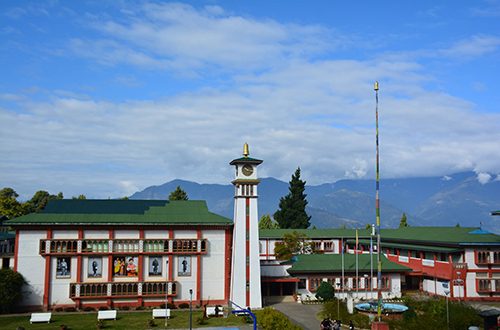
The government is considering a more progressive scholarship system that directs financial assistance to students according to their needs, as the proposed increase in monthly student stipends remains undecided.
At the 33rd Meet-the- Press on 20th November, the Ministry of Finance (MoF) acknowledged that the rising cost of living has affected university students, including those receiving government scholarships. However, it said the proposed increase would be assessed as part of a broader review of tertiary education financing.
The monthly stipend of Nu 2,500, unchanged since 2019, has come under renewed scrutiny following the Royal University of Bhutan’s (RUB) proposal to increase it to as much as Nu 6,500. The proposal has been under the MoF’s consideration since February.
The MoF said no financial decision had been taken on the proposed revision, adding that the government would consider it after receiving consolidated recommendations from RUB, the Khesar Gyalpo University of Medical Sciences of Bhutan (KGUMSB) and the Jigme Singye Wangchuck School of Law (JSW Law).
The ministry acknowledged the importance of providing adequate financial support to students but said the issue should be examined beyond the monthly allowance.
Government support for tertiary education includes tuition fees, capital investments in university infrastructure, facilities and equipment, operational subsidies to higher education institutions, and other student benefits.
The Finance Secretary Leki Wangmo said any decision on increasing stipends must consider the overall expenditure on tertiary education and the complete package of support students receive, rather than treating the monthly allowance separately.
She also indicated that the government wants to examine how scholarship assistance can be distributed more equitably, taking into account differences in students’ financial circumstances.
The Finance Secretary pointed to international models of tertiary education financing, where some countries provide extensive public subsidies, while others share education costs among governments, students and families. Some systems also differentiate financial assistance according to students’ economic circumstances.
Bhutan, the MoF said, has reached a point where it needs to examine how its scholarship system can become more progressive, ensuring that adequate financial assistance reaches students who need it most while making responsible use of limited public resources.
The proposed stipend revision is therefore being considered alongside a broader scholarship framework review being undertaken by RUB, KGUMSB and JSW Law. The review aims to ensure consistency in student support across the three institutions and consider tuition fees, living allowances and other benefits together.
The ministry said the government’s objective was not simply to increase or maintain the existing stipend rate, but to establish a student support framework that is fair, responsive to students’ needs and financially sustainable for future generations.
While the government reviews the broader scholarship framework, students say the current allowance remains insufficient to meet their monthly expenses.
A student currently studying at Sherubtse College said the Nu 2,250 received after deductions was not enough to cover a month’s expenses, particularly for students under the self-catering arrangement, who must purchase their own food and daily necessities.
The student said that even basic items, including groceries and other daily essentials, had to be purchased using the limited monthly allowance.
“Surviving on Nu 2,250 for a month is quite challenging,” the student said, adding that rising commodity prices had further increased the financial pressure on students.
The student cited the price of a bag of rice, which had increased from Nu 1,350 during the second semester to Nu 1,570. Although the difference may appear relatively small, the student said such increases had a significant impact on those managing their expenses on a limited allowance.
The student also linked rising commodity prices to geopolitical tensions, including the Gulf crisis, and expressed concern that further price increases could place students under greater financial pressure.
“If we calculate the minimum daily expenditure, it is below the poverty line,” the student said, describing the financial circumstances of students as difficult and calling for an increase in the monthly stipend.
The student also raised concerns about the possible impact of inflation and changes in civil servants’ salaries on the cost of living, saying students could face further difficulties if shopkeepers continued to increase prices.
The account highlights the gap between the financial support students receive and the expenses they must meet independently. For students under self-catering arrangements, the stipend must cover food and other daily necessities, leaving little room for unexpected expenses.
Concerns raised in 2024
Concerns over the adequacy of student stipends are not new. A 2024 report by The Bhutanese documented how deductions for accommodation, mess fees and electricity left some students with little money from their monthly allowances.
The report found that students receiving between Nu 2,500 and Nu 3,000 often struggled to meet daily expenses after deductions, with some depending on their parents to buy groceries and cover other necessities.
A student in Thimphu told the publication that deductions for vegetables and electricity sometimes left mess students with only Nu 800. The student also alleged that the remaining amount was sometimes used for other college functions.
The student said the existing stipend could be sufficient if the government covered food, accommodation or electricity costs. However, if students had to meet these expenses themselves, an increase was necessary.
At Gedu College of Business Studies, a student told the publication that mess students received Nu 2,500 of which Nu 2,250 was deducted for mess fees and Nu 250 for rent.
Self-catering students received Nu 2,250 after rent deductions, with further deductions for electricity. The student said the remaining amount was sometimes insufficient to purchase groceries, forcing students to seek financial support from their parents.
A student from Sherubtse College also called for an additional stipend to help meet daily expenses without depending on family support. The student highlighted the difficulties faced by those from financially unstable households and called for greater transparency in stipend allocation.
In its response at the time, the MoF said stipend eligibility was determined by RUB and limited to students receiving government scholarships. Self-financing students were not eligible for stipends because they were not enrolled under government scholarship arrangements.
The ministry also maintained that scholarships should be merit-based, irrespective of students’ economic backgrounds.
It further said the government’s investment in educational infrastructure was substantial, and that student collections were hardly sufficient to cover hostel operating costs and basic amenities. The ministry also raised concerns about the sustainability of providing services without greater cost-sharing.
Two years after the issue first surfaced, the MoF’s latest statement points to a broader examination of how student assistance should be allocated, including whether financial support should be more closely tied to students’ economic circumstances. However, with no decision yet on the proposed increase and no completion date announced for the scholarship review, students are still waiting to learn how the revised framework will affect their monthly financial support.