 The Bhutanese Leading the way.
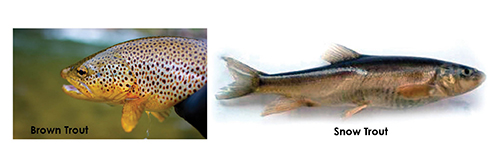
Bhutan’s native fish species called Yue Nya (Snow Trout and also known asla/asala) has seen a significant decline in the years after the introduction of the invasive fish species called the Brown Trout.
Dasho Benji Dorji shares a story from his younger days about how the yue nya population has greatly declined over the span of decades after the Brown Trout was introduced to Bhutanese rivers.
He said that the Brown Trout species had been brought to Bhutan long ago and was introduced by his grandfather, Gongzim Raja Sonam Tobgay Dorji, from Kashmir in India, thinking that the fish species would be suitable for Bhutanese rivers. This was meant to be a new food and fishing resource for Bhutan.
“However, little did they know about the nature and behavior of this fish back then because there was no scientific means to truly understand the fish species,” he said. Later on, the Brown Trout would go on to become a menace for the river ecosystem.
“Back in the days when I had a hobby of fishing, there used to be a lot of native fish species in the rivers. These little fishes were bottom feeders and essentially played a role in maintaining balance in the river ecosystem,” said Dasho Benji.
These fishes were known to feed on the algae that accumulated under the rocks and along the riversides. Dasho Benji said that the Yue Nya basically kept the river clean by feeding on the algae.
As the story goes, years after the introduction of the Brown Trout, it fed on the yue nya, leading to the decline of the fish population.
“In the 1970s, there was a time when I visited the riverside and I saw that the rocks had accumulated a lot of algae and it made the water dirtier. All the native Yue Nyas had disappeared and the Brown Trout had eaten them all,” he said.
Dasho Benji clarifies that he is not an expert on the topic, and he drew his opinions from his experiences and what he knew and saw.
Dr. Dhan B. Gurung, an ex-professor at the College of Natural Resources, said that the Brown Trout species is a carnivorous species and it was introduced to rivers in the temperate regions of Haa, Paro, Thimphu and Bumthang up to the Chamkhar Chhu.
“They were introduced in some lakes in Haa, and in rivers such as the Punatsangchhu, Pa Chhu, Thim Chhu, Haa Chhu and even the Chamkhar Chhu,” said Dr. Dhan.
“The Brown Trout will eat the native fish and it is bad news for the river ecosystem as each fish has its own ecological importance and the decline of the native fish species means an imbalance in the natural ecosystem,” he said.
While the Brown Trout species has threatened the native yue nya species of Bhutan, they are only found in larger and faster rivers.
According to Dr. Dhan, the Brown Trout species essentially thrives in bigger rivers with strong currents and, as it eats away the smaller native yue nyas in the river, the yue nyas will be confined to smaller rivers and tributaries of the bigger rivers.
Dasho Benji said that the decline of the fish population led to a significant decline in the waterbird population in the country as well.
“Back then, there used to be a lot of chhubjas (waterbirds) by the rivers and over the years, it has greatly reduced as their main food source had vanished and they migrated to more lush rivers with more fish,” he said.
In a study titled “Coldwater Fish and Fisheries in Bhutan” by T. Petr, it states that the Brown Trout (Salmo trutta) was first introduced in Bhutan in 1930.
Until the 1980s, two trout hatcheries (in Haa and Wangchutaba) produced about 20,000 trout fingerlings per annum.
The study says that the Brown Trout has established viable and self-replenishing stocks in a number of streams and rivers, including Haa, Thimphu, Paro, and some tributaries of the Sankosh and Manas rivers, i.e. Mo, Ho, Mangdi and Chamkhar.
The stocking of Brown Trout was discontinued in 1983 on the assumption that Brown Trout was feeding on and suppressing indigenous coldwater fish such as asla (Yue Nya).
Dr. Dhan said that the topic of aquatic fish species and aquatic conservation in Bhutan receives little attention and is somewhat neglected and, hence, it is a gray area where conclusive evidence-based statements cannot be made. This is attributed to a lack of research, which is also fueled by resource and budget constraints.
On a separate topic, Dasho Benji narrates another insightful story of how a handful of disease-infested imported goats were released (Tsethar) into the wild and how it basically led to the decimation of Bhutan’s Takin population.
“These goats were brought from India and it wasn’t known by the local people that these goats were carrying diseases. A handful of these goats were released in the forest below the Tango and Chari Monasteries and it led to the death of a huge number of Bhutan’s Takins.”
Dasho Benji says that while it is a noble deed for Buddhists to be able to do Tsethar for animals, it is also important to keep in mind the need to adopt a more responsible and mindful way of doing it.
Similar to how the invasive Brown Trout suppressed the local fish species and the Tsethar of the disease-infested goats, he said that it is crucial to note that one’s actions can have unintended consequences, and not doing things responsibly can do more harm than good.



Great article! Several years ago, when working with Dr. DB Gurung, we found a population of magur catfishes near Phuntsholing, that were there as a result of Tsethar! They too are not native and were eating all of the native fishes. When we cut the stomachs open of one, we found around 10 native “Hilay” fish inside.
I think it would be a worthwhile experiment to make Tsedar release ponds that are kept separate from native waterways, so that the Buddhists can continue their tradition, but in a way that is in closer harmony with the natural balance.