The Bhutanese Leading the way.
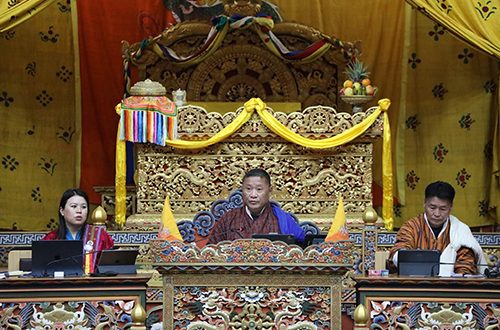
The Jabmi (Amendment) Bill of Bhutan 2026 was introduced and passed by the National Council (NC) during its 36th Session as a Private Member’s Bill before being transmitted to the National Assembly (NA) in accordance with legislative procedures. Upon receiving the Bill, the NA referred it to the Legislative Committee for review. As per Section 216 of the Rules of Procedure of the National Assembly 2006, Bills originating from the NC are directly tabled for the third reading without undergoing the first and second readings.
The Member of Parliament (MP) Kuenga from Nyishog-Saephu, also the Chair of the Legislative Committee, NA introduced the Jabmi (Amendment) Bill of Bhutan 2026 along with the Committee’s Review Report. The report highlighted the importance of strengthening the legal profession to ensure access to justice and uphold the rule of law. The Bill aims to strengthen the governance and institutional framework of the Jabmi Tshogdey, including the roles and responsibilities of its leadership, eligibility criteria, professional conduct and disciplinary procedures.
It also provides for adequate financial support from the State for the administration of the Jabmi Tshogdey and outlines measures to address professional misconduct, including reprimand, suspension and removal from practice.
The proposed amendments seek to promote accountability, integrity and professionalism while strengthening the administration of justice and public confidence in the legal profession. During the deliberations, MPs raised concerns over certain provisions of the Bill, including its underlying principles and the proposal to allocate a budget to the Jabmi Tshogdey as part of the annual budget. Following the concerns raised, the House decided to further review the Bill in consultation with the Legislative Committee before continuing deliberations the following day.
The Chair of the Legislative Committee, as directed by the House, met with its members and unanimously agreed that the government shall provide adequate financial support, by way of grants, for the sustainable operation and functioning of the Jabmi Tshogdey.
During the second day of deliberations on the Jabmi (Amendment) Bill of Bhutan 2026, the House deliberated extensively on Section 9(f), which concerns the provision of pro bono legal aid to indigent persons, in addition to financial support from the State.
However, Members could not reach a consensus on the provision, with discussions centring on who should be eligible to receive pro bono legal services. The Committee was directed to submit its recommendation to the House the following day before the Bill is adopted. Meanwhile, the House endorsed all other amendments proposed by the Committee, along with the new sections added to the Bill.
The NA continued deliberations on the Jabmi (Amendment) Bill of Bhutan 2026 on 20th November. The Chairperson of the Legislative Committee presented the Committee’s review report on five sections of the Bill, including Section 9(f). The House endorsed the amendments proposed by the Committee, including its recommendation on Section 9(f) to provide pro bono legal services to indigent persons in addition to financial support from the State.
Following two days of extensive deliberations on the Bill, the Chairperson moved the motion for its adoption. The House adopted the Jabmi (Amendment) Bill of Bhutan 2026, with 36 members voting in favour and one abstaining out of 37 members present and voting. The Bill will be referred to the NC as per procedure.