 The Bhutanese Leading the way.
By Dhanapati Sharma
In every graduation ceremony, we celebrate the achievements of young people who complete their university education. We congratulate them, confer them their degrees, and wish them success. Yet one important question often remains unanswered. Are our graduates really ready for the world of work? For years and until now, higher education around the world has been criticised for producing graduates who possess academic knowledge without practical experience. Employers often expect graduates to be active and productive from their first day at work, while in reality the graduates struggle to adapt to the realities of professional life. Bridging this gap has become one of the biggest challenges for the universities today.
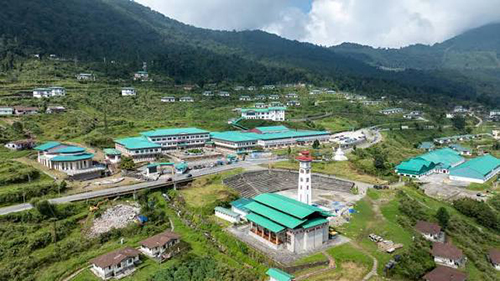
To address this challenge, Gedu College of Business Studies (GCBS) has taken a bold step to rethink business education. Beginning in December 2025, the college introduced its first-ever six-month Professional Internship Program (PIP) as a compulsory component for all students in Year 3, Semester II of its four-year undergraduate programmes. Rather than spending the semester in lecture halls, we wanted our students to experience the workplace as their classroom thus, 352 students left the campus. They joined organisations across Bhutan to work alongside professionals in ministries, government autonomous agencies, corporations, financial institutions, private companies, and civil society organisations. They will return to the college in July 2026 and will continue their final academic year before graduating in June 2027. This was more than an internship. It represented a fundamental change in the way GCBS prepares its students for employment. The objective of the internship program is simple but important. GCBS firmly believes that students should not wait until graduation to experience the world of work. They should understand organisational culture, develop professional ethics, improve communication, build confidence, and apply classroom knowledge while they are still learning. Universities can teach theories, concepts, and analytical thinking but professionalism, teamwork, responsibility, resilience, and workplace judgement are learned best through experience.
The results of the PIP have been encouraging. Across the country, students became part of operating and functioning organisations. They assisted in banking operations, financial analysis, taxation, auditing, digital marketing, customer service, project implementation, human resource management, business analytics, and many other professional functions. They attended meetings, worked with multidisciplinary teams, met deadlines, solved practical problems, and experienced the expectations of a modern workplace. Many host supervisors entrusted them with responsibilities usually reserved for regular employees. Most organisations even indicated that the interns demonstrated strong potential for future employment. Perhaps the most important outcome was not just the technical knowledge and skills. Students returned with greater confidence, stronger communication skills, improved professionalism, and a better understanding of what employers expect.They have also learned that success in the workplace depends not only on academic performance but also on attitude, discipline, initiative, and teamwork. For employers, the internship also created value. Rather than recruiting graduates based only on interviews, organisations had the opportunity to observe potential future employees over six months. They got to witness students’ work ethics, adaptability, commitment, and learning ability in real working environments. Such experiences reduce recruitment uncertainty for employers. It would help organisations identify promising young professionals before they enter the labour market.
This success would not have been possible without the generosity and commitment of the potential employers of the country. The college (GCBS) expresses its deepest appreciation to every ministry, autonomous agency, corporation, financial institution, private company, non-government organisation, and development partner that opened its doors and invested time in mentoring our future graduates. Many organisations went beyond providing workplace learning. They offered accommodation, meals, transportation facilities, performance incentives, or monthly stipends to help students meet their daily expenses. These very acts of kindness reflected not only corporate responsibility but also a genuine commitment to developing Bhutan’s future workforce. The college remains sincerely grateful for their support.
However, the internship experience also highlighted an important national concern. Many students had choosen to go to urban areas such as Thimphu because of the economic environment of the job market, where cost of living is relatively higher as compared to other parts of the country. For six months, they had to find accommodation, pay for food and transportation, and meet daily living expenses while working full-time. Although they contributed meaningfully to their host organisations, many received no financial support. Understanding the financial challenges that students may face during a six-month internship, the Royal Government of Bhutan has provided funding to enable GCBS to offer a monthly stipend of Nu. 3,000 to each intern. This support reflects the government’s recognition that workplace learning is an essential part of higher education and workforce development. However, for many students placed away from their homes, particularly in urban centres, this amount only partially covers the cost of accommodation, food, and transportation. Across many developed countries, paid internships are increasingly recognised as an investment in future talent rather than simply a training exercise. For instance, undergraduate interns in the United States earn an average of about USD 23 per hour, and many organisations view internship programmes as an important pathway for recruiting future employees. While Bhutan’s economic context is different, the underlying principle remains the same. Supporting interns is an investment in building a skilled, confident, and work-ready workforce. Without such support, most of them had to rely on their families and others had to borrow money to complete the internship. Therefore, supporting them with even a modest monthly stipend, accommodation, transport, or meals can make a significant difference. It reduces financial stress, improves learning, and enables students to focus on their professional development.
As Bhutan continues to strengthen its economy and prepare for new opportunities, the demand for competent, adaptable, and industry-ready graduates will continue to grow. The higher educational institutes alone cannot prepare this workforce. The employers are equally important partners in shaping the next generation of professionals. The PIP demonstrates that education is the strongest when universities and industry work together. It is no longer enough to produce graduates who simply possess degrees. Bhutan needs graduates who understand workplaces, solve problems, communicate effectively, adapt quickly, and contribute from the first day they join an organisation. GCBS has taken an important first step. The college has moved beyond traditional classroom teaching and incorporated experiential learning as a core of business education. It is preparing students not only to graduate, but to succeed and be changemakers.
The responsibility now belongs to all of us. We encourage more partnerships with organisations, institutions and private firms across Bhutan to continue opening their doors to student interns, not just for GCBS as a college, but for the entire university. Do provide them with meaningful work, mentor them with patience, and where possible extend financial or any kind of support during their placement in your organization. The investment you make today will return many times more through a stronger national workforce and enhanced national economy. The students who completed their internships this June will return to campus for their final year of study. They will graduate in June 2027 carrying not only a university degree, but also six months of real workplace experience. This experience will make them more confident, more employable, and better prepared to serve the organisations and communities of Bhutan. This is the future of higher education. More importantly, it is the future that Bhutan deserves.
Gedu College of Business Studies, Chukha


I deeply resonate with this vision of learning beyond the classroom. As a student who experienced the Professional Internship Program (PIP), I am a living example of how such opportunities transform students into confident and workplace ready professionals.This six month journey helped me develop practical skills, professionalism, and a deeper understanding of the real world beyond textbooks.
I sincerely thank Gedu College of Business Studies and Druk Holding and Investments for supporting and creating such valuable opportunities.I look forward to seeing future GCBS students benefit from this initiative, not only through internships within Bhutan but also through international exposure that will help them grow as global professionals and contribute back to Bhutan.