The Bhutanese Leading the way.
Concerns are growing over the potential impact of a “Super El Niño” on Bhutan’s energy production. This weather phenomenon typically brings drier conditions and reduced rainfall across the region.
Many fear that lower water levels could hinder the country’s hydropower output. However, the Ministry of Energy and Natural Resources (MoENR) maintains a positive outlook for the year ahead.
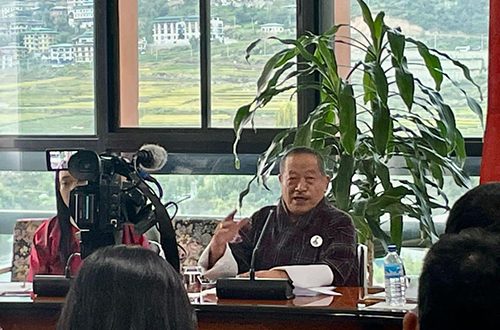
During the 29th Meet-the-Press session, Minister of MoENR Lyonpo Gem Tshering explained that the relationship between El Niño and Bhutan’s weather is complex.
“The impact of El Niño on Bhutan’s weather and hydropower generation is not always direct or consistent,” Lyonpo Gem stated.
Historical data support this view. Records show that Bhutan has experienced near-normal rainfall even during past El Niño years. Therefore, a drier season is not a certainty.
The National Center for Hydrology and Meteorology (NCHM) recently issued its monsoon outlook for 2026. The forecast suggests that rainfall will be normal to slightly below-normal from June to September.
While lower rainfall could result in slightly decreased river flows, significant impacts are not expected. “Based on available forecasts and past experience, no significant impact on overall monsoon hydropower production is anticipated at this stage,” said Lyonpo Gem Tshering.
Current data show that the energy sector is performing better than expected.
From January to May 2026, hydropower plants generated 3,655 million units (MU). This figure significantly exceeds the projected target of 3,217 MU for that period.
What has helped is the early rains from March and April but the rains in June and so far in July has been below normal.
Looking ahead, the ministry is confident that energy output will continue to grow. New projects are currently under development to increase the nation’s generating capacity.
Lyonpo Gem noted that while year-to-year weather variations occur, the addition of these new projects will result in an overall increase in production.
The MoENR continues to work closely with relevant agencies to monitor the situation. They are tracking weather forecasts and hydrological conditions throughout the season.