The Bhutanese Leading the way.
When the government recently announced a drop in fuel prices, online commentators noted that they expected a sharper decline due to falling international crude prices.
There are two main reasons why the expected drop has not materialized with one being domestic and the other external.
Domestic Reason
When the Iran war broke out and international fuel prices began skyrocketing, the government implemented the National Fuel Price Smoothening Framework (NFPSF), utilizing funds from the Economic Stimulus Program (ESP) to absorb the additional costs.
In response to a query, the Ministry of Finance (MoF) stated, “During the period of exceptionally high global fuel prices, the Royal Government provided substantial price support to cushion consumers from sharp increases in fuel prices. To date, approximately Nu 1.823 billion (bn) has been spent on fuel price support.”
The ministry added that this intervention helped mitigate the impact on households, transport operators, businesses, and the wider economy by limiting hikes in transport costs, food prices, construction costs, and the prices of other essential goods.
For example, the peak price of diesel was recorded on April 17, when it hit Nu. 199.66 per liter, necessitating a peak support of Nu. 101.35 per liter to maintain the consumer price at Nu. 98.31. Around the same time, petrol received a price support of Nu. 8.19 per liter to keep its retail price at Nu. 102.90 per liter.
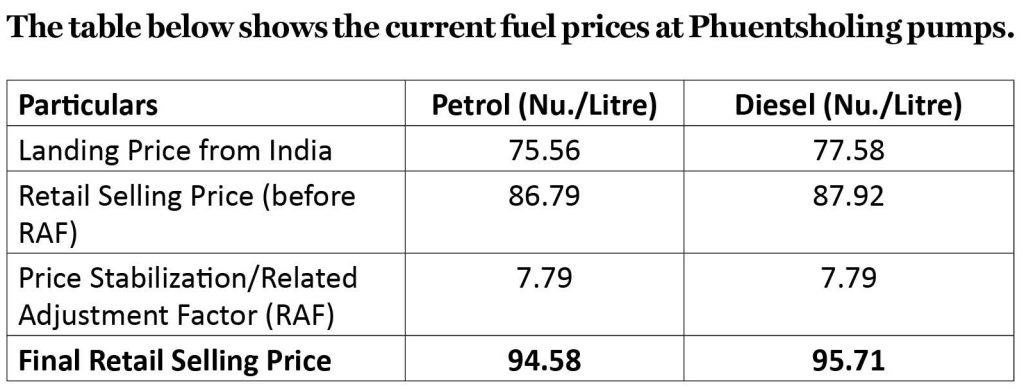
To recover a portion of this Nu. 1.823 bn expenditure, the government has added a temporary charge of Nu. 7.79 per liter to the cost of both petrol and diesel.
The landed price of petrol from India stands at Nu. 75.56 per liter, while diesel lands at Nu. 77.58 per liter. Local taxes and charges are subsequently levied on these base rates.
These charges include an Excise Tax at 5%, Goods and Services Tax (GST) at 5%, an Import Permit Fee of Nu. 0.25 per liter, transportation charges, a depot surcharge (Nu. 0.60 per liter for petrol and Nu. 0.50 per liter for diesel), transit losses (shrinkage allowance), and dealer margins (Nu. 2.5 per liter for petrol and Nu. 1.6 per liter for diesel, last revised in 2023).
This brings the base retail selling price in Phuentsholing to Nu. 86.79 for petrol and Nu. 87.92 for diesel.
On top of this, the Related Adjustment Factor (RAF) of Nu. 7.79 per liter is applied to both fuels, resulting in a final retail price of Nu. 94.58 per liter for petrol and Nu. 95.71 per liter for diesel in Phuentsholing.
Prices in Thimphu are higher, standing at Nu. 97.46 per liter for petrol and Nu. 98.31 per liter for diesel, due to the additional transportation costs incurred from Phuentsholing to Thimphu.
Even with the RAF included, fuel prices in Bhutan remain comparable to those in India.
The Bhutanese found that in Alipurduar (West Bengal), the price of petrol is Nu. 114.28 per liter and diesel is Nu. 101.13 per liter. Meanwhile, the average national price in India is Nu. 106.58 per liter for petrol and Nu. 97.05 per liter for diesel.
The MoF explained that the current Price Stabilization and RAF are integral components of the Government’s overall fuel price stabilization approach.
“The RAF is a temporary pricing adjustment that allows the Government to gradually recover a portion of the support provided during periods of unusually high fuel prices. The objective is to rebuild the resources needed so that similar support can be provided again if fuel prices rise sharply in the future,” the MoF stated.
According to the ministry, this approach achieves three key objectives. First, it protects consumers from sudden price shocks by smoothing out large fluctuations in fuel prices.
Second, it reduces inflationary pressures by limiting the impact of fuel hikes on transportation costs and essential goods.
Third, it promotes fiscal sustainability by reducing the need for sudden budget reallocations during unexpected fuel price surges.
The MoF noted that although international crude oil prices have moderated, global energy markets remain highly uncertain. Fuel prices continue to be influenced by geopolitical developments, supply chain disruptions, exchange rate fluctuations, and regional market conditions.
“Maintaining a modest stabilization buffer therefore enables Bhutan to respond more effectively to future price volatility while balancing consumer interests with long-term fiscal responsibility,” the ministry stated.
The ministry added that the government will continue to closely monitor developments in regional and international fuel markets. Future adjustments to domestic fuel prices will remain guided by actual import costs, prevailing market realities, and the ongoing need to balance consumer protection with fiscal sustainability.
International or External Factors
The primary reason the public anticipated a sharp drop in fuel prices is the concurrent decline in international crude oil benchmarks, with Brent crude falling to USD 71.52 per barrel from a previous high of USD 126.41 per barrel on April 30.
However, the reality is more complicated for Bhutan. The petroleum products sold to Bhutan by Indian Oil Marketing Companies (OMCs) do not reflect a straightforward calculation of crude oil costs, processing fees, transportation, and profit margins; the mechanism is much more complex and expensive.
According to the Indian Ministry of Petroleum and Natural Gas website, the average crude oil basket cost for India in June was USD 83.22 per barrel (a mix of Brent, Oman, and Dubai). As of July 2, this dropped to USD 67.72.
If Indian OMCs simply took this raw crude price and added refining, transport, and profit margins, the landing price of fuel in Bhutan would be substantially lower than it is today.
Instead, Bhutan, like Nepal, is subject to a different pricing structure.
Petrol is priced against the 92 RON Singapore Gasoline benchmark, which represents the price of processed petrol loaded onto ships in Singapore. This serves as the Asian benchmark for commercial export markets. The average price for this benchmark was USD 107.78 per barrel in June, onto which Indian OMCs add transportation, marketing, and other operational margins before selling to Bhutan.
Diesel is priced against the Arab Gulf Gasoil benchmark, which reflects the price of processed diesel loaded onto ships in the Middle East. The average price in June was USD 110.16 per barrel. Here too, Indian OMCs add their respective margins.
The baseline for Bhutan’s pricing is determined by the 14-day rolling average of these two distinct benchmarks. Consequently, domestic retail prices will only drop once these specific refined benchmarks decline.
Compounding the issue, Indian OMCs do not share detailed price break-ups with Bhutan or Nepal, despite requests to share them, leaving the exact profit margins they retain undisclosed.
While these two benchmarks generally ensure lower, stable prices for Bhutan and Nepal during normal economic periods, it becomes a very different story during global crises or acute fuel shortages.
The MoF acknowledged that many people naturally expect fuel prices to fall in tandem with international crude oil declines. However, because Bhutan does not import crude oil directly, instead importing refined petroleum products via Indian suppliers, domestic fuel prices are primarily tethered to the rates charged by those suppliers for finished products.
As a result, the price paid by consumers in Bhutan is influenced by several factors, like the price of refined petroleum products supplied from India, exchange rate movements, freight and transportation costs, distribution and operating costs, and applicable taxes (in Bhutan) and other approved pricing adjustments.