The Bhutanese Leading the way.
Weeks after a Shaba Higher Secondary School teacher was charged with child battery after assaulting many students with a rubber pipe, The Bhutanese reached out to the parents of the two students at the center of the case to understand how the children have been coping in the aftermath of the incident.
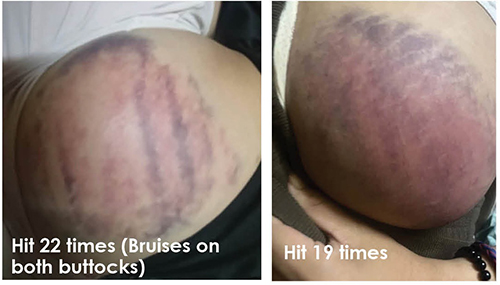
According to the parents, one child was struck 22 times and the other 19 times, leaving both with pain and visible bruises on their buttocks.
The images show only one side of the buttock for decency but the damage is on the entire buttock and even legs.
The students have since been relocated to another school, but their families say the effects of the incident have extended beyond the physical injuries.
As legal proceedings continue, the parents shared the emotional, psychological and educational challenges their children have faced since the alleged assault, highlighting broader concerns about child protection and student welfare in schools.
Student Allegedly Struck 22 Times with Rubber Pipe
For the mother of the 16-year-old student who was struck 22 times, the seriousness of what had happened did not become apparent until her daughter returned home on 15th July with her Economics examination paper.
The mother, who has no formal educational background, said she was unfamiliar with how academic marks were assessed. Her daughter told her she had not scored well in Economics, prompting the mother to ask how she had prepared for the paper and encourage her to study harder.
It was during this conversation that the girl mentioned that her teacher had punished the students in school.
The mother, however, said she did not initially understand what her daughter meant by being punished. She also did not see the injuries at the time.
“I thought she had not done well in all her subjects, and I was worried because she has to sit for her board examinations this year. When she told me that the teacher had punished her, I thought perhaps it was meant to correct her,” the mother said.
Her daughter later told her that she had performed well in her other subjects and had only struggled with Economics.
The mother said she continued to encourage her daughter to prepare for her final examinations, unaware of the extent of the injuries.
It was only after the girl asked her mother to look at her buttocks that the mother finally saw the injuries. She said she was overwhelmed with shock and emotion.
“I could not control my tears. I never expected to see her in that condition,” she said.
The mother said she might have understood if the punishment had involved one or two strikes, believing at the time that teachers sometimes discipline students for their own good. However, what she saw was far beyond what she had expected.
“If she had been struck once or twice, I would have understood. But when I saw the bruises, I knew it was serious,” she said.
According to the mother, her daughter told her she had been struck 22 times with a rubber pipe. She was initially struck on the legs, but because she could no longer bear the pain, she asked the teacher to strike her on the buttocks instead.
The mother said the situation left her distressed and unsure of what to do.
“I did not know where to turn. I did not even think about reporting it at first. I was simply in pain seeing my daughter suffer,” she said.
Her circumstances, she said, made the situation even more difficult. She and her daughter’s biological father had separated a long time ago, and she did not know whom to discuss the matter with.
As her daughter’s condition deteriorated later that evening, the stepfather who was away from home for work became concerned and advised her to seek medical attention.
“He told me to take her to the hospital. I called my sister, and she took us there at around 9 pm,” the mother said.
The girl was reportedly suffering from a high fever and sweating heavily.
At the hospital, health workers asked whether the family had reported the incident to police. The mother said she had not because she was uncertain whether her daughter might also have been at fault.
“I told them that I had not reported it because I wanted to know whether my daughter had also done something wrong,” she said.
She returned home after obtaining pain medication for her daughter.
That night, mother and daughter cried together as the child struggled with the pain.
“I could not bear seeing my daughter in so much pain. We cried together until around midnight,” she said.
The following day, a customer who regularly bought kira from the mother visited her home. Noticing her swollen eyes, the customer asked what had happened.
After hearing the mother’s account and seeing photographs of the injuries, the customer encouraged her to report the incident and helped her approach the police.
“I come from a humble background and did not know where to go. She helped me report the matter,” the mother said.
The physical effects of the alleged assault continued for days.
The mother said her daughter could not turn from one side to the other while lying down for nearly a week and struggled to use the toilet because of the pain.
The family also sought traditional treatment, including medicinal hot spring herbs, to help ease her condition.
The mother said her daughter’s emotional state has also become a concern, particularly with her board examinations approaching.
“She is depressed and tense about her examinations. Since the case became public, she also feels that people are blaming her,” she said.
The mother said the family has faced criticism on social media from people who believed the complaint was made over a minor disciplinary matter.
“People think we complained over a small punishment. They do not know what my daughter went through or how serious her injuries were,” she said.
She said she would allow photographs of the injuries to be used for awareness if it could help people understand the consequences of corporal punishment.
“People should see the injuries before judging us. This was not a minor punishment,” she said.
The mother also clarified that her decision to report the incident was not motivated by a desire to punish the teacher. “I did not report the case to harm the teacher. I reported it because of what happened to my child,” she said.
Her concerns now center on her daughter’s recovery and education.
Second Student Struck 19 Times
The mother of the second 16-year-old student, who was allegedly struck 19 times on her buttocks, said her daughter continues to experience pain and has struggled emotionally since the incident.
The mother herself is also dealing with health problems.
During the interview, she was accompanying her elder daughter, who was admitted to hospital, while she continued to worry about the condition of her younger daughter.
A single parent, she said she has been solely responsible for raising her daughter, ensuring that she attends school regularly and meeting her educational expenses.
She said the severity of the punishment was unacceptable, regardless of the circumstances that led to it.
“No teacher has the right to punish a child to this extent. Even as a teacher, he has no right to inflict such severe punishment on a student,” she said.
The mother said her daughter was repeatedly struck, even after she had been allowed to rest.
When her daughter returned home, the mother noticed that she was unusually quiet and appeared distressed. When she asked what had happened, she discovered the bruises.
“She was very quiet and looked extremely sad. When I saw the bruises, I was shocked. I could not bear to look at them,” she said.
The injuries, she said, were severe enough to affect her daughter’s ability to eat and sleep.
“For three days, she could neither eat properly nor sleep. She was in so much pain,” the mother said.
The mother said the effects have not been limited to the physical injuries. She said her daughter remains unhappy and appears emotionally distressed even after being relocated to another school.
“She is still not doing well. She is not happy and seems very sad, both mentally and emotionally,” she said.
Despite her own health difficulties and as a single parent, the mother said she has continued to shoulder the responsibility of raising and educating her daughter.
“I have been raising my daughter on my own. I make sure she goes to school on time and meet all her school expenses. No matter what the circumstances are, a teacher has no right to punish a child in this manner,” she said.
For now, the mother said she would leave the matter to the legal process and abide by whatever decision is reached.
“I will wait for the legal proceedings and follow whatever decision comes from the case,” she said.
Her immediate concern, she said, is her daughter’s recovery and well-being, but she remains worried about the lasting impact of the incident on her child.
Relocation of School Brings New Concerns for Families
Both students were relocated to another school on July 23 in consideration of their well-being.
Their mothers said school authorities helped facilitate the move after the families raised concerns about the students continuing at the same school.
Both children were also scheduled to receive counselling on 24th July. However, their mothers said they were later informed that the school would provide the counselling services.
Although the relocation removed the girls from the environment where the alleged incident took place, the mothers said the move has brought its own challenges.
The mother of the student allegedly struck 22 times said her daughter continues to struggle with the transition. During her most recent visit to the new school, she said she was concerned by her daughter’s condition.
“She looked weak and had rashes on her face. She does not seem happy there,” she said.
The mother said her daughter cried and told her that she was unhappy at the new school.
However, bringing her daughter home would also have consequences, particularly with her board examinations approaching.
“If I bring her home now, she could lose an entire academic year. She has to sit for her board examinations, and I am very worried about her future,” she said.
For the mother of the second student, the relocation has also been difficult. She said the new school allows parents to meet their daughters only once a month, making it difficult to closely monitor their well-being.
“She is not doing well, and I am worried about her. We can only meet her once a month, which is very difficult for us as parents,” she said.
The mothers said their concerns now extend beyond the physical injuries to their daughters’ emotional well-being, adjustment to the new school and ability to continue their education without being defined by the incident.
School Management Response
The two students above are not the only victims, but several other students of the same standard in four sections were assaulted by the teacher in a similar manner. Some were beaten on the buttocks and some on the legs with many carrying marks.
Despite the assault, the school management has stood behind the teacher. A management figure had said the teacher is a ‘good teacher’ and the students’ skin is ‘fragile’ and so there will be marks. The management also declined to share the contact details of the parents and the teacher despite having them. This prevented the paper from surveying the full extent of the damage done by the teacher to the students.
UNICEF and WHO
Corporal punishment in schools violates children’s rights and undermines physical and emotional well-being. According to Deki Dema, Child Protection Specialist at UNICEF Bhutan, physical punishment erodes trust between students and teachers, creates stress, and negatively impacts academic performance.
Fear of violence leads to disengagement, classroom avoidance, lower self-esteem, increased aggression, and higher dropout rates. Rather than promoting positive behavior, physical punishment normalizes violence as an acceptable method for resolving conflict. UNICEF advocates for non-violent approaches such as positive discipline, restorative practices, social-emotional learning, and teacher training to foster safe learning environments.
World Health Organization (WHO) reports that 25–50% of children globally experience corporal punishment in schools. WHO highlights that physical punishment carries no positive outcomes, triggers harmful physiological stress responses affecting brain structure, nervous and cardiovascular systems, and damages long-term cognitive and socio-emotional development.
Save the Children notes that corporal punishment remains legally permitted in schools across 63 countries, affecting approximately 793 million children. The organization advocates for legal reform, awareness, and positive discipline to preserve children’s safety and dignity.
Education Ministry
The Education Minister rejected calls on social media to reintroduce corporal punishment, stating it lacks scientific basis and creates anxiety and fear among students. She reaffirmed that the Ministry of Education and Skills Development (MoESD) maintains a zero-tolerance policy, favoring dialogue, understanding, and positive discipline. The MoESD is currently revising its School Discipline Guidelines to emphasize student well-being and accountability.

The Shaba HSS case highlights gaps in tracking disciplinary abuse. Bhutan’s Situational Analysis Survey (SAS), which monitors student safety issues, does not categorize corporal punishment at school separately. Because students often fear reporting teachers, improved monitoring and reporting mechanisms are needed to capture the true frequency of corporal punishment and protect students effectively.
Case background
On July 15, a teacher allegedly used a rubber pipe to punish Grade X students who failed to meet an arbitrary 55-mark benchmark in Economics. Parents reported that their children were struck up to 22 times, sustaining visible bruising.
Police completed their investigation and charged the teacher with child battery on July 26, forwarding the case to the Paro Dzongkhag Court. Police clarified that corporal punishment remains illegal regardless of whether students were warned in advance or had agreed to the benchmarks.
Following the incident, two affected students were transferred to another school on July 23 for their safety and emotional well-being. Discussions with other Grade X sections revealed that additional students had received similar punishment, though their parents opted not to press charges.