 The Bhutanese Leading the way.
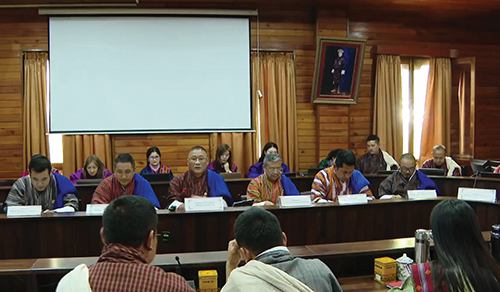
During the press conference held following the conclusion of the Fifth Session of the Fourth Parliament, Members of Parliament (MPs) of the National Assembly (NA) discussed the Bell Curve Method, particularly the Forced Ranking System used in the moderation process.
The Deputy Speaker Sangay Khandu of NA said that the issue has been deliberated since the beginning of the parliamentary sessions. He noted that, compared to the initial discussions, the Royal Civil Service Commission (RCSC) has introduced greater flexibility in the moderation process.
The Deputy Speaker said that for the Bell Curve Method to become more flexible, the Forced Ranking System would need to be either replaced with a more suitable mechanism or removed altogether.
According to the Deputy Speaker, the NA repeatedly questioned the RCSC on why the ranking system continues to remain part of the moderation process if it is not effectively serving its intended purpose.
“If the system does not work at all, even the Constitution, if necessary, can be amended,” he said.
However, he cautioned that any constitutional amendment must be approached carefully, taking into consideration its potential consequences.
“We cannot direct the Commission to remove it entirely, but we can provide recommendations and continue deliberating on the matter until the system is either replaced or removed,” the Deputy Speaker said.
The Chairperson of the Good Governance Committee (GGC), MP Kinzang Wangchuk, said that before deliberating on the Forced Ranking System, the GGC first sought to verify whether the concerns raised by civil servants were valid or whether the RCSC was being unfairly blamed despite the system functioning as intended.
The Chairperson said that the committee conducted an extensive review by consulting Secretaries who work closely with the RCSC. The GGC also gathered views from school principals across Thimphu, as well as district administrators from Thimphu and Trashigang.
In addition, the committee engaged with ministries that have large numbers of employees or have reportedly experienced significant challenges arising from the implementation of the system.
According to the Chairperson, these consultations were carried out to better understand the practical implications of the Forced Ranking System and to assess whether the concerns raised by civil servants reflected the realities on the ground.
The Chairperson said, “The ministries, with a significant number of employees, reportedly facing challenges under the system include the Ministry of Education and Skills Development (MoESD), the Ministry of Health (MoH), and the Ministry of Agriculture and Livestock (MoAL).”
The committee then asked the representatives to identify the issues associated with both the MAX Moderation System and the Forced Ranking System. According to the Chairperson, the representatives also conducted their own assessments and research on the matter.
The findings, the Chairperson said, were consistent with experiences observed in countries such as Australia, Japan, and Singapore where similar forced ranking systems were implemented.
According to the GGC’s findings, the Forced Ranking System did not achieve its intended objectives in those countries and was eventually discontinued due to the challenges it created in performance evaluation and workforce management.
The Chairperson also shared findings from Jigme Dorji Wangchuck National Referral Hospital (JDWNRH). He said that the President of the hospital informed the committee that there are only about 10 doctors in a particular unit, yet under the MAX Moderation System, one employee must mandatorily be placed in the “Needs Improvement” category.
“The President shared that there is only a handful of doctors, and the Forced Ranking System leaves some of them feeling discouraged despite the efforts they put into their work,” the Chairperson said.
According to the Chairperson, the RCSC’s response indicated that it currently has no alternative mechanism to replace the Forced Ranking System.
“The RCSC’s response states that it cannot remove the system entirely at this stage and has not yet identified a suitable replacement,” he said.
The GGC has submitted four recommendations to the RCSC during the recent parliamentary session.
These include reviewing the Bell Curve Method and the Forced Ranking System, strengthening fairness and grievance redressal mechanisms, enhancing support, training and incentives for employees, particularly those in the outstanding performance category, and developing sector-specific approaches to performance assessment that reflect the unique needs of different professions and agencies.




The current implementation of ‘max moderation’ in our civil service has unfortunately morphed into a tool for favoritism rather than genuine performance assessment. It is deeply discouraging to see dedicated, hardworking civil servants slapped with a ‘Need Improvement’ rating simply because they don’t engage in Cham-cha-geri. When leaders weaponize moderation to reward blind loyalty and punish quiet, honest hard work, it kills morale, breeds resentment, and ultimately weakens the entire system. True leadership should recognize merit, not flatterers.”