The Bhutanese Leading the way.
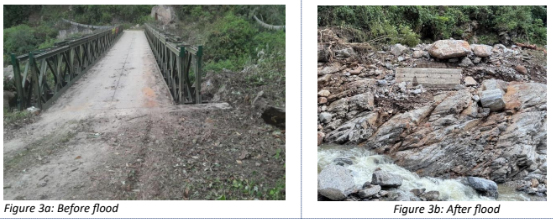
The Member of Parliament (MP) of Bongo–Chapcha, Pempa, raised concerns over the urgent need to restore four bridges that were severely damaged or washed away during the October 2025 floods.
He said the Lubichu, Bjimichu, and Togtokha bailey bridges, along with the Bayulkuenzang suspension bridge, were the only lifelines for residents of Bayulkuenzang and Togtokha, providing access to schools, hospitals, markets, and essential services. Their destruction, he said, had caused significant hardship and fear among the people, particularly with the 2026 monsoon looming on the horizon.
The MP asked how the government would arrange the budget to rebuild the bridges, which agency would be responsible for financing and executing the works, and whether the Natural Disaster Fund or an Emergency Infrastructure Budget could be used to ensure restoration before the next monsoon. He noted that despite consultations with the Gewog, Dzongkhag, and Ministry of Infrastructure and Transport (MoIT), responsibilities remained unclear, leaving local authorities unable to reassure the affected communities.
In response, the Ministry of Finance (MoF) outlined the mechanisms that guide how the government arranges financing and assigns responsibilities for immediate restoration, recovery, and reconstruction of essential public infrastructure.
MoF stated that recognizing recurring monsoon-related damages, the government had allocated resources to the Department of Surface Transport (DoST) under MoIT. Under the 13th Five-Year Plan, Nu 1.08 billion (bn) had been provisioned under the GoI Project Tied Assistance for the replacement and reconstruction of 12 Bailey bridges on national highways. From this, Nu 160 million (mn) was allocated to DoST in FY 2024–25, and Nu 36 mn was further allocated under RGoB funding in FY 2025–26.
MoF stated that a dedicated annual monsoon restoration budget was also provided to DoST to ensure that primary and secondary national highways and dzongkhag roads remained open and functional during and after monsoon events.
The provision, MoF said, enabled swift response to road and bridge damages. Regarding the recent budget request of Nu 533.5 mn from DoST for restoration of bridges damaged by the 4th and 5th October rainfall, Nu 388.5 mn required immediately and Nu 145 mn in the next fiscal year, the MoFnoted that it had advised MoIT to prioritize and meet the requirement from the Nu 350 mn allocated for monsoon restoration in the current fiscal year.
On the restoration of critical Local Government infrastructure, MoF stated that the Annual Grant Guidelines 2024 allowed Local Governments (LGs) to use their annual block grants for urgent repair, reconstruction, and restoration works. When damages exceeded LG budget capacities, the ministry said additional support could be provided through the Disaster Contingency Window under the General Reserve following a detailed assessment.
For recovery and longer-term reconstruction, MoF explained that such works, including permanent bridge replacement, slope stabilization, and flood-proofing, were incorporated into the regular planning and budgeting process, ensuring systematic funding and implementation through the national development and fiscal cycle.
MoF affirmed its commitment to ensuring timely and effective restoration of critical infrastructure. It said that resources would continue to be allocated prudently and sustainably while balancing urgent community needs with long-term fiscal responsibility. Through coordinated efforts with DLGDM, MoHA, DoST, MoIT, dzongkhags, and LGs, the ministry stated that it would work to restore essential connectivity, strengthen disaster resilience, and safeguard the livelihoods and well-being of communities.