The Bhutanese Leading the way.
The Bhutan Taxi Association (BTA) has called for urgent reforms and stronger government intervention to accelerate Bhutan’s electric vehicle (EV) transition, warning that the continued rise in fossil-fuel vehicle imports could threaten the country’s carbon-negative status.
The BTA said Bhutan’s EV transition cannot succeed through vehicle imports alone, and stressed that the country must urgently strengthen charging infrastructure, financing systems, technical support, repair services, insurance coverage, and policy implementation before large-scale EV expansion becomes sustainable.
The BTA said that a phased national timeline needs to be there to gradually reduce and eventually phase out petrol and diesel vehicle imports, prioritizing taxis, government fleets, and urban public transport first.
The association said the move should align with Bhutan’s broader target of achieving 100 percent EV taxi imports by 2035.
The association also recommended expanding EV incentives immediately, including lower-interest loans, tax exemptions, insurance incentives, and trade-in schemes for fossil-fuel taxis and buses.
According to the BTA, long-term policy stability is equally important to encourage public confidence in investing in EVs.
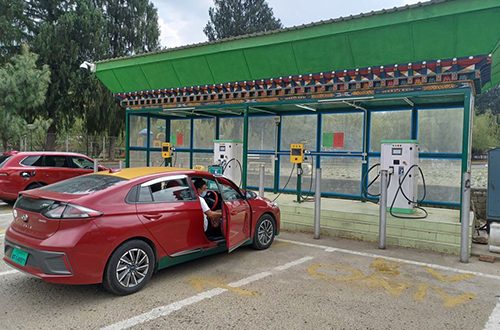
As per the association, charging infrastructure remains one of the biggest concerns raised by taxi drivers across the country. Drivers have reported long queues at charging stations, non-functional fast chargers in some regions, and instances of drivers sleeping inside vehicles while waiting to charge.
The association acknowledged that charging infrastructure has become the single biggest operational challenge facing EV taxi drivers.
It said the focus should not only be on increasing the number of charging stations but also on improving charger reliability, maintenance response systems, smart queue management, driver welfare facilities, and nationwide charging accessibility.
However, the BTA noted that solving these issues would require stronger coordination among government agencies, technical manpower, and increased investment to ensure infrastructure growth keeps pace with EV adoption.
Beyond charging issues, the association said that taxi drivers are also facing increasing financial pressure despite the long-term fuel savings associated with EV ownership.
According to the BTA, many drivers who depend entirely on daily earnings are struggling with high monthly loan repayments, charging downtime, repair-related income losses, and delays in obtaining spare parts.
The association said EV ownership can become financially beneficial in the long run for drivers with stable passenger demand and reliable charging access. However, under current infrastructure and operational conditions, many drivers still find EV ownership financially risky and difficult to sustain.
The BTA also highlighted that Bhutan’s EV ecosystem is still developing and that EV adoption is increasing faster than the availability of spare-part supply chains, trained technicians, diagnostic equipment, and specialized workshops.
Most EV parts still need to be imported, leading to lengthy repair delays.
The association noted that Bhutan currently has limited EV-certified mechanics and service centers, especially outside major urban areas, raising concerns over whether the country is technically prepared for large-scale nationwide EV usage.
While the government has already introduced several EV support measures such as subsidies and free charging facilities for EV taxis, the association said the existing 5 percent GST on EV imports continues to place a heavy financial burden on taxi drivers.
The BTA said exempting all taxes on EV taxis could further encourage the transition from fossil-fuel vehicles to cleaner transport while reducing financial pressure during the initial ownership period.
The association also stressed the need for stronger operational support systems, including improved battery insurance coverage.
According to Bhutan Construction and Transport Authority (BCTA) data, out of more than 128,740 registered vehicles in Bhutan, only around 1,343 are EVs.
The association said the relatively low number of EVs does not necessarily reflect resistance toward green transport but rather indicates that infrastructure, financing systems, technical support, and public confidence are still evolving.
“Most Bhutanese people appear supportive of cleaner transport in principle, but many remain cautious about the practical and financial realities of owning an EV under current conditions,” the BTA pointed out.
The BTA further emphasized that Bhutan’s EV transition goals remain realistic in principle, but the pace of transition must stay aligned with infrastructure readiness, technical capacity, and driver support systems.
The association also shared that it has been advocating stronger EV incentives, engaging with agencies to improve charging infrastructure, raising concerns over EV insurance coverage, promoting professional training for drivers, and coordinating with stakeholders to support a smoother transition toward electric mobility.
On financing, the BTA said many drivers still rely on standard commercial loans with high repayment burdens and strict collateral requirements.
The association proposed dedicated low-interest “green taxi loans,” longer repayment periods, government-backed credit guarantees, down payment support, flexible repayment systems, and battery-linked financial protection schemes to reduce long-term risks for drivers.
The association also acknowledged that some EV owners in recent years raised concerns regarding battery performance, driving range, charging efficiency, spare-part delays, software problems, and after-sales service support.