The Bhutanese Leading the way.
The government will focus on strengthening domestic production, reducing dependence on imported goods and improving supply chain systems as part of its long-term efforts to address rising inflation and ease the cost of living, the Ministry of Finance (MoF) said during the 33rd Meet-the-Press on 20th November 2026.
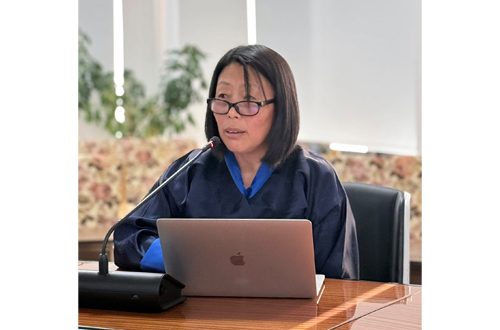
Responding to concerns over inflation reaching 5.58 percent in September 2026 and its impact on household purchasing power, Finance Secretary Leki Wangmo said Bhutan’s inflation is driven largely by rising costs, particularly higher international oil prices and the depreciation of the Indian rupee.
She explained that the rupee’s decline, to which the Ngultrum is pegged, has raised the cost of importing goods into Bhutan, putting additional pressure on transportation, production and domestic prices.
The government has introduced a National Fuel Price Framework to cushion the impact of rising fuel prices, particularly diesel, which plays an important role in transportation and the movement of goods.
However, the rising cost of fuel continues to affect transportation expenses, eventually adding to the prices consumers pay for goods and services.
Leki Wangmo said the government is also providing support to rural communities, including subsidies and the provision of mid-day meals in schools, to reduce the financial burden on households.
She highlighted three key areas the government intends to prioritize: strengthening domestic products, reducing dependence on foreign imports and improving the country’s supply chain system.
She said the government also aims to create an environment where the private sector can grow under the 13th Five-Year Plan (FYP), with stronger domestic production forming part of the country’s long-term economic strategy.
“Long-term plan is to strengthen the domestic product of our nation,” she said, adding that citizens also have a responsibility to make use of the support provided by the government.
According to the National Statistics Bureau (NSB), non-food inflation stood at 6.34 percent in September, higher than food inflation at 4.95 percent. Transport prices recorded a 12.43 percent increase, while housing and utilities rose by 10.87 percent year-on-year.
The NSB also reported that the purchasing power of the Ngultrum had declined by 5.29 percent over the past year. This means Nu 100 in September 2026 had the purchasing power of only Nu 51.30 when measured against December 2012 prices.
Responding to concerns over inflation reaching 5.58 percent in September 2026 and its impact on household purchasing power, Finance Secretary Leki Wangmo said Bhutan’s inflation is driven largely by rising costs, particularly higher international oil prices and the depreciation of the Indian rupee.
She explained that the INR’s decline has raised the cost of importing goods into Bhutan, putting additional pressure on transportation, production and domestic prices.