The Bhutanese Leading the way.
The government will not proceed with mandatory professional licensing for teachers. Instead, it plans to introduce a teacher registration system, run through the new Teaching Professionals Council (TPC), to monitor professional standards, assess competencies, and support continuous professional development.
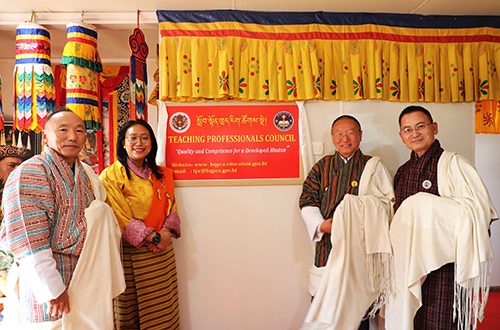
The Bhutan Qualifications and Professionals Certification Authority (BQPCA), under the Ministry of Education and Skills Development (MoESD), launched the TPC on 19th November. The launch came two days after Education Minister Lyonpo Yeezang Dee Thapa clarified the government’s decision during a question-and-answer session at the National Assembly on 17th November, after Members of Parliament (MPs) raised concerns over the proposed licensing system.
The government had earlier proposed mandatory licensing for all teachers to improve education quality, strengthen accountability, and prepare educators for 21st-century demands. MPs, however, questioned the need for an additional requirement, noting that teachers already graduate from recognized teacher training institutions.
Namgay Dorji, MP for Khamdang-Ramjar in Trashi Yangtse, asked what research the ministry had conducted to justify licensing.
“I would like to ask what kind of research the ministry has conducted, or whether it has identified any shortcomings in the two teacher training institutions or areas that need to be revised, which led the ministry to introduce the teacher licensing system,” he said.
The minister said the proposed registration system would neither require teachers to requalify nor question their existing credentials, focusing instead on continuous training and assessment.
“Teachers now meet the standards to teach, as they have completed their training from teacher training institutions. However, as the education system and curriculum in the 21st century are changing from time to time, it is important that teachers remain competent. This has to be done through additional training,” Lyonpo Yeezang Dee Thapa said.
Under the proposed system, teachers would be placed into four categories: Beginning, Proficient, Accomplished, and Distinguished. Those with less than five years of service would fall under Beginning and undergo competency assessments to advance. Implementation arrangements are still under discussion.
Responding to the South Thimphu MP on whether the council would function like a union, Lyonpo said Bhutan currently lacks a formal body to monitor professional standards.
“Without a teacher professional council, there is no clear mechanism to monitor professional standards and competency among teachers,” Lyonpo said.
The formal launch on 19th November marked a step toward institutionalizing these standards. According to a BQPCA press release, the TPC will advance professionalization through three pillars: professional registration, competency-based certification, and continuous professional development.
Its Continuing Professional Development (CPD) Framework aims to give teachers structured opportunities to upgrade their knowledge and practice. Speaking at the launch, Lyonpo Yeezang Dee Thapa called the council long overdue and highlighted the CPD Framework as vital for career progression.
The TPC has drafted foundational documents, including registration guidelines, the CPD Framework, a Code of Conduct and Ethics, and a ten-year Strategic Roadmap. According to BQPCA, the BPST and CPD Framework are undergoing further review with technical input from the Cambridge team.
Still, the ministry has yet to finalize implementation details, leaving questions about how competencies will be assessed and how the system will improve classroom learning.
The shift from licensing to registration has also sparked debate over whether another administrative system can resolve broader challenges in Bhutan’s education sector.
One individual who spoke to The Bhutanese argued that reforms must start with classroom realities rather than imported policies.
“Our education system will continue to struggle to improve if we keep politicizing education and blindly copying and pasting education models from other countries without considering our own realities,” the individual said.
Citing resource shortages, inadequate infrastructure, and limited training, the individual questioned whether the ministry regularly visits remote schools to hear teachers’ and students’ concerns.
“Instead of continuously introducing new systems and regulations, we need proper teacher training, adequate resources, meaningful consultation with teachers, and regular visits to schools, particularly those in the most remote communities,” the individual said, adding that teachers must first receive adequate tools and support.
Another interviewee questioned how the ministry evaluates education quality, urging reliance on measurable outcomes.
“Please do some research before declaring such views. We agree that private schools and colleges may not have the trained teachers, but the quality and efficiency can be measured from the output. Just reflect on every year’s quality output of Class 10 and 12 graduates securing colleges every year. That’s the testimony of the quality and output,” the individual said. “I am wondering what parameters MoESD is using to measure the quality of education.”
Meanwhile, a teacher told The Bhutanese that registration is preferable to licensing since educators already hold professional qualifications, though its success depends on execution.
“It should support teachers in becoming better professionals rather than make them feel that their qualifications are constantly being questioned,” the teacher said, cautioning against adding bureaucratic work without meaningful backing.
“Teachers already have many responsibilities beyond classroom teaching. They prepare lessons, assess students, participate in school activities, and handle administrative work. If registration brings more paperwork and assessments without providing meaningful support, it could become another burden,” the teacher said.
As the TPC moves toward rolling out its framework, questions remain over how the system will operate in practice, whether teachers will receive sufficient support, and how these reforms will ultimately raise education quality in Bhutan.