The Bhutanese Leading the way.
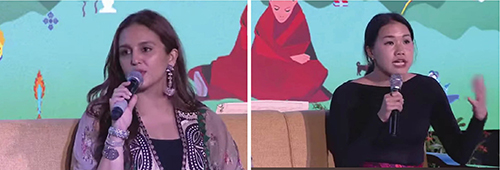
At the Drukyul Literature and Arts Festival, held from 2nd to 4th August this year, Singaporean lawyer-poet-playwright, Amanda Chong, and Indian actress-author, Huma Saleem Qureshi, came together in a session titled Challenging Stereotypes: Amanda Chong and Huma Qureshi in Conversation on Gender, Power, and Storytelling.
Moderated by Tenzing Lamsang, Editor of The Bhutanese the discussion explored how both women use their art to push back against patriarchal norms and portray women in all their complexity.
They spoke of deliberately moving away from idealized depictions of women often seen in mainstream feminism. Amanda, drawing from her work as a prosecutor, reflected on the contradictory gender expectations she encountered having to adopt traits associated with toxic masculinity to succeed professionally, while survivors of gender violence and sexual assault survivors were expected to perform submissiveness to be believed.
Huma described her fascination with “badly behaved women,” and her desire to portray flawed, contradictory female characters in her acting and writing, including her novel “Zeba: An Accidental Superhero” which features an unconventional Muslim woman superhero.
Amanda also highlighted race and class in Singaporean feminist narratives, citing her plays “PsychoBitch” and “#WomenSupportingWomen” as explorations of privilege and solidarity. The latter play even delved into a toxic workspace and sexual assault at the workplace.
Huma discussed gender inequality in the entertainment industry, noting persistent pay gaps and the risk of being labeled “difficult” for speaking out. Both agreed that storytelling is a vital tool for cultural change legal reform matters, but shifting public narratives is equally important.
They addressed the challenges of censorship and misinterpretation, with Chong using poetry to navigate legal constraints and Qureshi rejecting self-censorship despite the possibility and instances of online trolling. On the fatigue surrounding feminist slogans, they agreed that real change lies in the nuance of individual stories rather than in overused catchphrases.
Both Amanda and Huma also shared that the struggles of women across the world are similar with male dominated offices and work spaces and how patriarchy plays out in each society.
The issue of toxic work places in Bhutan, sexual harassment at the workplace and if the glass ceiling was truly broken in Bhutan also came up in the discussion.
In another session, “Shattering Glass Ceilings”, Indian audio storytellers, Samyuktha Varma and Radhika Viswanathan, co-founders of Vaaka, joined Lhanzey Palden, founder and creative director of the lifestyle brand Mapcha, to share their own creative and entrepreneurial journeys.
Samyuktha and Radhika, creators of In the Field, City of Women, and Kaalavasta, use audio storytelling to explore identity, climate, and social change. Viswanathan described City of Women as a mix of reporting and personal narratives that reveal women’s experiences in public spaces. She recalled an encounter with writer-archivist C.S. Lakshmi, who inspired their belief that recording women’s lives is itself a feminist act.
Palden spoke of launching Mapcha in 2018 to address the lack of quality, culturally rooted designs in the market. Guided by the principle of “MCHA MIND” (mindfulness, intention, narrative-driven, and design), her brand reinterprets Himalayan craft for contemporary audiences while preserving tradition. A highlight of her Bhutan visit, she said, was meeting people who already owned and wore Mapcha products, a “quiet win” for the brand she said.
The Vaaka founders reflected on starting their work when podcasting was still new in India, driven by a desire to share voices overlooked in formal NGO communications. They emphasised persistence, daily creative practice, and maintaining ownership of their work as values that keep them grounded through the ups and downs of running a creative business.
Across both sessions, the speakers, whether through audio storytelling, literature, fashion, or performance, demonstrated how creative work can resist stereotypes, question power structures, and carve space for voices often overlooked. Their conversations revealed a shared belief: Art, when practiced with intention and care, can bridge differences, preserve heritage, and spark more honest conversations about gender and society.