The Bhutanese Leading the way.
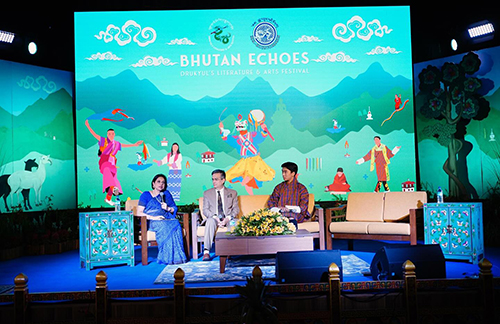
This year’s Bhutan Echoes: Drukyul’s Literature Festival unfolded as more than a celebration of books and ideas; it became a heartfelt tribute to His Majesty The Fourth Druk Gyalpo Jigme Singye Wangchuck, whose visionary leadership continues to guide the nation.
This was through the session The Wisdom of Balance: The Great Fourth’s Legacy.
The Wisdom of Balance: The Great Fourth’s Legacy
The Bhutan Echoes 2025 opened with a heartfelt tribute to His Majesty the Fourth Druk Gyalpo in a session titled The Wisdom of Balance: The Great Fourth’s Legacy.
This session, led by HSH Jigje Singye Wangchuck, reflected on the enduring impact of His Majesty’s extraordinary leadership and the timeless value. Marking the 70th Birth Anniversary of the Great Fourth, this year’s festival is a moment of gratitude, reflection, and renewal for the nation as it honors His Majesty’s lasting legacy.
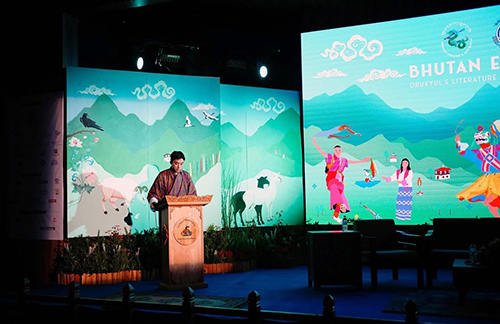
HSH Jigje offered a generational lens on the enormity of responsibility the Fourth King embraced at such a young age. “I’m turning 16 this year, and the thought of me being given the responsibility of an entire nation just absolutely terrifies me,” Dasho said. “Yet His Majesty transformed this responsibility into something truly extraordinary.”
HSH Jigje described His Majesty not just as a Monarch, but as a visionary who redefined global perceptions of national progress. Dasho Jigje said, “He wasn’t just a King, but a visionary who redefined the world’s view on GDP by developing a philosophy not based on economic growth, but a development centered around the people’s well-being, Gross National Happiness.”
This session featured the Ambassador of France to India and Bhutan, Dr Thierry Mathou, who has shared a close relationship with Bhutan for over three decades.
The moderator was a seasoned journalist and Diplomatic Editor at The Hindu, Suhasini Haidar.
During the session, Suhasini Haidar reflected on the remarkable achievements of His Majesty The Fourth Druk Gyalpo’s reign, emphasizing how much was accomplished in just three decades, milestones that many global leaders with far longer tenures would admire.
She highlighted how Bhutan introduced the world to the concept of Gross National Happiness, a philosophy that has inspired people globally to rethink their measures of progress.
Following this, Dr Mathou, who documented Bhutan’s transition to democracy, shared insights into the unique nature of His Majesty’s leadership. He described the Fourth King as a rare combination of visionary and doer.
“Vision without execution is just dreaming,” Ambassador Mathou said. “His Majesty was not a dreamer; he was an effective leader who took risks and translated vision into action,” he added.
He further highlighted the unprecedented nature of His Majesty’s voluntary abdication at the age of 51, a decision marked by altruism rather than obligation or old age, which is rare in monarchic histories. This act, Ambassador Mathou said, exemplifies the King’s selflessness and effective leadership, two qualities central to the lasting balance Bhutan enjoys today.
During the session, Haidar asked a question to Dasho Jigje about how his experience of His Majesty as a grandfather compared with what he had heard about him as a Monarch.
Dasho Jigje responded, describing His Majesty the Fourth King as “an amazing grandfather” who has imparted many life lessons. Dasho spoke of qualities like selflessness, compassion, and bravery, traits he aspires to embody from the Fourth King.
Furthermore, Dasho shared, “As I’m 16, life can be quite overwhelming sometimes, and every time I’m facing difficulty or having a challenge, I always think about His Majesty The Fourth King, how he was my age during his reign, how he faced challenges with fierce dedication to the people and the country.” Dasho added, “That dedication helped me overcome obstacles, and I know if I have that same dedication, I will overcome mine as well.”
The conversation then turned to Bhutan’s careful navigation of tradition and modernity. Suhasini Haidar reflected on her first visit to Bhutan when television was not yet introduced, noting that television arrived after the internet, something hard to imagine from an outside perspective. She asked Dasho how Bhutan balances modernization with preserving cultural values.
To this, Dasho highlighted how His Majesty embraced technology not to erase Bhutanese identity but to nurture it. “He believed the younger generation must progress towards the future while holding onto our cultural values,” HSH said. “This way, the next generation can enjoy the benefits of technology while staying deeply connected to our culture and traditions.”
Suhasini Haidar then asked Dr Thierry Mathou to weigh in on Bhutan’s strong cultural identity and how it harmonizes with modernization, a balance that might seem challenging for many countries in the face of globalization.
Dr Mathou responded by introducing the concept of “continuity change,” explaining that when His Majesty The Fourth King ascended the throne in 1972, he faced four major challenges: Raising political awareness, inventing a unique national ideology, uniting the country, and building new institutions.
“At that time, there was no television, no internet, and very limited media,” Dr Mathou said. To build political awareness, His Majesty implemented decentralization, bringing democracy to the grassroots through the Gewog and Chiwog levels. Remarkably, the King personally chaired the Planning Commission from 1971 to 1992, guiding Bhutan’s development with hands-on leadership.
Dr Mathou emphasized that Bhutan’s national ideology, the philosophy of Gross National Happiness, was deliberately crafted to translate Buddhist values into a modern governance framework, setting Bhutan apart from western political models.
When asked to share a personal memory of His Majesty The Fourth King, Dasho Jigje recalled their many outdoor activities together. “His Majesty is very active: cycling, walking, and hiking,” Dasho said. “Those moments in nature, his kindness to hikers, and his light-hearted jokes have a special place in my heart. His deep connection to nature reflects the compassion and selflessness that define his legacy.”
Suhasini Haidar then recounted an anecdote from The Bodhisattva King, about the King’s homework being done by someone else when his usual helper was unavailable, highlighting the very human side of the great monarch.
Dr Thierry Mathou added a personal story from his decades of interaction with His Majesty. He recalled his first audience with the King in the late 1980s, when he failed to answer questions asked by the Fourth King, the King gave him a detailed lecture on Albert Schweitzer, the Nobel Prize-winning doctor. Dr Mathou said, “It was a great lesson for me, because His Majesty knows everything about everybody and everything. Now, when I see him, I have to be very accurate with my answers.”
The session then concluded with a special tribute video honoring His Majesty The Fourth King, celebrating his remarkable legacy and lasting impact on Bhutan.