The Bhutanese Leading the way.
The government has allocated Nu. 622 million for monsoon restoration and disaster response works in the current financial year.
According to the Ministry of Infrastructure and Transport (MoIT), the allocation includes the regular annual monsoon restoration budget of Nu. 350 million along with an additional Nu. 272 million sanctioned following the widespread disaster damages caused by the October 2025 weather events.
The ministry revealed that 383 roadblocks had already been recorded nationwide as of 28th May 2026, surpassing figures from previous years despite increasing restoration spending.
Data shared by the ministry shows that 343 roadblocks were recorded in FY 2023–2024 and 305 in FY 2024–2025.
The Trongsa–Gelephu Primary National Highway, particularly the Boxcut area, remains the country’s most vulnerable stretch, recording around 70 roadblock incidents this year to date.
Among the regional offices, Phuentsholing received the highest allocation at Nu. 237.92 million, followed by Sarpang with Nu. 154.29 million and Thimphu with Nu. 111.77 million.
The ministry said 255 priority damages requiring restoration have been identified nationwide, with an estimated restoration cost of Nu. 465.42 million.
Another Nu. 90.05 million has been estimated for the restoration of washed-away bridges.
According to the ministry, changing climate patterns and increasingly intense rainfall events are worsening the fragility of Bhutan’s transport infrastructure, particularly in the southern foothills.
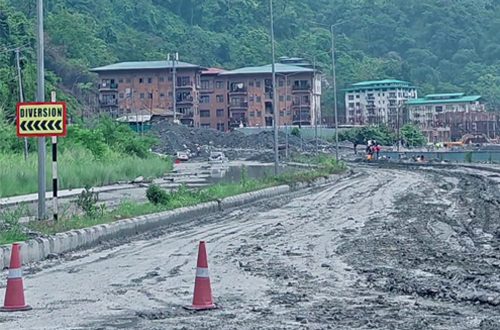
Recent flooding, mudslides, and debris flow incidents in Phuentsholing triggered even by relatively light rainfall have raised concerns about the vulnerability of existing infrastructure and ongoing construction activities.
The ministry stated that disasters in the southern region are not caused by rainfall alone, but also by weak geology, steep terrain, and unstable landforms.
The ministry said that infrastructure development projects, especially those involving construction and bypass construction activities can significantly influence downstream flood and debris risks.
Regarding the recent Phuntsholing incident including flooding, mudslides and debris flow, the ministry said that the implementation timelines were expedited for strategic reasons, leaving limited time to complete slope protection works before unexpected heavy rainfall occurred during what was expected to be the dry season.
To address immediate risks, the Department of Surface Transport (DoST) has been deploying machinery and response teams after every rainfall event to clear debris, restore roads, and maintain drainage systems.
Temporary protective measures such as green nets, tarpaulin coverings, check walls, and slope stabilization efforts have also been implemented along vulnerable stretches such as the Phuentsholing–Thimphu highway.
However, the ministry admitted that some temporary measures were not fully effective due to continuous heavy rainfall and recurring slope movement.
As part of long-term mitigation efforts, the ministry said slope benching, regrading works, bioengineering measures, improved drainage systems, and unloading of loose materials from unstable slopes are currently being carried out at high-risk areas.
The ministry said that they are now gradually shifting from reactive restoration works toward climate-resilient infrastructure planning and risk-informed engineering approaches.
The DoST have developed the ‘Guidelines on Design, Construction, and Maintenance of Road Infrastructure Incorporating Climate-Resilient Features’ in 2019 under the National Adaptation Programme of Action (NAPA-3).
According to the ministry, climate projections and disaster risk assessments are now increasingly being integrated into major road infrastructure projects.
Ongoing projects such as the Gelephu–Tareythang Road Project under the World Bank-funded ACCESS Project and the Asian Development Bank-supported Lhamoizingkha–Sarpang Road Project are incorporating climate-resilient drainage systems, slope stabilization works, and flood protection measures.
The ministry said future climate scenarios are also being considered during engineering design stages.
Under the Lhamoizingkha–Sarpang project, climate studies are assessing possible increases in precipitation of up to 10 percent under worst-case climate projections.
The ministry also highlighted the use of the Road Slope Failure Database (RSFD), a web-based monitoring system used to identify and prioritize chronic landslide-prone areas for long-term mitigation interventions.
Besides Boxcut, other chronic roadblock locations identified by the ministry include Lama Lamaney along the Raidak–Lhamoizingkha highway.
At present, two machines and trucks are continuously deployed at Boxcut during the monsoon season, while a bypass road from Tshachu Top to Jigmecholing is under construction to reduce future disruptions.
The ministry said preparedness measures have also been strengthened through the stockpiling of Bailey bridge parts, gabion mesh boxes, de-icing salt, and heavy machinery across nine regional offices.
Currently, the DoST maintains 18 sets of Bailey bridge parts and operates nine heavy equipment units, including wheel excavators and wheel loaders, for emergency response activities.
Real-time road condition updates are being shared through the Bhutan RoadWatch mobile application and the DoST Facebook page, providing information on roadblocks, causes of disruption, and estimated reopening times.
Despite the increasing annual expenditure on restoration works, the ministry acknowledged that conventional restoration-focused approaches alone are no longer sufficient given Bhutan’s fragile terrain and increasing climate-related risks.
The ministry stated that while emergency restoration remains necessary to maintain connectivity and public safety, greater emphasis is now being placed on permanent stabilization measures, climate adaptation, and long-term infrastructure resilience.