The Bhutanese Leading the way.
Several legal holes in the arguments by DoMCIIP and RTA
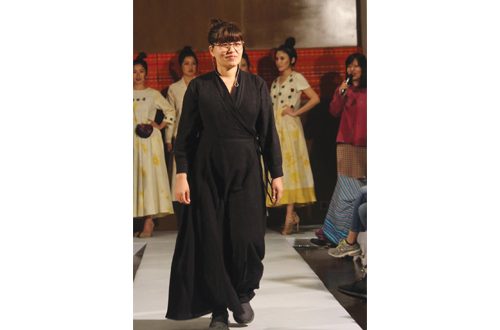
Chandrika Tamang, has decided to withdraw her design house, CDK GYENCHA, from the upcoming Bhutan Fashion Week (BFW) after the Department of Media, Creative Industry and Intellectual Property (DoMCIIP) and the Royal Textile Academy (RTA) declined her pleas to give her a co-founder status or even proper due credit for coming up with BFW and its concepts, themes and other details.
Chandrika said, “After seeing everything, I have decided not to participate. I think the main thing of this fashion week was to show the world how sustainable we are and how it is an ethical fashion show but we have lost that ethical thing here, and so it has now become an unethical fashion show. Our first fashion week was an opportunity to show really sustainable and ethical fashion to the world.”
She said she only really joined initially because BFW was her baby and she wanted to see how it goes but she was also disappointed in the way they are going about things as so much more could have been done.
Instead DoMCIIP came out with a three page press release on 7th September Sunday night trying to argue why Chandrika could not be given her due and with the RTA also coming up with a similar two-page release on Monday evening on 8th September.
Some actors, musicians and social media influencers, who have been receiving grants, jobs and foreign trips from DoMCIIP under the Nu 530 mn Creative Industry ESP fund, promptly shared the press releases on their handles. Even some newspapers who never did the story carried the DoMCIIP release.
The Bhutanese did its own research and also contacted a lawyer who specializes in Intellectual Property law over the various issues raised in the two press releases
‘Stolen Ideas’
The DoMCIIP release argued that there is no such thing as ‘stolen ideas’ and that copyright only protects the expression of ideas and not ideas or concepts. It says Expression means the way an idea is fixed in a tangible form like a written proposal, a painting, logo or a photograph.
It says for there to be copyright infringement Chandrika’s fashion week proposal would have to be produced word-for-word, or in a way that substantially replicates its original expression. It claims that for BFW the concepts and strategies of the consultants hired to implement these generic ideas into a tangible form were unique in their own way and so no infringement is detected.
It also quoted section 7 of the Copyright Act which says subject matter which are not protected are, ‘Any idea, procedure, system, method of operation, concept, discovery, or mere data, even if it is or they are expressed, described, explained, illustrated, or embodied in a work.’
DoMCIIP’s rebuttal is self-contradictory.
The exclusions above under section 7 applies to the abstract concept. When an idea is given a concrete, original form, that form becomes protectable as said by DoMCIIP itself.
Chandrika’s BFW proposal was not a vague idea that was expressed but a written proposal with proper structure, format, theme and unique content that was acknowledged by the RTA several times in email correspondence and messages.
There were online presentations made too with minutes of the meeting of the RTA attributing the BFW name and presentation to Chandrika. The above by itself qualifies for protection under Bhutanese copyright law.
The DoMCIIP says that for copyright infringement BFW would have to substantially replicate Chandrika’s fashion week proposal in its original expression which is what happened as shown in the last article by this paper.
Many things like the name Bhutan Fashion Week (BFW); Sustainable Fashion concept; a multi-day event, 5Ws (What, Where, When, Why, Whom) and 1 H (How) way of explaining BFW; the theme of past, present and future; Bhutanese talent working with international counterparts; fashion stalls where buyers can buy the products; locations of the show; national platform where designers, brands, buyers, media, and influencers come together; collaborating with some international fashion talent; doing it once a year in Bhutan ; and integrating photographers, stylists, creative and professionals into a single curated experience were all substantially replicated by RTA and DoMCIIP from its original expression in Chandrika’s written proposals, presentations and messages.
The above apart from not being abstract thoughts are the tangible embodiment of her creative intellect, meticulously structured and articulated.
They constitute a ‘literary work’ as defined under Section 5(a) of the Copyright Act, which includes “books, pamphlets, articles, computer programs and other writings”.
A detailed proposal, outlining a complex event with specific operational procedures, falls squarely within the ambit of ‘other writings’ and is an ‘original intellectual creation in the literary and artistic domain,’ as per the Copyright Act.
DoMCIIP contradicting section 8 and 9 of Copyright Act
By claiming ideas cannot be protected and infringement requires exact copying, DoMCIIP is contradicting Sections 8 and 9 of the Copyright Act.
The replication of the core structural and thematic elements constitutes an infringement under Section 8(1) of the Copyright Act which grants the author “the exclusive right to carry out or to authorize” various acts, including reproduction, adaptation, and communication to the public.
Her work has been ‘adapted’ without her permission and the public announcement and subsequent implementation of BFW, mirroring Chandrika’s detailed plan, can be construed as an unauthorized ‘communication to the public’ of the work.
DoMCIIP’s assertion that ‘no infringement is detected’ because the concepts and strategies of their hired consultants were ‘far and unique in their own way’ is a self-serving and unproven claim along with a conflict of interest given the substantial similarities pointed above, DoMCIIP’s role in executing BFW and DoMCIIP as the guardian of the Copyright Act and Industrial Property Act.
DoMCIIP and RTA are unable to prove their work is substantially different from Chandrika especially given the timeline of her submission from April 2024 onwards and the subsequent reactions and actions of RTA and DoMCIIP.
The RTA Director’s written statements via email to Chandrika on BFW saying ‘We have a lot of things to do together,’ ‘(DoMCIIP) would be better suited as the funding agency rather than interfering with our work,’ and “I would discuss it (BFW) with their team (DoMCIIP) separately tomorrow,” all said in 29th July 2024 after receiving detailed proposals and presentations from Chandrika further undermines DoMCIIP and RTA’s claim of independent creation and highlights the direct appropriation of Chandrika’s work.
In fact, one of the main BFW consultants that this paper talked to did not take credit for the BFW material that is similar to Chandrika’s proposal and said it was done by RTA. Chandrika says she received messages from the same consultant asking for her help with BFW and contacts. She said that in fact long before the consultant was hired by DoMCIIP she shared her idea of BFW and the format with the same consultant over a cup of coffee with her sister as she wanted to hire him for BFW and they even took a joint picture outside the coffee house.
In 19th December 2024 she received an email from the DoMCIIP representative to BFW Lekey Dorji asking her for help saying, “Meanwhile, I would also appreciate it if you could use your influence to explore some interested international models, designers, and potential buyers who are fond of Bhutan and wish to participate in the event…”
Under Section 9 Chandrika also enjoys moral rights. As per 9(1) of the Copyright Act, authors retain the right (a) to be identified, (b) to object to derogatory alterations, and under section 9 (3) those moral rights are inalienable.
Under section 9 (1) (c ) Chandrika also has the right “to object to any distortion, mutilation or other modification of, or other derogatory action in relation to, her work which would be prejudicial to her honour or reputation.”
As a fashion designer who invested significant time and effort in developing a major national event, the public allegation by DoMCIIP and RTA that she is falsely claiming ownership, severely damages her professional standing and credibility within the industry.
DoMCIIP and RTA’s failure to credit her infringes her moral rights even if economic rights are not asserted.
Section 18 on Duration of Rights in the Copyright Act protects the economic and moral rights of authors for the lifetime of the author plus 50 years after death. This confirms that Chandrika’s moral and economic rights are valid and enforceable over a substantial period.
DoMCIIP’s argument that “founder” status is determined by the institution that formally establishes, funds, and executes the event is irrelevant to the issue of authorship and moral rights. While they may claim organizational ownership of the event, they cannot claim authorship of the underlying creative work that originated from Chandrika. The Copyright Act explicitly protects the author’s moral rights regardless of who owns the economic rights or who ultimately executes the project.
Inconsistencies with Industrial Property Act 2001
Under the Industrial Property Act 2001 section 32 (2) “Trade names shall be protected, even prior to or without registration, against any unlawful act committed by third parties. In particular, any subsequent use of the trade name by a third party… likely to mislead the public, shall be deemed unlawful.”
Chandrika initiated public communications and proposals related to “Bhutan Fashion Week” in April 2024, well before the trademark registration in December 2024 by DoMCIIP. Chandrika’s concept “BFW” may be unregistered but it is still a protected trade name. DoMCIIP and RTA’s adoption without acknowledgment or her permission can be legally challenged as she can invoke Section 32(2) to argue that the registration, made in bad faith or without regard to her existing rights, is invalid.
There is also the issue of unfair competition as the Industrial Property Act 2001 section 33 (1) says “Any act of competition contrary to honest practices… is unlawful,” while section 33 (2) says acts that create confusion with a competitor’s commerce or mislead the public about a competitor’s establishment/services are particularly prohibited.
Chandrika provided detailed proposals for BFW, and so the similarity in structure, branding themes, and concept by DoMCIIP and RTA could mislead the public into believing they originated the idea which is potentially actionable as unfair competition.
Chandrika’s extensive engagement and communication regarding BFW began in April 2024, significantly predating DoMCIIP’s trademark registration in December 2024. This is when the initial name was Thimphu Design Week. In many jurisdictions, prior use of a mark in commerce can establish common law rights that supersede later registrations.
Since DoMCIIP registered the trademark after Chandrika extensively used the term in connection with her detailed proposals for the event, it could be argued that the registration was made in bad faith or that the mark lacked distinctiveness at the time of their application due to Chandrika’s prior public association with the term.
There is also the issue of breach of confidence. Disclosing the BFW concept given in confidence, only to have it appropriated by public agencies without permission or acknowledgment, violates the principle of honest dealing. Chandrika’s reliance on RTA and her good-faith submissions strengthen this argument.
DoMCIIP’s outright dismissal of idea theft ignores Section 33’s unfair competition protections.
The Preamble to the Industrial Property Act of the Kingdom of Bhutan, 2001, explicitly recognizes that “protection against certain acts of unfair competition is necessary to create a sound environment for the development of industry and commerce.”
The actions of DoMCIIP and RTA fall squarely within the realm of unfair competition. Chandrika’s detailed proposals had significant commercial value, representing years of experience and market insight and by appropriating these without compensation or credit, DoMCIIP and RTA gained an unfair advantage, leveraging Chandrika’s intellectual capital for their own benefit and for the benefit of the event, without acknowledging the source.
Chandrika, through her CDK GYENCHA brand, sought to be the “founder of the event” in partnership with RTA but this was not accepted.
National Competition Policy
The National Competition Policy of Bhutan aims to promote fair competition and prevent anti-competitive practices. DoMCIIP, as a government body, holds a position of significant influence and power. Its actions in appropriating a private individual’s creative work and then claiming it as its own, without proper acknowledgment or compensation, directly contradict the principles of fair competition.
This will stifle innovation as such actions discourage private individuals and entities from investing their time, creativity, and resources in developing innovative concepts, fearing that their work may be appropriated by government bodies without recognition or benefit.
DoMCIIP’s use of its governmental authority and resources to effectively take over a concept originated by a private individual, and then to register a trademark for it, could be construed as an abuse of a dominant position, hindering fair market dynamics in the creative industry.
Breach of Trust and Estoppel
Chandrika’s interactions with the RTA Director, Ugyen Tenzin, created a reasonable expectation of collaboration and fair dealing. Her detailed proposals were shared in confidence, with the understanding that they would form the basis of a partnership.
The subsequent use of these ideas without her consent, and the public denial of her contribution, constitutes a breach of the implied trust and confidentiality that should exist in such engagements.
The RTA Director’s actions and communications, including inviting Chandrika for meetings and discussing the implementation of BFW based on her proposals, could be argued to have created a promise or assurance that her contributions would be recognized and utilized in a collaborative manner. Chandrika relied on these assurances, investing further time and effort. The subsequent appropriation of her work without credit or partnership could invoke the principle of promissory estoppel, preventing DoMCIIP and RTA from denying their prior implied commitments.
Estoppel is a universal legal doctrine that prevents a party from going back on their word or conduct when another party has relied on it to their detriment.
Sweat of Brow and threats
DoMCIIP correctly states that hard work alone (“sweat of the brow”) does not confer IP rights, especially under patent law. However, the crucial nuance is that once ideas are fixed in an original, creative form, like designs, writings, or structured proposals, as shown above they are eligible for protection under copyright law, which the department’s statements ignore.
The DoMCIIP press release warns of legal action, injunctions, damages, seizure under the Industrial Property Act. But those remedies apply only when there is infringement of a registered IP right (e.g., trademark, design, patent), subject to procedural requirements.
The claim of the original creator of the name, concept and theme of BFW backed by strong evidence cannot constitute infringement. There is no mention of what specific right is being infringed and vague threats like this are excessive and coercive.
Article 7 of the Constitution
Finally, the most important right of all, which is Chandrika’s Constitutional right, is being violated.
Article 7 which deals with Fundamental Rights under section 13 affirms that “Every person in Bhutan shall have the right to material interests resulting from any scientific, literary or artistic production of which he or she is the author or creator.”
Chandrika, therefore, has constitutional backing in her right to profit from and be credited for her creative concept.
Factchecking the RTA release
There is then the matter of the two-page RTA press release which first listed four fashion shows it did in the past saying that hosting fashion shows is not a novelty.
Here Chandrika said that till date all fashion shows in Bhutan were a one time event, just for a season or just for the designer or to launch or promote a brand. She said there is a major difference between BFW and the past shows as the BFW is going to be recurring every year at the same time. Also, unlike past shows it would be over several days.
“In the past it was just a one-time event and then they also never bothered where did the clothes go after the show. It was actually entertainment. There was no stall to sell or connect with the buyers which will happen with BFW,” said Chandrika.
She said if RTA had collaborated with her apart from the stalls, she also wanted to prepare designers to up their capacity to take large orders from retailers as currently designers make only make one or two sets of the design for the show. She said there are certain standards that have to be met and certain things that have to be done to deliver large orders.
RTA said that discussions and planning to secure funding for the project were held by DoMCIIP prior to June 2024 while Chandrika’s first meeting took place with RTA in May 2024. It says on 13 December 2024 DoMCIIP formally adopted BFW and in January RTA was invited to join as a partner through the MoU. RTA claims the time demonstrates the activity is a government-based initiative that went through the required process.
Chandrika said the statement above is contradictory as they say planning for BFW was prior to June 2024 but yet the name BFW could only be formalized in December 2024.
“If RTA is saying DoMCIIP had a similar proposal from before June 2024 then why did the RTA Director never tell me in my many communications with him. He could have told me DoMCIIP had the same idea and so our collaboration is not possible.”
Chandrika said that if RTA is claiming that they had the same idea all along then she would like to very solid evidence like email exchanges with the dates and other dated communication proving this.
The RTA says that their staff Tashi Yangki, who was privy to Chandrika’s May 2024 presentation mentioning BFW, was not at the December 2024 committee meeting with DoMCIIP which decided the BFW name.
However, here it was the DoMCIIP Intellectual Protection Officer Lekey Dorji who in a telephonic interview clearly said that RTA was represented by Tashi Yangki in the committee.
So here both DoMCIIP and RTA are giving differing accounts of the same committee meeting.
Chandrika said she did her May 2024 presentation to five RTA officials and even if one of them was there in place of Tashi Yangki then they would have been privy to her BFW name and proposal.
The release denied that the RTA Director made veiled threats to Chandrika. She said, “He said whether you take the matter up or wherever, the government will make you end up nowhere. He also asked me if I have money (for the show).” On the Director’s claim that there was an RTA staff to show no threat was issued she said that the junior staff will obviously not speak out against his boss and so is not a reliable witness.
The RTA release also said the release of the emails without redacting the emails addresses, confidential minutes and private messages is unethical and demonstrates poor judgment in handling disputes through media manipulation.
However, the lawyer the paper talked to said none of the above is privileged information like attorney client privilege or a doctor and patient privilege.
This paper had consent from Chandrika to publish the emails and messages on her computer and phone to provide evidence of what she was saying. The paper published the email address to show who the emails were from. The email address published was also official work place email addresses. The same email address of the RTA Director in fact was published in public spaces like BBS, RTA Facebook etc to solicit public contact with it so it was never a private secret.
The minutes sent from RTA to Chandrika were not marked confidential.
In fact, if there was any issue then it is the leaking of Chandrika’s proposal and ideas sent to RTA without her permission and without even giving her any credit.
Chandrika said she had no option but to approach The Bhutanese as she gave the Director more than a year. The final straw was the 27th August 2025 BFW press conference where she saw her proposal being discussed with no credit given to her after which she went to see the RTA Director one last time but she said, “He told me I can go wherever I want and that is when I came straight to The Bhutanese office with my story.”
Chandrika said, “In Melbourne I sorely missed Bhutan and I wanted to do something for my country. I wrote the entire BFW proposal listening to Bhutanese songs by talented youngsters and feeling for my country. Apart from BFW, even at a time when I did not have much funds, I asked Director Yeshi Lhendup about any upcoming good Dzongkha singer who needs support and Yeshi gave me a name to whom I sent Nu 50,000 to support him with his new album. I shared my BFW proposal to the RTA Director despite a warning from my friend in the fashion industry and came back to Bhutan with a very positive mindset to help the fashion industry.”
“Now I have not only not been given due credit for my work and instead I have been defamed widely by the RTA and DoMCIIP.”