The Bhutanese Leading the way.
By Dr Pem Namgyal
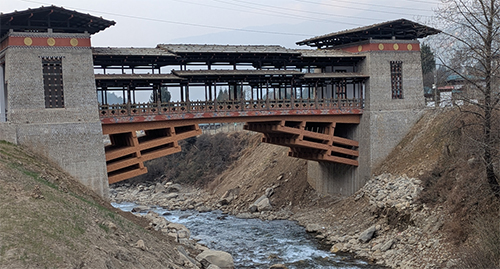
I watched this bridge at Pangri Zampa slowly rise from the river bed to become what it is now. There are two things that were right about this bridge which makes me immensely happy.
First, the traditional architecture of the bridge that blends modern cement and steel with the ancient art of bridge-construction with just wood and without even nails that not only brings the brilliant engineering of our ancient carpenters who never studied science and yet understood intuitively the laws of mathematics and physics of bridge building.
And the integration of the ancient with the modern makes engineering embrace the past with the present for the future.
The second aspect I appreciated about this bridge is that there is sufficient height between the bridge and the water below it. As monsoon rains nears, one starts thinking of the many bridges that were washed away due to floods simply because we failed to realize that river beds silt up fast and if the height of the bridge is not high enough, water will bring detritus with it and soon flow over the bridge, eventually washing it away.
I have seen in other countries how they raise both ends of the bridge so that the bridge itself is raised to the highest level possible. This provides sufficient time for silt to build up in the reiver bed without affecting the bridge when the water is in spate. In Switzerland I have even seen inclined bridges built to align perfectly with the slope of the land.
However, when I travel around our country, I see the way bridges are built where standard approach seems to be to deliberately lower both ends of the bridge towards the riverbed so that the height between the river bed and the bridge is already minimal when a new bridge is inaugurated. And come a few monsoon rains, the bridge is already underwater!
Hope the Pangri Zampa bridge will be an example for future bridges.