The Bhutanese Leading the way.
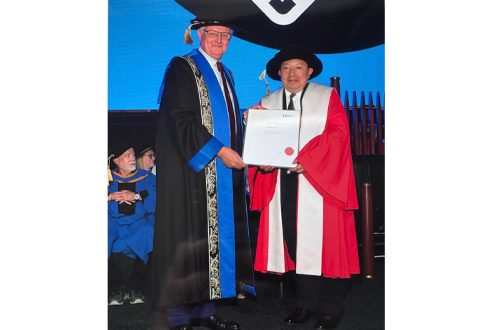
At a time when many Bhutanese are pursuing studies and careers abroad, one academic has returned home after earning international recognition for his research.
Dr Sonam Dorji W., an academic at Paro College of Education, has been awarded the prestigious Faculty Thesis Award at the University of Technology Sydney (UTS) for his doctoral research highlighting Bhutan’s spiritual ecological traditions and their role in environmental education.
The University of Technology Sydney (UTS) is ranked among the top 100 universities globally with a 96th rank.
Dr Sonam completed his PhD at UTS in 2025. His doctoral thesis was selected as the most outstanding thesis within the university’s Faculty of Arts and Social Sciences, which has recently been renamed the Faculty of Design and Society.
The Faculty Thesis Award is conferred on only one recipient each year and recognizes the most exceptional doctoral thesis produced within the faculty.
Dr Sonam’s research focuses on advancing a homegrown spiritual ecology and a Global South framework for environmental citizenship education.
His research highlights how Bhutan’s spiritual ecological traditions and local knowledge systems can serve as meaningful foundations for education alongside modern sustainability frameworks. It also examines how such locally rooted knowledge systems risk being sidelined when education relies heavily on externally derived curriculum models.
Speaking about the motivation behind his research, Dr Sonam said “As an educator, I have always been concerned that education in Bhutan and many Global South contexts often relies on imported models, while our own homegrown education approaches, embedded in our values, realities, and knowledge systems, are often overshadowed in the formal curriculum, despite their relevance and strength,” he said.
According to him, such approaches are not only relevant for Bhutan but also contribute to wider global conversations on education.
“Knowledge from the Global South has an important role in shaping sustainable and relevant education for the future,” he said.
Bhutan is widely known as a carbon-negative country, but Dr Sonam Dorji stressed that this achievement should not be taken for granted and must be sustained across generations.
“Education has a critical role in this. By drawing on our spiritual ecological perspectives and local knowledge systems, we can nurture a deeper sense of responsibility, care, and connection to the environment among young people,” he said.
At a time when the country is witnessing increasing numbers of Bhutanese studying and working abroad, Dr Sonam’s journey reflects a continued commitment to returning home and contributing to the country.
His academic journey in Australia was not new to him, as he had earlier completed his Master’s in Social Sciences there in 2007.
Reflecting on his studies abroad, he said returning to Bhutan to contribute has always been important to him.
“Each time I studied abroad, I returned to Bhutan to work and contribute, and that has always been important to me,” he said.
Having recently returned to Bhutan, Dr Sonam Dorji said it is still early to speak of a significant impact, but he has already begun contributing through his teaching.
“I have begun contributing through my teaching at Paro College of Education, where I am integrating ideas from my research into classroom practice and teacher education,” he said.
“I look forward to contributing to strengthening the research culture, where research and lived experiences can better inform decision-making, and where I can, in a small way, contribute to building a sound and contextually relevant education system in our country,” he said.
Speaking about the award, Dr Sonam said “I am told that the award is competitive, in the sense that it is conferred on a single doctoral graduate each year within the faculty. The selection is based on the quality, originality, and overall contribution of the thesis,” he said.
Looking back at his PhD journey, he said completing the research required sustained effort over several years. “My main focus was on studying and completing the research, so I did not take up additional work and depended fully on scholarship support,” he said.
He added that there were challenging moments, particularly in aligning his research with Bhutan’s context while engaging with broader academic discussions. “At times it felt demanding, but I stayed consistent, and over time everything came together,” he said.
Commenting on Bhutan’s education reforms, particularly the introduction of the Cambridge curriculum, Dr Sonam Dorji said it is still too early to make a firm judgment.
“At this stage, I am still trying to understand how the Cambridge model is being adapted within the Bhutanese education system,” he said.
However, he observed that many ideas shaping education appear to be coming from outside.
“When education relies too heavily on external frameworks, there is a risk that it may not fully build contextual understanding, values, and ways of knowing that are meaningful to our setting,” he said.
At the same time, he emphasised that external ideas should be balanced with Bhutan’s own knowledge systems.
“The key is balance. We need to thoughtfully adapt external ideas with Bhutan’s spiritual, cultural, and environmental knowledge systems, so that education remains both globally informed and locally grounded,” he said.
He added that imported curriculum models should complement, rather than replace, Bhutan’s homegrown knowledge.
“We need to help younger generations understand that there are different ways of knowing. Our own ways of knowing, shaped by how Bhutanese people see and relate to the world, can work in synergy with external knowledge systems,” he said.
While his research has earned international recognition, he says his focus now is on applying his knowledge within the country’s education system in meaningful and practical ways.