The Bhutanese Leading the way.
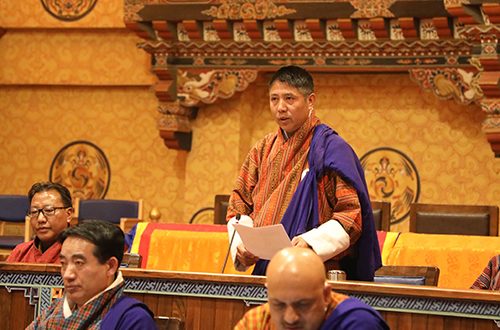
On 15th May 2026, the National Council (NC) deliberated on the framework agreement on the establishment of the International Big Cat Alliance (IBCA).
Chairperson of the NC Sangay Dorji said that the framework agreement was introduced and approved in the Fourth Session of the Fourth Parliament, with the Natural and Environment Committee tasked with formalisation.
Chairperson of the Natural and Environment Committee of NC, Member of Parliament (MP) Leki Tshering said that the committee has collaborated with the Ministry of Energy and Natural Resources and conducted stakeholder meetings with them.
According to the committee, the IBCA was instituted in 2023 for the conservation and protection of seven big cat species. These species include tiger, lion, leopard, snow leopard, puma, jaguar and the cheetah.
He said that the alliance would bring enhanced international cooperation for the protection of the big cat species and foster collaboration and synergy by establishing a platform dedicated to sharing best practices in big cat conservation.
Additionally, the alliance will also promote long-term cooperation and strategies with changing times.
The alliance has the main objective of fighting causes of big cat extinction and its causes. Bhutan currently has three species, tiger, snow leopard and leopard.
MP Leki Tshering said that this alliance will bring extensive opportunities for Bhutan such as the development of capacities and expertise in species conservation.
It will also provide opportunities for international funding and foreign technical assistance. The alliance will also improve Bhutan’s conservation efforts with global standards.
Furthermore, there are prospects of international institutions to establish in Bhutan, technical support, enhanced knowledge development and training that are internationally funded.
MP Leki Tshering said that the responsibility of studying existing problems for discussion, making recommendations, monitoring relevant proposed events and proposed funding and budgeting lies with the committee.
The budget and funding will purely be proposal-based and extra requirements will be requested from the UN and private agencies under collaboration.
MP Rinzin Namgyal of Trongsa shared that while this is a good initiative for Bhutan to improve its conservation efforts, a greater threat lies in human-wildlife conflict, where it may pose significant threat to people.
He shared a concern regarding funding, where it is sourced entirely from international sources and if it becomes costly and these international institutions fulfil their objectives of conserving or increasing the big cat population, which would lead to creating more problems in the future.
He also mentioned the paradox over improving technological advancements and enhancing conservation efforts at the same time.
MP Namgay Dorji of Punakha raised concerns over the increasing leopard population, saying it is posing risks to both human safety and livestock.
He cited an incident in Punakha where a leopard entered a settlement and killed domestic animals, and questioned what kind of compensation or welfare support is available to affected households in such situations.
The committee chairperson responded that the issue of livestock depredation by wild animals has been discussed.
He noted that leopards are also a species at risk, and if their numbers decline further, only tigers would remain among the large carnivores. This, he said, could disrupt the ecological balance by allowing herbivore populations to increase unchecked.
He added that in Bhutan, conservation support has historically been provided for species such as tigers and snow leopards. However, he acknowledged that leopard attacks on domestic animals have been a recurring problem, and said that affected households have not received adequate compensation or support so far.
MP Tshering Tshomo of Zhemgang raised questions on whether Bhutan would need to amend its laws if it joined the proposed alliance, and sought clarification on the Cabinet’s decision in this regard.
It was clarified that the decision had already been approved, with provisions aligned to the Constitution of Bhutan as well as the country’s environmental laws and regulatory frameworks.
MP Pema Tashi of Sarpang also raised concerns about the increasing wildlife population and questioned what measures would be in place to address recurring human-wildlife conflict, noting that communities often face difficulties when such issues arise.
MP Tshering Tshomo further suggested that if wildlife-related losses occur, a compensation mechanism or relief fund should be considered to support affected households. She also pointed out that the funding structure under the agreement has been clearly outlined, with a significant portion coming from voluntary contributions, including USD 18 million from the Government of India.
She raised concerns about the long-term sustainability of such arrangements and whether decision-making could be influenced by countries contributing larger funds, potentially affecting equal participation among member states.
In response, the chairperson stated that Bhutan has been allocated USD 18 million under the arrangement, and while participation is voluntary, concerns about dominance by larger contributors have been raised.
MP Leki Tshering added that, under the alliance framework, such dominance is unlikely as the governing board is rotated every five years.
He further noted that discussions with the alliance and the Ministry of Home Affairs indicate plans to develop frameworks addressing compensation for losses caused by domestic animal harm.