The Bhutanese Leading the way.
The Royal Bhutan Police (RBP) crime statistics for the first half of 2026 have revealed a concerning upward trend in several key areas of public safety and cultural heritage.
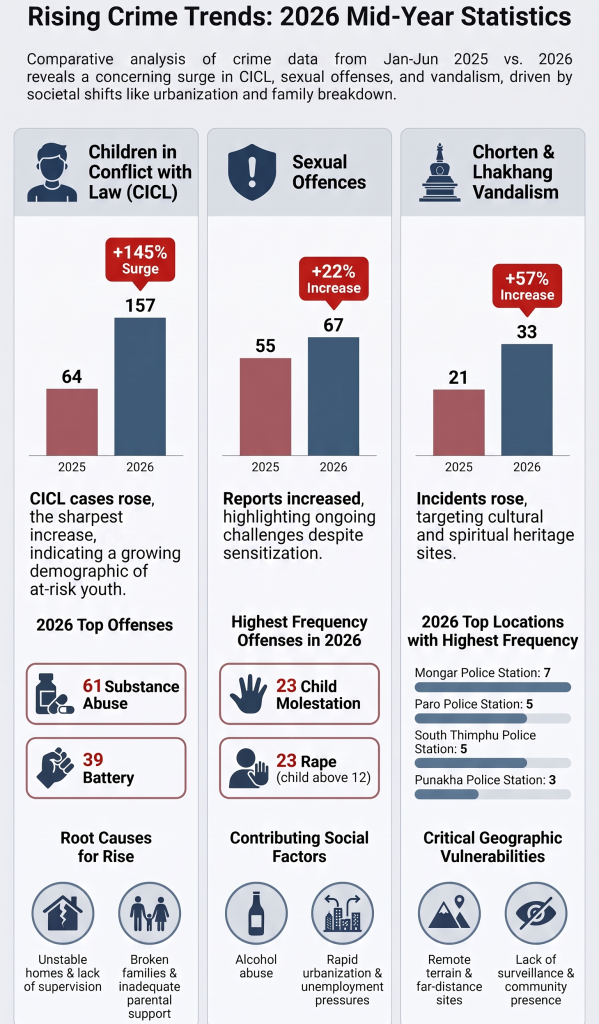
Comparative data from January to June shows significant increases in cases involving children in conflict with the law, sexual offences, and the vandalism of chorten and Lhakhangs when compared to the same period in 2025.
Children in conflict with law
The most prominent increase was observed in the category of Children in Conflict with Law (CICL), which more than doubled from 64 cases in 2025 to 157 cases in 2026.
Data provided by the RBP indicates that in 2026, substance abuse is the leading offence among minors, accounting for 61 cases, followed by battery with 39 cases, burglary with 17 cases and larceny with 14 cases.
Others included 4 cases of illicit trafficking of narcotic drugs, 3 cases of child molestation, 2 cases each of auto stripping, harassment and illegal sale of inhalants, and 1 case each of rape of a child above 12 years of age, child battery, battery with display of a weapon, aiding and abetting battery, criminal attempt to commit burglary, criminal attempt to rape a child above 12 years of age, deceptive practice, emotional abuse, illegal possession of cannabis, libel, malicious mischief, physical abuse and reckless endangerment.
Likewise, in 2025, battery offences were 22, followed by 17 cases of substance abuse, 10 burglaries, 4 larcenies and 3 cases of deceptive practice.
Others were child battery, rape of a child above 12 years, criminal attempt to commit burglary, assault, criminal misappropriation of property, trespass, malicious mischief and auto stripping with 1 case each.
Police station (PS)-wise, as of mid-2026, the Narcotic Drugs Law Enforcement Unit (NDLU) recorded the highest number of cases with 28, followed by Phuntsholing PS with 20 cases, South Thimphu PS with 15, Central Thimphu PS with 14, North Thimphu PS with 13 and Gelephu PS with 12 cases.
In 2025, Gelephu PS recorded the highest number of cases with 15, followed by Central Thimphu PS with 13, South Thimphu PS with 8, Paro PS with 5 and North Thimphu PS with 4 cases.
Police said the reasons for this surge include a rise in the local population and settlement size within the police station’s jurisdiction, which has contributed to a larger at-risk youth demographic.
Also, the report said that many children in conflict with the law come from unstable homes with broken families and a lack of adequate parental support and supervision.
Further, circumstances such as easy targets and opportunities to commit crimes are reasons for children coming into conflict with the law.
Sexual offences
Sexual offences also saw a notable climb, increasing from 55 cases in 2025 to 67 cases in 2026.
The breakdown for 2026 shows that child molestation and the rape of a child above 12 years of age were the most frequent offences, with 23 reported cases.
Others included 6 cases of sexual harassment, 4 cases each of rape and statutory rape, 3 cases of criminal attempt to rape a child above 12 years, and 2 cases each of criminal attempt to rape and criminal attempt to commit statutory rape.
As of mid-2025, rape of a child above 12 years was the highest with 19 cases, followed by child molestation with 16 cases, sexual harassment with 7 cases, 5 cases of rape, 3 cases of statutory rape, and 1 case each of rape of a married person, criminal attempt to rape a married person, incest, criminal attempt to commit statutory rape and criminal attempt to rape a child above 12 years of age.
The PS-wise data for 2026 shows that South Thimphu PS recorded 9 cases, North Thimphu PS and Gelephu PS 6 cases each, Paro PS and Phuntsholing PS 5 cases each, and Trongsa, Tashichholing and Central Thimphu PS 4 cases each.
In 2025, Central Thimphu and Gelephu PS both recorded 7 cases each, Phuntsholing, Wangdue and South Thimphu PS 5 cases each, and Norbugang PS, Samtse and Lhamoizingkha recorded 4, 3 and 3 cases respectively.
Several socio-economic factors are cited as contributors to this rise, including alcohol abuse, unemployment and the social pressures of rapid urbanization.
Additionally, the report states that the transient nature of the growing migrant labour population has created significant obstacles for law enforcement in conducting effective and targeted awareness programmes.
Chorten and Lhakhang vandalism
The country’s cultural and religious heritage is also facing increased risk, with chorten and Lhakhang vandalism rising from 21 cases in 2025 to 33 cases in 2026.
The most affected districts in 2026 were Mongar with 7 cases reported by the PS, Paro and Punakha with 5 cases each, Lhuentse, Tsimasham and Punakha with 3 cases each, and Gedu with 2.
In 2025, Paro, Tashigang and Tashiyangtse recorded 3 cases each, followed by Punakha and Wangdue with 2 cases each.
The remote and isolated terrain where many of these structures are located remains a primary challenge, making it nearly impossible for authorities to identify exactly when the vandalism occurred.
Other factors contributing to the increase included the lack of active community surveillance and the improper categorization of these structures, which leaves them vulnerable to exploitation.
Meanwhile, Colonel Passang Dorji, the Deputy Chief of Police for Crime and Operations, said that a Regional Special Investigation Team (RSIT) has been formed to strengthen operations in cases of chorten and Lhakhang vandalism.
He said that so far, in Thimphu, 20 chorten and 13 Lhakhangs have been vandalized. Fourteen individuals have been arrested and are currently under investigation.
In Punakha, 4 cases have been solved and 3 arrests made.
In Mongar, 8 chorten were vandalized and 9 individuals arrested. The case is currently in the verification process.
One case in Trashiyangtse that occurred in 2025 was solved with 7 arrests, and 2 individuals have been convicted.
He added that in the current investigation, it was found that most of the cases and individuals involved are linked to past cases over the last five years, and that is the main reason there has been an increase in solved cases, including the reopening of cold cases.
He said that the SPs of the concerned divisions will lead the RSIT whenever cases arise.
Further, he said that the team will not only be chorten and lhakhang case-centric but will also handle other crimes. The team will concentrate on each case and follow it through until results are achieved.
This will help in keeping track of every case.