The Bhutanese Leading the way.
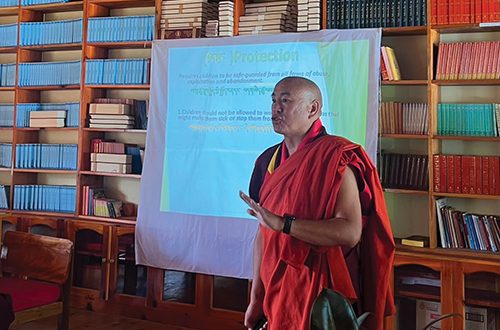
Child protection office says all forms of violence against child monks or nuns are unacceptable
Earlier this year this paper had reported about a case in a monastery in Sarpang in October 2025 where a Kudrung (senior monk/teacher) severely beat a 17-year-old monk as four other monks restrained him for leaving the premises without permission. The young monk later died by suicide. The police charged the Kudrung and while he was convicted in court for the assault the police and court were unable to link the suicide to the beating due to a 15-day gap despite the pleas of the mother alleging the two were linked. The mother has currently appealed to the High Court.
At the time the Child Care and Protection Office (CCPO) under the Zhung Dratshang completed its investigation into the battery case involving the Kudrung and confirmed that separate disciplinary action will be taken against him.
This action will be independent of the case currently under appeal before the Sarpang Dzongkhag Court.
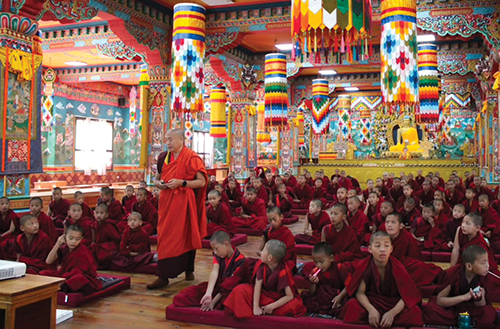
The Dratshang Lhentshog said it has adopted a zero-tolerance approach to corporal punishment and all forms of violence against child monks and nuns, with an internal child safeguarding framework requiring every monastic institution under the institution to respond even in cases involving ‘a simple slap.’
An official from the Child Care and Protection Office (CCPO) under the Dratshang Lhentshog said that while corporal punishment may have been used in the past as a means of disciplining monks, it is no longer considered appropriate in today’s monastic education system.
He said that violence against children is not tolerable at all, adding that there is a common misconception that monastic institutions experience high levels of corporal punishment.
The official clarified that this perception is inaccurate and stressed that the monk body is committed to ensuring the safety and wellbeing of every child under its care.
Under the internal child safeguarding and protection framework, every monastic institution under the Dratshang Lhentshog is required to safeguard children from exploitation, abuse, neglect and violence.
The framework is guided by principles including the best interests of the child, protection from all forms of harm, non-discrimination, respect for children’s views, confidentiality and safety.
The official said that if a child is subjected to any form of exploitation, abuse, neglect or violation, the framework comes into effect.
In cases involving serious offences, such as sexual abuse or severe corporal punishment, the cases will be reported to the Royal Bhutan Police through due process.
He said that the office also provides awareness to child monks on personal safety, including recognizing good touch and bad touch.
He said, “To strengthen child protection across the monastic community, the CCPO has been conducting awareness and capacity-building programs nationwide. Supported by UNICEF, the office launched a pilot programme in 2023 and 2024 covering Samtse, Chukha and Trashigang, selected because they had larger populations of child monks.”
During the pilot phase, 108 lams, including social service lams, received training on violence against children, child protection and their responsibilities in safeguarding children and sharing these messages within their communities.
Following the pilot’s success, the awareness programs have continued annually in Dratshang Rabdeys across the country.
Each year, between 700 and 1,000 monks particularly new recruits receive training on child rights and protection.
More than 1,000 nuns have also received similar awareness programs through the Bhutan Nuns Foundation.
In addition, monastic teachers are trained to identify early signs of mental health concerns and other child protection issues so that children can be referred for appropriate support.
The official said the office has also begun educating children about online violence as mobile phone use becomes more common among young monks.
According to the office, the Dratshang Lhentshog currently has more than 13,000 monks, of whom just over 7,000 are registered. More than 6,000 of them are minors, making child safeguarding a key priority for the institution.
While the set minimum age for enrolment is six years, the official said a small number of younger children, some as young as five are accepted in exceptional circumstances when they have no one to care for them.
The majority of monks are between 8 and 12 years old.
The CCPO was established in 2009, with its dedicated office set up in 2013 through support from the government and UNICEF.
It serves as the central agency responsible for planning, coordinating, implementing and monitoring child protection programmes across monastic institutions.
The office is supported by an advisory committee, regional representatives and child protection focal persons stationed in monastic institutions and nunneries throughout the country to strengthen reporting, monitoring and early intervention.
The office reported that it recorded six cases of violence so far this year, most of which were minor and resolved within the institution.
It also recorded three cases in 2023, two in 2024 and three in 2025, all of which were considered minor and dealt with internally.
The reforms by the Dratshang Lhentshog is important as those who support corporal punishment link it to culture and tradition in Bhutan where the Dratshang plays a major role.