The Bhutanese Leading the way.
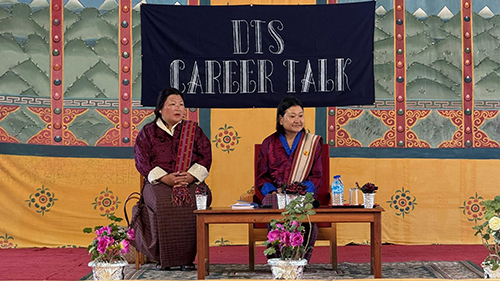
For Sonam Zangmo, becoming the first female Gup among the eight gewogs that coordinate the Punakha Dromchoe has meant taking on responsibilities traditionally associated with men.
The Gup of Chang Gewog in Thimphu has served in the position for five years. Before becoming Gup, she served as a Mangmi and officiated as Gup for two years. Her journey into local leadership began as a Tshogpa from a Chiwog, where she said she was dedicated to communicating and navigating the issues faced by her community.
She subsequently became the first female Mangmi of Thimphu Dzongkhag and later the first female Gup among the eight gewogs involved in coordinating the Punakha Dromchoe and its Pazap tradition.
“I was able to gain the trust of my people, and this is my last tenure, making it more than 15 years in this field,” she said.
The eight gewogs under the Wang Tshochi Gye include five in Punakha and three in Thimphu-Chang, Kawang, and Mewong.
“In the Wang Tshochi Gye, there are eight gewogs: five in Punakha and three in Thimphu. The three in Thimphu are Chang, Kawang, and Mewong. Out of the eight Gups, I am the first female Gup,” she said.
Part of Sonam’s responsibility involves coordinating the Pazaps during the Punakha Dromchoe, a tradition rooted in Bhutan’s history.
Pazaps were historical militia or volunteer warriors who defended Bhutan and Punakha Dzong during the 17th century under Zhabdrung Ngawang Namgyal. They were chosen warriors who defended Punakha with great courage, wearing bold red and black clothing and serving during a period when Bhutan faced invasions from Tibet.
Their bravery continues to be honoured through the Punakha Dromchoe, an annual festival that includes a vivid re-enactment of the historic battle, complete with firecrackers to mimic gunfire. It is the only festival in Bhutan that stages a live procession to remember the fight against the Tibetan forces, keeping the spirit of the Pazaps alive for future generations.
Sonam said her experience as a Mangmi and Gup taught her that women should take up responsibilities traditionally associated with men.
“We should just go and take up the responsibilities that men can do. We have to coordinate, and we have to take about 18 Pazaps and take care of them. Instead of the Gup, we can send a representative,” she said.
She said there had been a perception that female Gups were not acceptable because Gups were expected to participate as Pazaps, a role viewed as the sole responsibility of men.
“Until now, people have said that female Gups are not acceptable since they have to go as Pazaps, and that is the sole responsibility of a man. The older generations thought that. However, since I started out as a Mangmi, they have started to slowly realise that even women are capable of being leaders,” she said.
The tradition surrounding the Pazaps also includes the Tsen Dhar, a warrior flag symbolising protective deities, which is traditionally kept away from women based on indigenous purity rituals.
The Department of Culture under the Ministry of Home Affairs has said that it is not mandatory for all Gups to take part in the Pazaps.
During local elections, a common misconception arose that local leaders, or Gups, must personally ride horses and perform as Pazaps during the festival. Clarifications from the Department of Culture and the Central Monastic Body have noted that participating as a Pazap is not mandatory for Gups, and leaders can use male stand-ins to fulfil the tradition.
In the past, Gups were expected to ride horses along with the Zimpoens. Today, Sonam said, there is no strict rule requiring the Gup to be male or preventing a Gup from sending a representative.
“The men have to wear tetsey and shamta and go into the lhakhang for now. However, we can send in a representative. I don’t stay inside while the Dromchoe is happening. For me, I go to the Dromchoe, coordinate among my gewog Pazaps, and the only thing I cannot do is go inside with the Pazaps,” she said.
“If we need something to change in society, in my opinion, I feel like we have to start the change by setting an example,” she said.
She said she sees herself as an example for women who may take up leadership positions after her, particularly because age-old traditions can be difficult to change.
“Whoever comes next after me or any Gup, I think of myself as an example because age-old traditions themselves are very hard to break for women, who weren’t generally expected to be leaders before,” she said.
She hopes her experience will show that women can take on such responsibilities without the need for a male Gup.
“In the future, I hope this shows that women can do these things and that needing a male Gup isn’t compulsory, thereby breaking social restraints,” she said.
The Punakha Dromchoe has been celebrated since the reign of Zhabdrung Ngawang Namgyal, with the eight gewogs carrying out the tradition under his orders.
“When there are future elections, and during the times of the Gups ahead of me, I hope they look back at my tenure and think that if the first female Gup of the eight gewogs was able to do it, so can I,” she said.
“I hope that there will be more than one female Gup in the future, and it doesn’t have to be only one female among the eight gewogs,” she added.
According to the Election Commission of Bhutan, there are nine female Gups out of a total of 205 Gups in the country. Women account for 4.39 percent, while the remaining 196 Gups, or 95.61 percent, are male. This translates to a female-to-male ratio of 9:196, or approximately one female Gup for every 22 male Gups.
For Tshering Wangmo, a resident of Punakha Dzongkhag, traditions surrounding local leadership and the Pazap culture have historically been associated with men.
“In the olden times, there were a lot of taboos surrounding local leaders and how only men could be leaders, especially surrounding the Pazap culture and the relics in the Dzong,” she said.
She said that although progress may be gradual, the presence of women leaders and the use of representatives are signs of change.
“Even if progress is not fast, a few women leaders are slowly coming forward and sending in representatives. Even if social norms cannot be broken in a heartbeat, I hope we will see more women leaders, as we already have one now,” she said.
This story is published under an EU-funded project managed by Save the Children Bhutan in partnership with the Bhutan Transparency Initiative and RENEW.