The Bhutanese Leading the way.
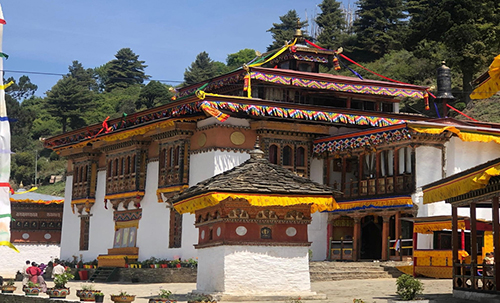
Dokhachoe Gompa, also known as Dargaycholing Gompa, is located in the Chapcha area of Chhukha district. This Kagyu monastery sits at an elevation of around 2,950 metres and was established by Choje Lama Thinley Gyatsho during the mid-17th century.
Lama Thinley Jamtsho was among the early students of Zhabdrung Ngawang Namgyal, who founded the Drukpa Kagyu tradition in Bhutan in 1620. Thinley Jamtsho also played a key role in spreading Drukpa Kagyu teachings in Ladakh. After completing a pilgrimage to Ladakh and Swayambhunath Stupa in Nepal, Choje Lama Thinley Gyatsho meditated under a pine tree known as Lamai Tongphu Tsawa, meaning “The Lama’s Blue Pine Root.”
Realising the profound importance of the spot, Choje Lama Thinley Gyatsho made the monumental decision to build the monastery known today as Dokhachoe Gonpa. He named it “Dokhachoe Goempa,” meaning “Upright Boulder Gonpa,” in reference to the towering boulder nearby. It is said that within the grounds of the lhakhang, Choje Lama Thinley Gyatsho engaged in meditation facing eight different directions.
The significance of the rock extended to its use during religious ceremonies, where it served as a platform for blowing horns. This practice led to the rock being named Chodung Phumi Dophung, meaning “Boulder on which horns are blown.” As a result, the name of the monastery was derived from the significance of this rock.
The ground floor of the monastery features a main altar adorned with the Dusum Sangay, representing the Buddhas of the past, present, and future. Particularly noteworthy is the primary relic contained within the Shakyamuni statue- a precious gem known as Nob Samphyel. These statues are crafted to resemble the Jowo Rinpoche of Lhasa, giving them a distinctive appearance. Paying homage to these statues is regarded as akin to visiting the renowned Jowo Rinpoche in Lhasa.
A life-sized depiction of Choje Lama Thinley Gyatsho himself is prominently placed in front of the Buddha statue. The presence of this statue evokes a profound feeling of being in his presence, serving as a poignant reminder of how his founding of this monastery has brought countless benefits to sentient beings.
On the Choetri, two remarkable statues of Green Tara and White Tara stand, both crafted with exceptional skill by Choje Lama Thinley Gyatsho. It is worth mentioning that all statues created by the lama are believed to possess the ability to speak. Devotion to these profound Tara statues through prayer is believed to assist in the fulfilment of aspirations and offer solace and healing from ailments.
Another notable relic of the monastery is the self-spoken statue of Zhabdrung Ngawang Namgyal, expertly crafted by the Zhabdrung himself. This statue is distinguished by a unique characteristic: the head is subtly inclined downward, conveying a solemn expression. An intriguing legend surrounds this statue, recounting that after its construction, Zhabdrung Ngawang Namgyal posed a question to it, asking if in the future it could serve as his substitute. Remarkably, the statue responded with a reverential bow, indicating its agreement. It is believed that this extraordinary interaction is the reason behind the statue’s slight downward tilt.
Initially, the statue was meant for Chapcha Dzong. However, as the dzong deteriorated over time, the statue was moved to Chhukha. Unfortunately, this relocation coincided with negative outcomes, such as famine and suffering within the village. Seeking guidance, villagers consulted an astrologer who advised that the Zhabdrung statue should be taken upstream against the river’s flow. Unfortunately, this advice was ignored at first, and the statue remained in its temporary location.
Fortunately, within the village, there was a devoted individual- a mute person- who diligently tended to the monastery by performing daily cleaning tasks. One significant day, the caretaker noticed a sorrowful expression on the Zhabdrung statue’s face and, upon closer examination, saw tears flowing from its eyes. In an astonishing turn of events, the Zhabdrung statue spoke, declaring that its rightful abode was at Dokhachu Goenpa and that it needed to be transported there. Thus, through this divine revelation, the statue was ultimately relocated to the monastery.
Inside the altar, there is another stupa that looks as though it is made of wood, but is actually crafted from silver. Encased within this stupa is a precious golden statue. This stupa is called the Namgyemgi Chorten, named after a woman named Namgyem who dedicatedly cast the statue using her precious belongings and presented it to the monastery as an offering.
Upon ascending to the first floor, the magnificent Kanjur Lhakhang, home to the renowned Ekajati Goenkhang, appears. The atmosphere is markedly distinct, with devotees immersed in various practices such as performing prostrations, making offerings, and seeking guidance through divination dice. The sacred Ekajati dice typically display the auspicious numbers 5, 13, and 15. Within the assembly, certain individuals listen attentively with profound devotion as a monk imparts insights into the monastery and the revered deity Ekajati.
On a table within the room, four framed photographs are prominently exhibited alongside eight bowls of offerings. The monk focuses his explanations on Ekajati, emphasising two distinct aspects. One pertains to the terma discovered by Tertoen Drukdra Dorje, which is presently sealed under the authority of relevant agencies. The other aspect involves the representation crafted by Tertoen himself, which is revealed to the public annually, specifically on the 15th day of the fourth lunar month.
It is crucial to clarify that Ekajati’s main residence is located at Pasakha Tumdra Ami Ney. Despite certain popular beliefs, Dokhachoe Goempa is not considered Ekajati’s primary dwelling place; instead, it holds significance as the sacred residence of Choje Lama Thinley Gyatsho.
Additionally, behind the monastery, devotees can find the Drupkhang, a cave dedicated to Choje Lama Thinley Gyatsho’s meditation. This site is deeply revered for its connection to the enlightenment of numerous followers of Lama Thinley Gyatsho. According to historical accounts, after three days of profound meditation at this cave, Lama Thinley Gyatsho witnessed the Khachoe Dakpai Zhingkham, a celestial realm, through the rock face. This extraordinary experience led to the naming of the site as “Dokhachoe Goempa.”
Dokhachoe is primarily known as the home of the deity Ekajati. The deity Ekajati is recognized by three names: Ekajati, Aum Ngarsum, and Aum Kanchima. However, her true name is the Sanskrit term Ekajati. “Aum Kanchima” is considered a local name meaning “one-legged goddess,” as explained by the monk. Lhamo Ekajati is distinguished by having singular features: one hair, one eye, one breast, and one leg, which is the basis for the name Ekajati.
The female deity was also referred to as Aum Ngarsuma because she was entrusted with the protection of the secret mantras by Buddha Shakyamuni. Essentially, all secret mantras are encapsulated within the four Tantras (རྒྱུད་བཞི): the action tantra, conduct tantra, yoga tantra, and unsurpassable yoga tantra (བྱ་བའི་རྒྱུད་ སྤྱོད་པའི་རྒྱུད་ རྣལ་འབྱོར་གྱི་རྒྱུད་ རྣལ་འབྱོར་བླ་ན་མེད་པའི་རྒྱུད).
Ekajati’s presence can be traced back to the time when Buddha Shakyamuni first imparted teachings in Varanasi, where the deity diligently safeguarded these profound mantras. The deity is also recognized by the name Molem Njurdroma. Among countless deities, Ekajati is renowned for swiftly fulfilling three primary wishes within a short span of time.
The first wish encompasses a wide range of desires, including wealth, success in studies, resolution of legal matters, and even requests for visas. The second wish pertains to the blessing of children, allowing individuals to specify their preference for a son or daughter. Even families without children may receive this blessing if their true aspirations align. The third wish focuses on healing from illnesses, with reports of individuals recovering even from late-stage cancer. It is important to recite Ekajati’s mantra with devotion: མ་མ་ཏྲི་བྷྱོཿ མ་མ་ཏྲག་རཀྵ་ཨེ་ཀ་ཛྙཱཊི་ཛཿ ཛཿ (Ma Ma Tri Bhyoh Ma Ma Trag Rak Sha Ekajati dzaH dzaH).
It is noteworthy that there have been cases where individuals have experienced healing after consuming the offered Serkyem following offerings made to Ekajati. Serkyem is available for consumption during the designated offering time, which is between 10:00 AM and 12:00 noon. The monk advises that when making these wishes, one should approach Ekajati with the same earnestness as seeking the help of one’s own mother, rather than viewing her as a distant deity.
Ekajati holds special significance, along with three other deities, in connection to Pel Yeshey Goenpo. Her statue at Dokhachu Goenpa was originally transported from Tumdra Ami Nye in Dala, Phuentsholing, during the Duar War in 1864.
According to oral history, it was the responsibility of the dzongpoen (governor) and khangnyer (caretaker) to transport the statue to Paga Goempa, considering the risks associated with the war. However, they encountered an obstacle at a place called Chapcha Zimla and could not proceed further. Ngab Thou, who was responsible for carrying the treasure to Paga Monastery, rested at Zimla. Later, he found that the treasure could not be lifted and seemed to indicate a preference for the direction of the Gompa. In a remarkable turn of events, the statue appeared to indicate its preference to be taken to the location where Dokhachu Goempa now stands. Additionally, it is believed that the presence of Tertoen Drukdra Dorji Chazo’s Ekajati at the monastery also played a role in attracting the relic there through prophetic means.
The Ekajati statue crafted by Tertoen Drukdra Dorji was meticulously carved from white sandalwood, a material known for being challenging to shape. However, with remarkable skill, Tertoen managed to fashion it in a way that appeared as though it had been effortlessly moulded.
Another highly esteemed artefact is the Ganapati statue, one of five crafted by Manjushri (Jamphelyang). Legend has it that one of these statues miraculously flew and landed in Japan. Behind the statue, there is a self-originated letter “ཨོཾ་ཨཱཿ ཧཱུྃ” (OM AHH HUNG) with the small letter “ཆ” (Cha) positioned above and below, symbolising its seal.
In iconography, Ekajati is depicted with singular features, including one strand of hair, one eye, one fang, one leg, one arm, and one breast. Legend tells that Guru Padmasambhava pierced one of her eyes to enhance her vision, empowering her to assist in defeating evil and demons. Another belief suggests that she was about to transcend into Nirvana through deep meditation but was halted by her celestial teacher, Buddha Akshobhya, ensuring she remains a bodhisattva and avoids entering Nirvana.
As a female deity, Ekajati is known for her swift response to sincere requests for assistance, even for everyday needs. This attribute has made her highly favoured among those seeking prosperity and fertility, leading to her widespread popularity. According to local belief, the wealth of the Chapcha gewog community is attributed to the blessings of Aum Ekajati.
An anecdote recounts how a close acquaintance of the narrator became a mother at the age of 41 after visiting Dokhachu Gonpa. It is believed that her blessings come with a guarantee of effectiveness. Many influential individuals from Thimphu, as well as virtually every resident born in this area, hold her in high esteem as their guardian deity capable of fulfilling wishes.
Dokhachoe Gompa stands as a beacon of spirituality and reverence in the heart of Bhutan’s Chapcha region. Through centuries of devotion and mystical encounters, this sacred monastery has become intertwined with legends of divine intervention and blessings. From the ethereal presence of Ekajati to the profound teachings of Choje Lama Thinley Gyatsho, each aspect of Dokhachoe Gompa holds significance and serves as a reminder of the enduring power of faith and devotion. Whether seeking solace, guidance, or blessings, visitors to this hallowed site are met with a sense of awe and reverence, leaving with hearts uplifted and spirits enriched by the profound energy of this spiritual sanctuary.
Thukten Tenzin, History Assessment Officer
Thimphu