The Bhutanese Leading the way.
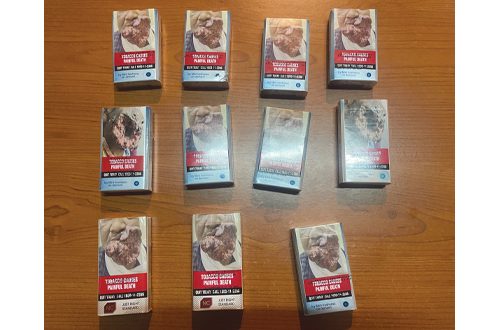
In 2025, the government increased the taxes on cigarettes by introducing an excise tax of Nu. 10 per cigarette, with another Nu. 1 per cigarette as the import permit fee, effective from January 2026, meaning an excise tax and permit fee of Nu. 11 per stick or Nu. 110 for a pack of 10 cigarettes, irrespective of the brand.
The aim was to make cigarettes expensive to discourage smoking, and an additional benefit would be enhanced tax revenue.
However, when one looks around in public areas, everyone seems to be lighting up and increasingly younger people, especially students, are taking up the habit.
These visible signs show the failure of the excise tax and also the inability to curb massive smuggling or illegal imports of cigarettes into the country.
An investigation by The Bhutanese found that the majority of cigarettes available in the market have not paid tax and have been smuggled in or imported illegally without paying the excise tax, import permit fee and even the Goods and Services Tax (GST).
Cigarettes sold below the excise tax rate
The Bhutanese visited 12 pan shops and grocery shops in Thimphu town and found cigarette packets either being sold below the Nu. 110 tax rate or just above it, suggesting that the tax had not been paid.
A popular brand in town is Wave cigarettes, with 10 sticks in each pack. This means that the excise tax and permit fee should be Nu. 110 per pack. When one adds the invoice price, GST, transportation costs, the wholesaler’s margin, the distributor’s margin and the retail margin, the price should be around Nu. 170 to Nu. 180 for the retail customer. The maximum retail price on the packet is Nu. 60, and if one adds the tax to that, the price should be at least Nu. 170.
However, several outlets in Thimphu were selling this cigarette packet for less than the tax rate. One shop in the Hong Kong market area sold it to us for Nu. 90 per packet. Another outlet along Norzin Lam, near the Lugar Theatre, sold it to us for Nu. 80 per packet. An outlet at the beginning of Norzin Lam sold it to us for Nu. 100 per packet. Another outlet nearby also sold it to us for Nu. 100. A grocery shop in Sabzi Bazar sold it to us for Nu. 90 per packet.
A row of outlets near the main traffic area were all selling the packets for either Nu. 120 or Nu. 130.
An outlet in Olakha sold it to us for Nu. 80.01, including GST, while a grocery shop in Taba sold it to us for Nu. 85 per packet. The Taba shop charged Nu. 100 for the slightly bigger version of the packet.
Another popular and more expensive cigarette brand being smuggled in is Wills Navy Cut. If one adds the invoice price, GST, transportation costs, the wholesaler’s margin, the distributor’s margin and the retail margin, the final price should be around Nu. 200 to Nu. 220.
However, due to tax avoidance, the cigarettes are being sold for Nu. 170 per packet. They were sold to us at an outlet in Norzin Lam and another in Olakha.
Most of those selling the cigarettes either did not provide receipts or did not have them, but the paper managed to collect four receipts showing the prices.
Supply and youths taking it up
The paper also spoke to two shops selling such tax-free cigarettes and, on the condition of anonymity, learnt that different groups of people come around to market and supply the cigarettes. Sometimes, they are the people who supply doma and pani, while at other times, they are people who conduct this business exclusively and move around in vehicles.
Given how cheap and widely available the cigarettes have become because no taxes are being paid, an increasing number of youths are taking up the habit.
This reporter waited near a pan shop along Norzin Lam in the evening and found that, within just an hour, around 25 people came to buy cigarettes, of whom around 20 were youths, including school students.
The owner of the particular pan shop on Norzin Lam said that cigarettes were his main business because of the high sales volume and profit margin. The pan shop owner said that smoking had increased significantly.
One of the shops said it sold six to seven packets a day, with around half of its sales coming from customers who bought individual cigarettes rather than full packets. The profit margin for the shopkeeper is better on individual cigarettes.
Some may assume that cigarettes are cheaper this year because of the hoarding that took place last year, when taxes were lower. However, the cigarettes bought by this paper were all manufactured in either June or August 2026, showing that they are new stock.
Trade statistics tell their own story
Another curious development is that, according to the official import data in Bhutan Trade Statistics, around 165.674 million cigarette sticks worth Nu. 676.26 million were imported in 2024. In 2025, this increased to 204.292 million cigarette sticks worth Nu. 715.947 million.
However, according to Bhutan Trade Statistics, only 9.813 million cigarette sticks worth Nu. 71.86 million were imported in the first six months of 2026. If the figures for the first six months are assumed to be the same as those for the second six months, annual imports in 2026 are likely to be around 19.626 million sticks, worth Nu. 143.72 million.
This would mean that the supply in 2026 had crashed by 90 per cent compared to the 2025 annual volume. Ideally, this should mean a massive shortage in the market and very high prices, but the opposite is true, with prices remaining low, even below the excise tax rate.
However, the fact that this is not happening clearly suggests that the vast majority of cigarettes available in Bhutan have been smuggled in.
One argument made by some officials is that 2025 was an outlier year because there was a lot of hoarding. However, this does not hold up, as the import figures for 2024 and 2025 are similar, with only a minor increase in 2025.
Bhutan Trade Statistics shows that around 107.402 million cigarette sticks worth Nu. 507.649 million were imported in 2023.
The import figures above include third-country imports. However, since Indian cigarettes are the ones being smuggled, comparing only Indian imports for 2023, 2024, 2025 and 2026 makes the figures even more telling.
In 2023, Indian cigarettes worth Nu. 501.100 million were imported, amounting to 102.999 million sticks. In 2024, imports were worth Nu. 596.432 million, amounting to 135.861 million sticks. In 2025, they were worth Nu. 591.686 million, amounting to 141.815 million sticks. In the first half of 2026, imports were worth Nu. 71.86 million, amounting to only 9.813 million sticks. If this figure is averaged over a year, imports would amount to Nu. 143.72 million and 19.626 million sticks for the whole of 2026. This means that the annual volume of Indian cigarette sticks entering Bhutan legally is likely to collapse by 86.16 per cent in 2026.
The above anomalies in the import data, combined with the widespread availability of Indian cigarettes at prices below even the excise tax rate of Nu. 110 per packet of 10 cigarettes, indicate massive smuggling.
The Department of Revenue and Customs said it collected Nu. 319.31 million in excise duty on cigarettes in the first eight months of 2026. However, a source said this figure was misleading because Nu. 208 million of this amount was excise duty on cigarettes imported last year but paid this year. The source said that this Nu. 208 million amount was under litigation in court.
Legal importer says smuggling is rampant
When it comes to the legal import of Indian cigarettes, which are primarily from ITC, the only authorised dealer is Druk Ventures. Druk Ventures management said that it had stopped importing Navy Cut and Wave cigarettes because it could not compete with smuggled, excise-free products.
The only Indian brand it is bringing in is the more expensive Wills Classic, priced at Nu. 430 per packet of 20 cigarettes, and in smaller quantities because taxes in India are so high that, even after being smuggled into Bhutan, the brand cannot compete with legally imported cigarettes from Druk Ventures.
In fact, Druk Ventures has imported the bulk of legally imported cigarettes into Bhutan in 2026, and these are exclusively Wills Classic.
This is additional evidence that the widely consumed Navy Cut and Wave cigarettes in Bhutan are mainly smuggled.
Druk Ventures management said that in 2025, it remembered having paid huge taxes on legally imported cigarettes. However, it now pays only a fraction of what it paid in 2025, 2024 and 2023, despite the higher excise duty.
Smuggling and collusion
This paper spoke to people legally involved in the tobacco business, who said that smuggling on this scale was not possible through traditional methods of crossing the border on horseback or carrying goods on people’s backs. Instead, the cigarettes must be entering in large quantities through trucks and other vehicles.
The paper spoke to two people across the border in Jaigaon who were familiar with the smuggling of Indian cigarettes into Bhutan. They said there were essentially two methods. One was the traditional method of hiding cigarette boxes among other goods so that customs and other officials would not notice them. The other involved collusion with customs and other officials who allowed the smuggling to take place.
The two people said that cigarettes were not sent to Thimphu in a single bulk consignment but in multiple smaller consignments to avoid detection at the Rinchending check post and at other checkpoints further up.
A source said that the Department of Revenue and Customs (DRC) had been informed about cigarettes being sold below the excise tax rate in the middle of the year, but no action was taken. The source said that an Indian cigarette brand called Richman Royal, containing 20 cigarettes per packet, was being sold for Nu. 150, even though the excise tax and import permit fee alone should amount to Nu. 210. Wave cigarettes were being sold for Nu. 80, even though the excise tax and import permit fee alone should amount to Nu. 110.
The source said that, despite being made aware of the above, the DRC took no action on the issue.
The end result of the smuggling is that cheap and accessible cigarettes are encouraging young and old people to take up smoking, which will be a major national health issue in the coming years, and the government is also losing hundreds of millions in revenue.
This paper sent questions to the DRC through the media focal person, but received no response.