The Bhutanese Leading the way.
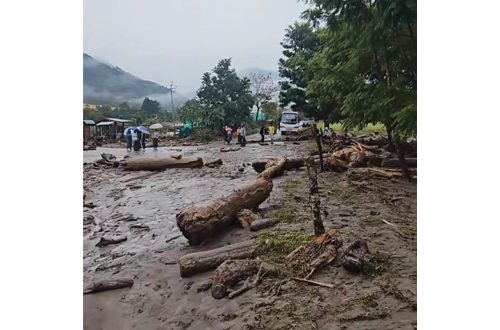
Road access disrupted, homes and infrastructure damaged, and around 130 tourists affected by the flood
A glacial lake outburst flood (GLOF) from Shintaphu Lake in Gasa’s Mo Chhu sub-basin reached Taktsemakhang at around 8:27 pm on 29th October, triggering flood warnings along the Mo Chhu and downstream of Punatsangchu.
Night of the Incident
For people in Laya, the first warning came from yak herders in the mountains above the settlement. Between 7:30 pm and 7:40 pm, the herders began making calls and sending messages through their gewog group chat, reporting that Shintaphu Tsho had burst and water was flowing downstream.
Speaking to The Bhutanese, a teacher at one of the schools in Laya said residents were having a group dinner when the calls and messages began coming in. With no lights around the lake, the herders could not see the outburst but sensed vibrations and heard the sound of rushing water.
The teacher said residents immediately began informing local authorities and people they knew, as news of the outburst spread through the community.
“We received calls around 7:30 pm, and after 30 minutes, we also felt the vibrations and heard the gushing sound of the river,” he said.
A video that circulated on social media at around 7:47 pm showed a message being shared in the Laya Gewog group chat, in which a man alerted residents that Shintaphu Tsho had burst and urged them to spread the warning to downstream dzongkhags, including Punakha.
“The lake has burst, and the water is flowing down at a very steep pace, almost like it is rushing into battle,” he said.
He also said he had moved up the hills because he could not remain near the lake.
Following the outburst, residents in areas considered vulnerable in Laya and other parts of Gasa were moved to safer locations as a precaution. Local authorities coordinated the evacuation of people from areas potentially exposed to the flood.
As the flood moved downstream, it reached Punakha, raising concerns among residents living along the river. Residents also took to TikTok livestreams to share updates, with some showing the area in darkness after the lights went out.
The flood then reached Punakha as it moved downstream along the Mo Chhu, prompting concern among residents in areas along the river.
Residents in potentially vulnerable areas were alerted through phone calls, gewog group chats and social media platforms.
Flood warning sirens were also activated along the Mo Chhu and downstream of Punatsangchu.
Videos shared on social media showed residents leaving their homes and moving to safer locations. Monks were also seen evacuating, while in Bajo, Wangdue Phodrang, residents were seen getting into vehicles and moving towards higher ground.
The urgency of the situation was also reflected in videos showing families preparing to leave their homes.
In one video, a family had packed essential belongings, including warm blankets, pillows and food, in preparation for a possible evacuation.
Other residents described the situation as one of panic and uncertainty as warnings spread.
The flood also swept a majority of the Gasa Tsachu facilities and damaged several sections of roads along the affected areas, disrupting travel and making movement difficult for residents.
Day after the Flood
The Laya Gup, Tshewang, said that as of 30th October, no threat to human life had been reported, although there were concerns about the safety of yak herders and their livestock due to poor network connectivity in the area.
“All people in areas at potential risk from the flood have been evacuated and are safe. However, we have not been able to reach the yak herders and their animals due to network connectivity issues,” he said.
In Punakha, two houses in Changyel Chiwog were affected after floodwater entered the homes, according to the Chiwog Tshogpa Namgay Bidha.
Harvested paddy crops have also been soaked and damaged.
Residents have been moving away from the affected areas as a precaution, while the nearby school remains safe.
In Lakhu Tshogom Chiwog, eight cattle were lost in the flood. Three were found dead at the site, while five were washed away.
More than two acres of paddy fields have also been affected, according to the Tshogpa.
Dzomlingthang Park in Punakha has been covered with debris, and the road has been blocked
The flood has also damaged two Bailey bridges connecting Zhengosa Chiwog and Gumgang-Yorbo Chiwog in Goenshari Gewog, Punakha. The bridges were affected by flooding in the Mo Chhu.
In Yebisa, a road bridge was completely washed away, while a pedestrian bridge was damaged by the flood. The walking route was also damaged, making it impassable for travellers. Paddy fields in the area were washed away as well, according to the Yebisa Tshogpa.
In Gasa, preliminary damage reports show extensive destruction at Taktsemakhang and Gasa Tsachu.
At Taktsemakhang, a newly constructed public washroom and a store room belonging to the Army Camp were damaged.
Moreover, a section of the Gasa-Laya road, approximately 21 kilometres from Gasa, was also damaged.
An artificial lake has formed near Taktsemakhang but it is stable as of now with no major or immediate danger (see separate story on pg 9).
The GLOF caused extensive damage to facilities at Gasa Tsachu, washing away the water source, two public soaking ponds, the VIP and VVIP soaking ponds, resting areas, public toilets, canopies, a newly constructed hot stone bathhouse, a children’s soaking pond, two changing rooms and a sales counter.
The parking area and approximately 350 metres of road leading towards the hot spring were also damaged, along with a toilet near the Royal Guest House.
The extent of the damage is still being assessed.
Authorities said the situation is being closely monitored and a fuller assessment will be carried out once it is safe to access the affected areas.
The flood has disrupted access to communities and damaged essential infrastructure, while authorities continue to assess the impact and monitor the situation.
People Stranded as Flood Disrupts Travel, Halts 108 Jangchub Chorten Project
With several roads damaged by the flood, many people from Punakha and Gasa could not travel to attend the 108 Jangchub Chorten event, while some remained stranded due to disrupted routes.
The Laya Gup said that although he had reached Gelephu on 29th October, before the flood, many people who had planned to travel the following day could not make the journey as several routes were damaged by the flood.
Similarly, Changyul Chiwog Tshogpa Namgay Bidha said those who had travelled on 28th October reached Gelephu, while those who planned to leave after the flood could not proceed due to the damaged routes.
Around 130 tourists affected by road disruption following the disaster
Around 130 tourists are affected by road disruptions following the recent disaster, with some visitors stranded in Laya and unable to return due to disrupted access.
“As per the information received and the ongoing registration process, approximately 130 tourists are currently affected by the disruption across the affected areas,” the Department of Tourism (DoT) said.
Immediately following the incident, the department-initiated coordination with tour operators and trekking agencies and circulated a Google Form to facilitate the registration and reporting of affected tourists.
Through the registration process, the DoT has been receiving information about tourists whose itineraries have been interrupted or who are unable to return from Laya.
The information collected is being used to monitor the situation and coordinate appropriate assistance.
The department has also been coordinating with local authorities and officials to ensure the safety and well-being of tourists in affected areas.
The DoT said it has been in direct communication with the Dzongdas of Gasa and Punakha, along with Gups, Tshogpas, Planning Officers and other relevant officials, to assess the situation, identify the needs of stranded tourists and facilitate necessary assistance.
As a precautionary measure, guests from several hotels, including The PemaKo Punakha, &Beyond Punakha River Lodge, Jungle Lodge and Amankora, were evacuated to higher ground.
With the situation improving, the guests are now being transported back to their respective hotels, the department said.
The DoT has issued advisories through its official website, Facebook page and other communication channels to inform tourists, tour operators and trekking agencies about the prevailing situation and travel disruptions.
The advisories discourage travel to affected areas and urge tourism stakeholders to take necessary precautions when planning and managing their clients’ itineraries. They also include the contact details of a designated focal person whom tourists and tourism stakeholders can reach for information, assistance and coordination.
So far, no injuries have been reported among the affected tourists.
“As per the information received so far, no injuries have been reported among the affected tourists. Nevertheless, the department is continuing to monitor the situation closely and remains in contact with local authorities and tourism stakeholders to identify any emerging concerns or requirements for emergency assistance,” the DoT said.
The department has also advised tour operators, trekking agencies and other relevant stakeholders to suspend or avoid arranging further trips to Laya and other affected areas until the situation improves and access is considered safe.