The Bhutanese Leading the way.
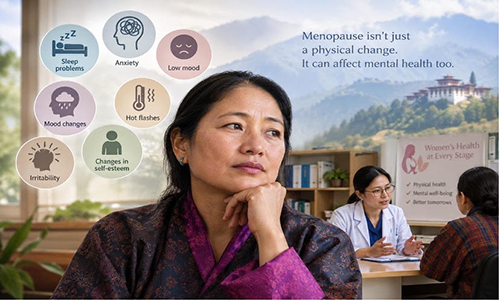
For some women, menopause is something they have read about, researched online and prepared for. For others, the changes begin without a clear understanding of what is happening to their bodies.
Some women learn about perimenopause, menopause and postmenopause through online searches, personal research and conversations about health. They may manage the changes through exercise, gym routines and a healthy diet.
But for women with little information, the experience can be confusing. Hot flashes, disturbed sleep, tiredness and mood changes may be put down to ageing or the demands of everyday life rather than recognized as possible symptoms of menopause.
The contrast raises an important question for Bhutan, how many women understand the changes they are experiencing, and how many go through them without knowing where to seek help?
Menopause is a natural stage of life, but its symptoms can affect women’s daily routines and quality of life.
A gynaecologist at the Military Hospital in Thimphu, Dr Cheni Zangmo, said hot flashes and sleep problems are among the most common symptoms, generally appearing around the 40s. The timing varies, and some women may notice symptoms as early as their mid-30s.
For women with limited information, recognizing these symptoms may not be straightforward.
A woman working long hours at a market, for example, might attribute tiredness and poor sleep to her workload. Another might experience mood changes without realizing they could be linked to menopause.
“Many women are not aware that the symptoms they experience may be related to menopause,” Dr Cheni said.
This does not mean women with less formal education know less about their bodies. Rather, it raises the question of whether women from all educational backgrounds have equal access to reliable information and appropriate healthcare.
Women who actively seek information may be better placed to recognize symptoms and understand what is happening. But access to information does not guarantee that symptoms will be recognized correctly or that medical care will be readily available.
For women with little knowledge of menopause, the first challenge may simply be understanding what it is and which symptoms warrant medical attention. This matters in a country where health professionals say many women may not link their symptoms to menopause.
It also shows the need for clear, accessible health information beyond online platforms, so that women with limited digital access, or those unfamiliar with medical terms, are not left behind.
When Physical Symptoms and Mental Health Overlap
Menopause can involve more than physical discomfort. Mood swings, anxiety and forgetfulness may also occur.
Speaking to The Bhutanese, Dr Ngawang Samten, a psychiatrist at the PEMA Centre, named mood swings, forgetfulness and anxiety among the psychological symptoms, and described hot flashes as a hallmark symptom.
“Doctors should maintain a high degree of suspicion that symptoms may be menopause-related when women are approaching the menopausal years, particularly in their late 40s and early 50s,” he said.
He said medical causes should be assessed when women have psychological symptoms, because treatment may differ depending on the underlying cause.
Women in their late 40s or early 50s who experience hot flashes should first see a gynaecologist before a psychiatrist, he said.
He added, “At Jigme Dorji Wangchuk National Referral Hospital, patients can be referred between departments through the electronic Patient Information System (ePIS).”
This coordination matters because anxiety and sleep disturbance can have different causes. Women should not assume every emotional change is due to menopause, just as menopausal symptoms should not be dismissed as ordinary ageing.
Recognising symptoms is only part of the challenge. Women must also know where to seek help.
Dr Cheni said health facilities are expected to receive education on menopause, including how to assess and treat women and when to refer them. “A menopause manual is yet to be published, and a dedicated menopause clinic is in the pipeline,” she said.
For now, women are generally assessed and treated according to their symptoms, particularly when these affect quality of life. Lifestyle changes are advised first, followed by non-hormonal treatment and, where appropriate, hormonal therapy. Tests are advised before treatment starts, especially hormonal therapy.
She said basic blood tests, including blood counts, liver and kidney function, blood sugar, lipid and thyroid tests, are available. Mammography and bone-density testing using dual-energy X-ray absorptiometry (DEXA) are also options.
Not every woman needs every test; it depends on individual circumstances and clinical assessment.
Protecting Long-Term Health
Declining oestrogen around menopause can accelerate bone loss and raise the risk of osteoporosis.
“Early menopause, low body mass index, physical inactivity and inadequate calcium and vitamin D intake are among the risk factors for weak bones. Smoking and alcohol use can also increase health risks,” Dr Cheni said.
She advised Calcium and Vitamin D, including supplements where appropriate, and said Shelcal, a Calcium and Vitamin D supplement, is available at health centres. Individual needs vary, so women should seek professional advice on supplements, bone-density assessment or other preventive measures.
Support at Home Matters too
Partners and family also play a role. “Men need to understand that menopause is a natural process and support their partners,” Dr Cheni said.
She stressed communication and mutual understanding between couples.
When symptoms are misunderstood, women may find it harder to explain what they are going through or ask for support. Clear information can help families see that changes in mood, sleep or physical comfort may call for patience and, sometimes, professional assessment.
Closing the Awareness Gap
A small number of interviews cannot establish whether education level determines awareness or access to treatment across the country.
Dr Cheni said, “There is currently no evidence or data available to support conclusions about whether women are more likely to seek care for physical symptoms than for mood or sleep-related concerns.”
She said recording menopause consultations in the ePIS could help build a better picture of women’s experiences. She also named integrating menopause care into routine healthcare, improving health professionals’ knowledge and raising public awareness as key steps to reducing stigma and encouraging women to seek help.
For women who have researched menopause, the challenge may be applying that information to their own health. For women with little information, the first step is recognising the changes and knowing that help is available.
Improving menopause care in Bhutan will take more than encouraging women to educate themselves. It will also take accessible information, trained health professionals, appropriate assessment and treatment, and support from families and communities.
Menopause is a natural stage of life, but women should not have to go through it without reliable information or the chance to seek care.