The Bhutanese Leading the way.
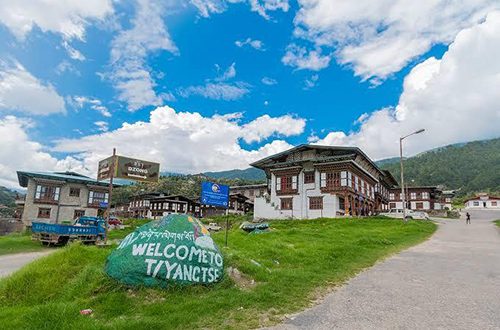
Project targets roads, pedestrian facilities, water services, utilities and sewerage across 17 urban centers, with activities scheduled from January 2027 to June 2028
The Ministry of Infrastructure and Transport (MoIT) has proposed a Nu 480 million (mn) project to develop and upgrade infrastructure in urban centers across seven dzongkhags, with interventions covering mobility, water services, utilities and other urban amenities.
According to the Initial Project Document prepared by the Department of Infrastructure Development and Department of Human Settlement under MoIT, the project will cover urban centers in Gasa, Zhemgang, Dagana, Lhuentse, Trashi Yangtse, Tsirang and Haa.
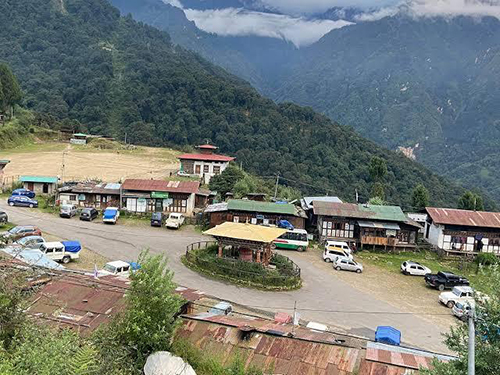
Gasa Town (Photo courtesy X)
The project profile lists its duration from July 2026 to June 2029.
The project is aimed at addressing infrastructure deficits in the selected urban centers, which the document identifies as important regional service and economic centers under the Comprehensive National Development Plan (CNDP) 2030.
The document states that the towns face inadequate road networks, pedestrian facilities, drainage, water supply, sanitation, public spaces and utility services.
The proposed interventions are intended to improve urban mobility, water services, green infrastructure and public utilities, while strengthening the functionality, resilience and livability of the urban centers.
The project is also aligned with the objectives of the 13th Five-Year Plan and CNDP 2030, including balanced regional development, improved service delivery, enhanced economic competitiveness and sustainable urbanization.
The project notes that population growth, business relocation and increasing tourism in the towns have not always been matched by the delivery of basic services such as road networks, drainage systems, public lighting, recreational spaces and sanitation.
It states that previous planning initiatives have provided a foundation, but implementation has remained incomplete in many areas.
The project therefore proposes priority investments based on approved Structure Plans and Local Area Plans.
The infrastructure interventions are organized around transportation and mobility, green infrastructure, water services and utility networks.
The project will cover a total population of 20,215 across 17.13 square kilometres.
The budget allocation for the seven dzongkhags is based 70 percent on population and 30 percent on area.
Dagana has the largest proposed allocation at Nu 87.65 mn for Dagana Town, Lhamozingkha and Dagapela Town, followed by Trashi Yangtse with Nu 86.36 mn for Trashi Yangtse Throm and Doksum.
Zhemgang has been allocated Nu 79.74 mn for Zhemgang Throm, Tingtibi and Pangbang Town, while Tsirang has Nu 79.01 mn for Damphu and Mendrelgang Town.
Haa has an allocation of Nu 64.02 mn for Haa Throm and Jyenkhana, Lhuentse Nu 51.60 mn for Phaling Town and Autsho Town, and Gasa Nu 31.62 mn for Gasa Throm and Damji.
The proposed works include development and upgrading of primary and secondary road networks, enhancement of pedestrian infrastructure, construction of utility ducts, sewer infrastructure and other amenities.
The project describes the cost framework as covering mobility, accessibility and urban resilience within the project areas.
Among the planned interventions, Gasa’s development plan focuses on preserving and enhancing its natural environment, with open spaces, play areas and greenery.
In Zhemgang, the structure plan prioritizes local area planning, recreational spaces, footpaths and drainage, while Panbang faces identified needs in road connectivity, water supply, drainage and waste management.
In Dagana, the Dagapela planning area is envisioned as a polycentric settlement with emphasis on road and pedestrian connectivity, open spaces, drainage, sewerage, water supply and solid waste management.
Lhuentse’s proposed interventions include widening the main road with side footpaths and drains, four sections of new roads, open spaces and a pedestrian bicycle trail.
For Trashi Yangtse, the Structure Plan identifies growth zones while providing essential infrastructure such as roads and footpaths, with development to be carried out sensitively considering the habitat of the black-necked crane.
In Tsirang, the Damphu Structure Plan prioritises road networks, open spaces and amenities.
In Haa, proposed interventions include conservation of streams through green buffers and walkways, deweeding and de-silting of streams, construction of loop roads to improve interconnectivity and green spaces along roads.
The Department of Infrastructure Development will be the lead implementing agency, with an existing division under the department entrusted with project management and implementation.
Dzongkhags and Regional Offices for Infrastructure Development will participate in prioritizing activities during preparation of the Detailed Project Report.
The document states that comprehensive needs assessments and stakeholder consultations will be conducted while finalizing activities.
The Department of Human Settlements will support design vetting, review of urban plans and preparation of urban design proposals.
The project objectives include transforming urban services and strengthening the towns as centres of commerce and economic activity, boosting regional economic growth, promoting pedestrian-oriented transportation and walkability, enhancing urban livability, increasing infrastructure resilience and strengthening the integration of land use and mobility.
The document states that the activities are scheduled to be completed between January 2027 and June 2028, depending on mobilization of resources.
Of the total Nu 480 mn, Nu 275.65 mn is proposed for fiscal year 2026–27 and Nu 204.35 mn for fiscal year 2027–28.
For FY 2026–27, the highest proposed allocation is Nu 70.12 mn for Dagana, followed by Nu 63.20 mn for Tsirang and Nu 51.22 mn for Haa.
Gasa’s entire Nu 31.62 mn allocation is proposed for FY 2026–27, while Zhemgang, Trashi Yangtse and Lhuentse have larger portions of their allocations scheduled for FY 2027–28.