The Bhutanese Leading the way.
A blockchain project involving 21 households in Rukha village under Athang Gewog, Wangdue Phodrang is exploring how digital technology could support rural transactions and address community needs.
However, its practical applications and potential benefits for residents have yet to be determined.
Known as Project Digital Village, the initiative brings together Singapore-based digital asset infrastructure firm Qore3, Gyalpozhing College of Information Technology (GCIT), Tarayana Foundation and Switzerland’s Lucerne University of Applied Sciences and Arts.
The project will explore digital wallets and a community-based token model linked to services and practical benefits within the village.
A GCIT project member said the broader aim is to develop a system that delivers practical benefits to residents by improving access to services and creating value within the community.
However, any direct financial or other benefits will depend on the system’s final design, implementation and outcomes.
The project is still in its research and planning phase, with full implementation expected to take approximately two years, according to a GCIT project member.
Researchers are gathering information and identifying areas where digital technology could address community challenges. Their findings are being discussed with international partners to identify practical solutions suited to Rukha’s needs.
GCIT President Audrey Low said the initiative aims to simplify blockchain technology and make technology education more accessible.
“The goal of Project Digital Village is to simplify the technology and make education and tech inclusion accessible to everyone, creating social impact at the edge of a fast-moving digital economy,” she said.
Fieldwork began in August 2026, when researchers from GCIT and Tarayana Foundation, accompanied by Low and Qore3 Head of Partnerships Jeffrey Cheong, visited Rukha to assess community needs and existing practices.
In a conversation with The Bhutanese, Athang Gup Dawa Gyeltshen said aquaculture and livestock farming are the village’s main sources of livelihood.
He welcomed the researchers’ visit and agreed to the project, adding that he regularly receives calls and inquiries from various institutions proposing development initiatives for the village.
He said, “I remain open to supporting initiatives that could benefit the community,” expressing gratitude to the Tarayana Foundation for its longstanding support for the village.
The initiative builds on a partnership between Qore3 and GCIT that began in early 2025, focusing on capacity development, curriculum design and talent recruitment.
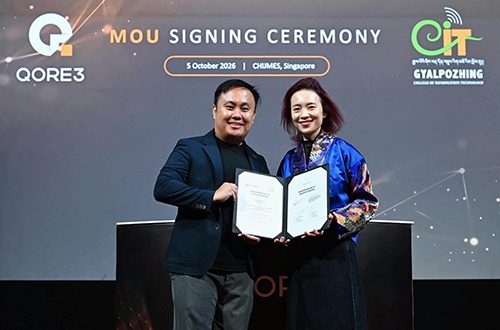
The two organisations formalised their long-term partnership through a memorandum of understanding (MoU) signed on 5th October 2026, during TOKEN2049 Week in Singapore. The signing took place at Digital After Hours, a networking event hosted by Qore3 at CHIJMES.
The partnership aims to advance blockchain education, applied research and the development of blockchain solutions in Bhutan.
GCIT students and researchers are involved in preliminary research and data collection and are expected to contribute to the development and evaluation of the proposed system.
GCIT said its immediate priority is to develop a functional prototype to demonstrate how the system could work. The duration of the pilot and the measures for evaluating its success will be refined as the implementation plan develops.
Whether the initiative will deliver tangible benefits to Rukha households will depend on the system’s final design and its ability to address the community’s needs.