The Bhutanese Leading the way.
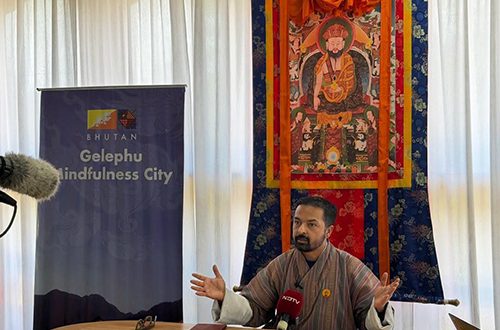
As global demand for artificial intelligence infrastructure surges, Bhutan is positioning its flagship Gelephu Mindfulness City (GMC) to capture an unserved regional market for AI computing, leveraging its zero-thermal green power grid and geopolitical trust to serve as South Asia’s primary digital compute vault.
Speaking at a press briefing in Gelephu, Ujjwal Deep Dahal, Chairman of the Gelephu Investment Development Corporation (GIDC) and CEO of Druk Holding and Investments (DHI), framed the shift into computing power not merely as a tech venture, but as an imperative for national self-reliance.
“Your sovereignty will depend on how well you compute for yourself, and economic independence will also depend on how we can position ourselves to compute for the masses,” said Ujjwal Deep Dahal, pointing to the deep geographic imbalance in global cloud infrastructure where nearly 90 percent of data centers remain concentrated in Western and Nordic countries.
With South Asia rapidly expanding its digital footprint while lacking sufficient localized, low-carbon data infrastructure, GMC aims to bridge the gap. Ujjwal Deep Dahal noted that capturing even 2 percent to 5 percent of the region’s surging computing requirements would represent a transformative economic leap for Bhutan.
The Chairman said that he would like to pitch European and international partners to invest in setting up data centers and model training hubs within GMC. The city’s unique selling proposition centers on competitive green energy rates, political stability, and high operational trust, as key parameters for international firms seeking latency-tolerant compute environments and training data facilities.
Rather than selling raw electricity across borders as an unrefined commodity, Bhutan intends to use its energy assets directly as a digital enabler.
“AI is the tipping point of the economy. It’s an AI era, and GMC is an instrument to leap into the future,” said Ujjwal Deep Dahal, outlining how the country’s existing economic foundations such as hydropower and tourism will be funneled into an innovation-driven circular economy in constant partnership with the RGoB and DHI.
Powering high-density server racks requires vast amounts of energy, an area where Bhutan holds a distinct natural advantage. Bhutan currently operates its renewable energy sector fed by runoff-the-river hydropower, with an ambitious target to scale capacity to 20 gigawatts (GW) by 2040, requiring an estimated capital inflow of over USD 26 billion.
To support capacity for heavy AI computing workloads during seasonal low-water winter months, DHI and the Druk Green Power Corporation (DGPC) are expanding beyond hydro.
DHI is currently exploring alternative energy sources, including geothermal energy in collaboration with partners in Iceland and Kenya, alongside green hydrogen and ammonia to meet growing regional energy demand.
Meanwhile, digital asset operations such as Bitcoin mining continue to serve as economic batteries and long-term treasury stores. By converting excess summer hydropower into non-depreciative, non-inflationary assets, the mining operations offset thermal power generation globally while generating revenue to finance broader computing infrastructure. Anchor investors like Bitdeer are already anchored in the country’s early-stage digital asset strategy.
Despite the rapid influx of global tech interest and capital raising which includes domestic and diaspora bonds, Ujjwal Deep Dahal emphasized that GMC will remain anchored in the principles of Gross National Happiness (GNH) and must continue to do so.
Strict accountability frameworks, anti-money laundering (AML) controls, and transparent capital tracking are being established to ensure the city scales ethically. The most recent development being His Majesty’s Royal Decree for empowering the Gelephu Central Bank.