The Bhutanese Leading the way.
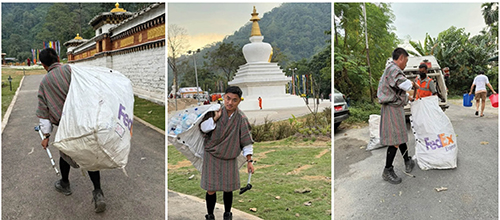
While thousands gathered in Gelephu to witness the historic raising of the 108 Jangchub Chortens, Gembo found himself drawn to something others might have overlooked; the waste/trash left behind.
Despite being unwell, he picked up his waste-picking stick and began cleaning the sacred sites, eventually carrying a large bag of trash back to town for proper disposal. For someone who has spent years turning waste collection into a personal mission, leaving the place dirty was simply not an option.
“I came from Nabji in central Bhutan, under Trongsa, to western Bhutan to ‘waste my time on waste’,” said Gembo, reflecting on a journey that he describes as both difficult and funny.
While some people laughed at his efforts, Gembo says he never regretted spending his time collecting waste. Today, he believes that his initiative has encouraged more individuals and groups to take up similar activities.
His concern for waste management began in 1998, when he worked as a tour guide. Over the years, he noticed increasing amounts of waste, particularly at tourist destinations such as Taktsang (Tiger’s Nest), as development brought changes to the country’s landscape.
Tourists often visit Bhutan for its clean and largely untouched environment. “The first word we hear from tourists is, ‘Wow! Your country is beautiful,’ ” he says.
Wanting visitors to continue experiencing a clean Bhutan, Gembo began clearing waste at tourist sites without drawing attention to himself. He recalls that some of his fellow tour guides would hide while he collected trash, while others accused him of showing off or trying to earn better tips from tourists.
His approach to the issue changed when a guest, who was the founder of Happyness, noticed him collecting waste and encouraged him to share his activities on social media.
Around the same time, he watched a local television program featuring Her Majesty the Gyaltsuen Jetsun Pema Wangchuck, the Patron of the Environment, and a Lopen participating in a cleaning campaign in town.
“That was when I said, ‘OK, now I will post every Saturday and do a cleaning campaign every Saturday,’ ” he recalled.
On 27th June 2019, Gembo began documenting his cleaning activities on social media, turning what he jokingly calls his time spent on waste into a regular public initiative.
He chose Saturdays because people generally have free time to participate during the weekend. Since then, he has continued taking his waste-picking stick and collection sacks to different places, collecting rubbish and ensuring that it reaches the proper disposal site.
One of his significant experiences was travelling across all 20 dzongkhags, carrying out cleaning activities and advocating for a cleaner environment in 94 days. He recalls covering the country from east to west and north to south, working in both freezing conditions and extreme heat.
“I feel a little proud about walking through 20 dzongkhags, cleaning and advocating, in 94 days,” he says.
His efforts also received recognition, including two awards from the Department of Tourism during World Tourism Day. He says the recognition was particularly meaningful because it was aimed at encouraging a change in the mindset of the younger generation.
However, his work has not been limited to tourist destinations. During the recent 108 Jangchub Chortens event in GMC, he saw an opportunity to extend his efforts to a major religious gathering.
Gembo says he initially remained quiet when he learned that several government and private agencies were planning cleaning campaigns. He was pleased to see more organizations taking up the issue of waste management.
Gembo offered to volunteer to clean the entire 108-stupa area after events, but GMC officials said they were more concerned about who would maintain the site once the gathering ended.
At the time, Gembo says he was not feeling well. He had gone towards the first stupa simply to make a wish, but the sight of trash around the area prompted him to start collecting it.
“I found lots of waste, and I couldn’t stop myself from clearing it up,” he says.
Despite his condition, he continued collecting rubbish, eventually carrying a large bag of waste back to town and disposing of it in a garbage truck.
Interestingly, he says he felt better after the cleaning activity, despite initially being unwell.
He subsequently shared the experience on Facebook and TikTok, hoping that the post would raise awareness and encourage people to be more responsible about waste disposal.
“One thing we Bhutanese have is a habit: when we see someone doing good or bad, we do it too. What I mean is that we Bhutanese need a wake-up call, and then we do it,” he said.
Following his post, he noticed people asking about those involved in the cleaning activity. One woman even offered to provide him with bags for collecting waste, although he was unable to meet her personally.
He says such responses encourage him to continue his work.
Gembo also has a group called CleanWave, which was approved by Thimthrom. However, he said most of his cleaning activities are still carried out alone because of limited financial resources.
“When I get funds, I go with my group, but mostly I go alone because there is no fund,” he says.
The expenses include purchasing collection sacks and waste-picking sticks, as well as providing refreshments and lunch for volunteers. These costs, he says, make it difficult to organize activities regularly with a group.
Despite the financial challenges, Gembo remains committed to his initiative. He believes that raising awareness is as important as collecting waste and that people need to understand their responsibility towards the environment.
“I feel hurt and sad to see people littering,” he said, adding that religious leaders, particularly high lamas, could also play an important role in educating the public.
He believes that even a brief message from respected religious figures before religious gatherings could encourage devotees to be more mindful of their surroundings.
For future religious events, he hopes to continue organising cleaning and awareness activities, particularly because such gatherings bring large numbers of people together.
Next year, he plans a 108-day walk combining cleaning, awareness and adventure.
He remains optimistic about the country’s environmental future and believes that more people are gradually becoming involved in keeping Bhutan clean.
“Don’t worry, Bhutan, our country will be clean soon under the guidance of His Majesty. But people of Bhutan too should be active and aware of it,” he said.
As GMC aspires to become a green and clean city, Gembo believes that such a vision will require more than infrastructure and development. It will depend on the everyday actions of individuals and the collective responsibility of communities to protect their surroundings. For him, the cleaning efforts during the 108 Jangchub Chortens should not end with the event but become a continuing commitment to keeping the sacred site and the city clean.
He hopes more people, particularly young Bhutanese, will take ownership of their environment and contribute to building the kind of clean and mindful city GMC envisions.