The Bhutanese Leading the way.
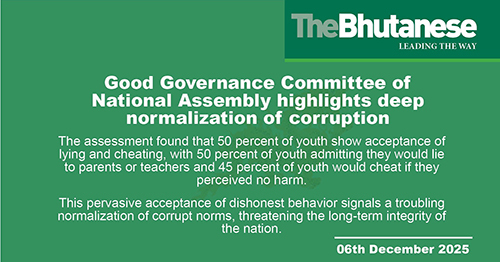
Review report on Anti-Corruption’s Annual Report 2024-2025 by the Good Governance Committee (GGC) to the Fourth Session of the Fourth Parliament reveal a worrying trend of cultural normalization of corruption in Bhutan, suggesting the issue is becoming deeply embedded in daily life, and posing a significant threat to future national integrity.
The challenge extends beyond traditional misconduct, with surveys indicating that a large portion of the citizenry is now “accustomed” to corrupt practices, and half of Bhutan’s youth demonstrate acceptance of dishonesty.
As per the report, despite stronger laws and improved global rankings, corruption in Bhutan is becoming more embedded in daily life. Public perception of corruption has risen sharply over the last decade, jumping from 14 percent in 2012 to 38.3 percent in 2022.
Crucially, the National Integrity Assessment (NIA) 2022 confirms that 39 percent of citizens now report being accustomed to corruption.
This growing tolerance stems from a persistent gap between policy reforms and actual behavioral change.
Corruption is increasingly driven by abuse of function. Favoritism, nepotism, and patronage making up 45.6 percent of ACC’s reports, followed by embezzlement 20.8 percent.
Access to services often depends on personal networks (friendship 22.47 percent, family 17.33 percent, orders from superior’s 16.04 percent), making informal influence a normalized part of bureaucracy.
Also, gift-giving is accepted as “customary” up to 45 percent.
The most alarming indicator of intergenerational transmission of corrupt norms comes from the Youth Integrity Assessment 2022. Recognizing that nearly half of the country’s population is youth, the ACC has focused on these critical behavioral findings.
The assessment found that 50 percent of youth show acceptance of lying and cheating, with 50 percent of youth admitting they would lie to parents or teachers and 45 percent of youth would cheat if they perceived no harm.
This pervasive acceptance of dishonest behavior signals a troubling normalization of corrupt norms, threatening the long-term integrity of the nation.
To combat this trend, the ACC has reinforced its prevention efforts through value-based education and behavioral change programs. These strategies aim to foster integrity-based behaviors across all age groups.
Key prevention measures include the Youth Integrity Program (YIP). This program is under the DAMTSI framework (Developing Accountable and Moral, Trustworthy and Successful Individuals).
Additionally, the DAMTSI Activity Book has been integrated into the Early Childhood Care and Development (ECCD) framework for children aged 2 to 5.
A national evaluation of this integration showed high uptake, with 92 percent of centers and 85 percent of facilitators utilizing the material. These efforts have shown positive behavioral outcomes related to honesty, responsibility, and fairness.
DAMTSI Handbook for Scouts is now part of national scouting training (from Classes V, VII, IX) and top Class IX scouts earn the DAMTSI Badge for ethical leadership.
Integrity Clubs have also been established in 21 schools across all dzongkhags to promote accountability and transparency.
For youth in tertiary institutions (ages 18-24), ACC has introduced a Leadership Course on Integrity, Accountability, and Transparency at the College of Natural Resources (CNR). Enhanced Ethics, Integrity, and Professionalism modules for Technical Training Institutes (TTIs), supported by refresher courses and detailed lesson plans.
Furthermore, for youth not in Education, Employment, or Training (NEET) ACC has collaborated with MoESD to conduct ToTs for NEET training manuals. Youth center sessions in Paro and Phuentsholing emphasized real-world integrity challenges, positive role modelling, and joint monitoring.
GGC stresses the urgency of integrating ethics, integrity, and anti-corruption principles across the national curriculum and public service frameworks to address the normalization of corruption.