The Bhutanese Leading the way.
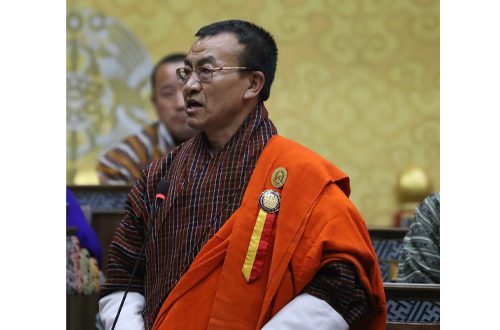
The Financial Services Amendment Act of Bhutan 2025 was introduced as an urgent bill in the National Assembly on Friday.
Lyonpo Lekey Dorji, the Finance Minister, said that the rationale for the amendment is grounded in regulatory alignment, fair competition, private sector development, alignment with international practice, and the introduction of prudential safeguards.
On regulatory alignment, Lyonpo said the amendment will align the Financial Services Act of Bhutan 2011 with the Foreign Direct Investment Rules and Regulations 2025, which permit direct insurance business to be conducted on a composite basis covering both life and non-life insurance. He said aligning the primary legislation with the investment framework will address regulatory inconsistency and enable coherent licensing and supervision.
On fair competition, Lyonpo Lekey Dorji said treating new and legacy insurers equally will create a level playing field, promote healthy market competition, and incentivise the development of diverse and innovative insurance products, ultimately benefiting consumers.
On private sector development, Lyonpo said the Bhutanese insurance market is small and that maintaining two separate legal entities for life and non-life lines may be inefficient and may hinder entry, scale, and product innovation. He said allowing composite insurers, under strict prudential safeguards, is a proportionate response to the market context.
On alignment with international practice, the Finance Minister said that while international best practice generally favors legal separation of life and non-life insurers, small or developing markets still allow composite insurance with prudential safeguards. He said given Bhutan’s market size and investment objectives, a calibrated permission for composite insurers subject to strict prudential conditions is justified and is in the public interest.
On prudential safeguards, he said the amendment introduces ring-fencing, solvency, and governance requirements to prevent contagion between life and non-life business lines.
Under the current provisions of the Financial Services Act of Bhutan 2011, Section 251(b) states that an insurer shall be restricted to writing either general or life insurance business, except where the general insurer’s life business is limited to reinsurance or the life insurer’s general business is restricted to accident and health. Section 251(c) states that companies already doing business of both kinds before the enforcement of the Act, referred to as composite companies, may continue to do so, provided they maintain separate book-keeping and accounting for life and non-life insurance operations and take appropriate steps to ensure that life insurance policyholders are not at risk from losses in the non-life sector and vice versa. The Act restricts insurance companies from engaging in both life and general insurance, except for those that existed prior to its enactment.
The National Council of Bhutan had earlier deliberated on the need to review this provision to align with the constitutional mandate of fostering private sector development through fair market competition under Article 9, Section 10 of the Constitution of the Kingdom of Bhutan. This regulatory restriction is viewed as creating an uneven playing field where legacy insurers enjoy broader business opportunities while new entrants are restricted to either general or life insurance. This market asymmetry is seen as posing several risks, including limiting fair market competition, constraining product innovation, and reducing private sector participation.
Member of Parliament (MP) Lhendup Wangdi of Bji Katsho supplemented the Finance Minister and said that he supported this decision. He said that when the country is developing, Acts should also be reviewed and sections that need to be amended should be changed, and that this amendment will help the private sector, which will in turn help the country as a whole.
However, MP Loday Tsheten of Gangzur Minjey and MP Tempa Dorji of Meanbi Tsaenkhar said that while the need for amendment was very important, they questioned whether the Bill qualified as an urgent bill.
The Finance Minister then explained that it was a pressing issue since people who had life insurance and received Nu 30,000 said that the government needed to increase the insurance coverage to Nu 150,000 as the amount was not enough, and that this was a matter of public interest and would benefit them.
The Bill was passed as an urgent bill and handed over to the Economic and Finance Committee, which has been asked to present the review report on 10th December during the third reading of the Bill.