The Bhutanese Leading the way.

During the FY 2024-2025, the ACC received a total of 364 corruption reports, averaging 30.3 per month, which is an increase from the previous year’s monthly average of 26.8. Out of 364 corruption reports recorded, 204 (56%) were from known sources and 160 (44%) were anonymous.
In terms of the mode of reporting, website was the most utilized channel, accounting for 166 reports, followed by walk-in with 100 reports.
Whereas, My ACC App and telephone were the least used, with 12 (3.30%) and seven (1.90%) reports respectively, indicating either limited awareness or usability issues with these modes.
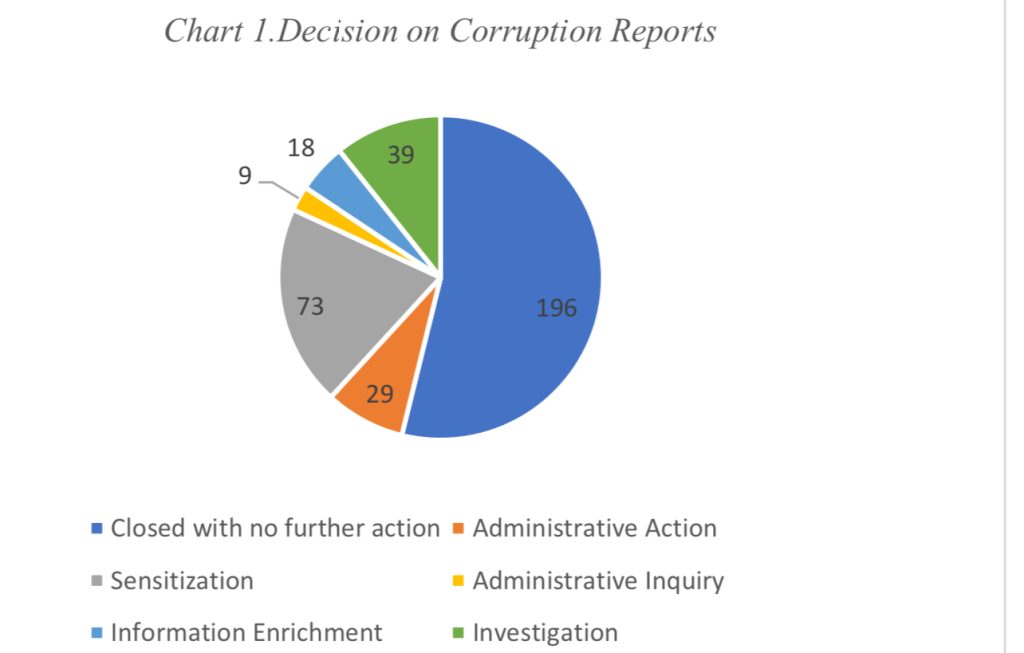
Out of 364 corruption reports received during the reporting year, 196 were closed with no further action. Out of remaining 168 reports, 39 corruption reports qualified for investigation, 29 shared for administrative action, nine shared for administrative inquiry, 73 shared for sensitization, and 18 shared for information enrichment.
By area, finance was the most reported, with 57 out of 168 corruption reports followed by procurement & contract with 33 reports and public property with 24 reports.
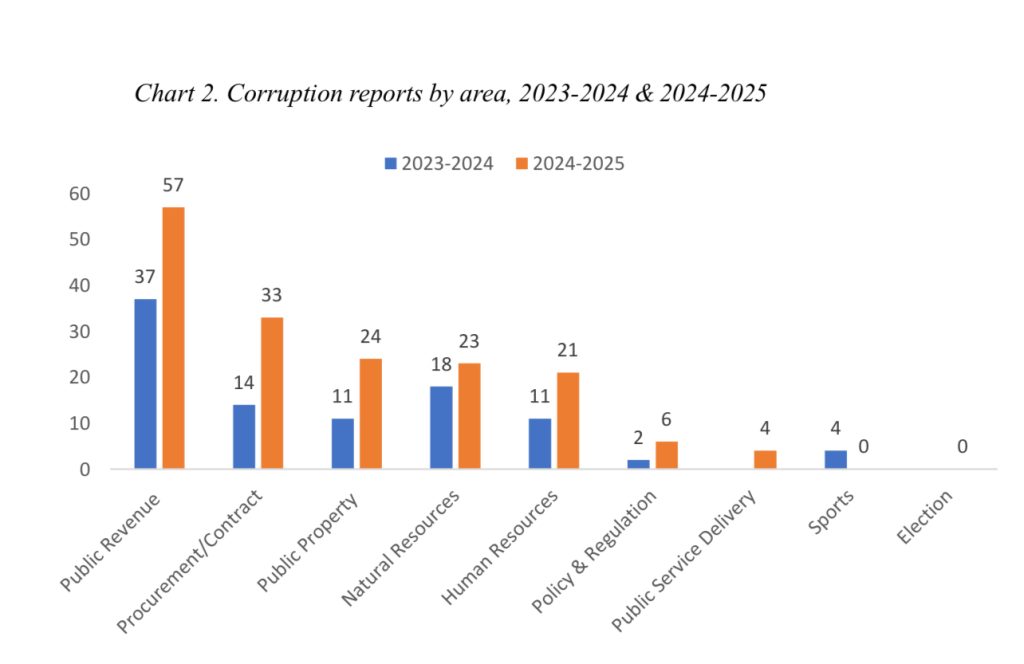
The above graph shows a noticeable increase in corruption reports in 2024-2025 compared to 2023-2024 across most areas, with the highest numbers in Public Revenue followed by Procurement/Contract. Public Property and Natural Resources also reported significant rises. In contrast, sectors like Sports and Election registered very few or no reports.
Corruption reports across various agencies during the reporting year show notable differences, indicating varying degrees of vulnerability or levels of scrutiny. Ministries registered the highest number with 46 reports, followed by gewog administrations with 32 reports, private sector with 23, and dzongkhag administrations with 21 reports. In contrast, constitutional offices recorded two reports followed by religious organizations with one report, which indicates either genuinely lower exposure to corruption risks or potential underreporting.
By offence, among the 168 corruption reports warranting action during the reporting year, the majority involved abuse of function with 86 reports, highlighting the persistent misuse of official authority for personal gain. This was followed by embezzlement with 32 reports and bribery with 18 reports, reflecting financial and transactional forms of corruption.
Identifying the place of occurrence, Thimphu recorded the highest number of corruption reports, followed by Paro, Samtse, Chhukha and Mongar, while Gasa and Pemagatshel reported none. Likewise, by profession, majority of the corruption reports involved civil servants, accounting for 71 reports, followed by the local government functionaries and corporate employees, accounting for 33 reports and 17 reports respectively.
During the reporting year, 22 corruption reports qualified for the information enrichment, including three assigned from the corruption reports shared for administrative actions to various agencies and one upgraded from sensitization. Of these, three were shared to relevant agencies for further action, one each was upgraded for investigation and administrative inquiry, and 17 were closed with no further action. Similarly, from the total of 102 corruption reports qualified to be shared with the agencies, 29 were shared for administrative action and 73 for sensitization.
During the reporting year, a total of 11 administrative inquiries were assigned, including one upgraded from information enrichment and another from the intelligence project. Among the 11 inquiries carried out, most related to finance, followed by cases involving human resources, public property, and procurement and contracts. Administrative or disciplinary actions were imposed in four cases, while systemic corrections or rectifications were initiated in six others and one case progressed to a full investigation, thereby completing all the administrative inquiry reports.
Regarding the Action Taken Report (ATR), 22 ATRs were received from the 29 shared during the reporting year. 16 were found valid, two were partially true, and four were found to be baseless.
At the end of the reporting year, a total of nine ATRs were not received from various agencies, marking a significant reduction from 22 in the previous year.
In terms of the investigation, a total of 40 corruption reports qualified for investigation, including one upgraded from the information enrichment. Of the 40 reports qualified for the investigation, 26 pertained to finance, followed by 10 in procurement and contracts. In terms of offence, 19 pertained to embezzlement, followed by 16 in bribery, and three in abuse of function.
By agency, ministries had the highest with 12 corruption reports qualified for the investigation, followed by the dzongkhag administration with 11 reports. The majority of the corruption reports qualified for the investigation were from Paro Dzongkhag, with 14 reports, followed by Thimphu Dzongkhag with six reports. By profession, majority of the report qualified for investigation pertained to civil servants with 23 reports, as they typically hold significant discretionary power over public resources and services, creating numerous opportunities for corrupt practices.
With regard to referral from the Royal Audit Authority, ACC received a total of four referrals related to suspicious fraud and corruption, out of which one was closed and three were not yet assigned.
Investigation and Its Outcome
There was a total case load of 61- 39 new cases were opened during the reporting year and 22 cases carried over from the previous year. Of the total case load, 39 cases were closed, resulting in a clearance rate of 63.93%. The average turnaround time for completing a case improved to 51.09 working days from 54.7 days in the previous year. Of the 39 cases completed, 26 were forwarded for prosecution, eight referred to agencies for administrative or disciplinary action and five closed with no further action.
A total of 485 individuals were implicated, excluding repeated appearances in the same case. The majority of the individuals involved were private employees, with 346 offenders, followed by civil servants with 42 offenders. Similarly, by agency majority of the offences were committed by the private sector, with 366 numbers. By gender, the majority of the offenders pertained to males,
with 441 (90.93%) cases compared to 44 (9.07%) female offenders.
During the reporting year, a total restitution prayed by ACC and court orders against the cases investigated and prosecuted amounted to Nu.57.574 million and 0.493 acres of land.
Proactive System Study
In the reporting year, ACC conducted proactive system study on Bhutan’s tourism sector to assess the potential corruption risk and systemic gaps. Some of the key findings include lack of system integration among key agencies (DoI, DoT and DRC), bribery and favoritism risk in licensing and certification, risk of SDF and tax evasion and embezzlement and favoritism in tourism development and marketing among others. Similarly, highlight of a few cases investigated during the reporting year includes misappropriation of monument fees and corruption in the engineering cell of Paro Dzongkhag administration.
Field Observations
Prolonged investigation hampers organizational performance because there is no replacement when the alleged person is under suspension.
A person being enquired by ACC officials feels intimidated and harassed. The enquiry method is often top down and therefore, a person under enquiry does not feel comfortable to share the required information effectively.
Any person or business entity if proven innocent after investigation, feels defamed and psychologically down when the act of innocence is not declared publicly.
Normalization of corruption is rampant during the time of election. The fines and penalties imposed by the ECB is found to be a bare minimum.
Challenges
Increasing Complexity and Normalization of Corruption
Public perception of corruption has risen sharply, driven by widespread abuse of function, reliance on personal networks for services, and the normalization of informal payments and gift-giving.
This is further reinforced by rationalization (everyone does it) and socialization (new officials being inducted into corrupt practices).
Poorly Resourced Law Enforcement Agencies (LEAs)
Law enforcement agencies play a vital role in enforcing compliance, detecting violations and safeguarding the rule of law. However, law enforcement agencies particularly in the high-risk areas face a growing corruption risk undermined by structural, economic, and institutional weaknesses.
For instance, evidence suggests that many of the officials in the high-risk LEAs earn barely above the subsistence threshold leaving them vulnerable to corruption risk.
Poor Attraction and Retention of Talent for Operational Continuity
A recurring institutional challenge is the ACC’s difficulty in attracting, retaining, and developing skilled professionals exacerbated by contract-based employment, limited career progression, and competitive job markets. This threatens long-term operational continuity and institutional stability.
For instance, since its inception a total of 170 out of 319 staff have exited – 76.71% through resignation and 19.86% through lateral transfers, peaking at 20.95% attrition in 2010 and 17.9% in FY 2023–2024.
Recommendations
The committee reiterates ACC’s observations and strongly recommends the following:
Strengthen public sector ethical resilience through continuous value-based education, enhance preventive systems in the high-risk sectors such as procurement, construction, licensing, contract management, and public finance and promote whole-of-society engagement. Further, introduce effective integrity tools such as risk mapping, behavioral insights, proactive vulnerability scanning and promote a culture of zero tolerance.
Support adequate funding and resources to ACC, RBP, OAG, Judiciary and allied law enforcement agencies to invest in specialized capabilities such as digital forensics, surveillance technology, financial investigations, forensic accounting and intelligence analysis. Similarly, strengthen inter-agency collaboration framework to reduce delays in referrals and prosecutions and enhance regional presence or outreach to respond promptly to corruption risks across all dzongkhags.
Expand integrity programs across schools, universities, and local governments. Utilize behavioral insights and community – driven approaches to foster an ethical culture.
Enhance its ongoing advocacy and interactive sessions to outreach greater awareness and embed anticorruption values among the larger sections of the society.
Media must be protected from exposing corruption. Strengthen legal framework and collaboration between the media, ACC, OAG, Judiciary, CSOs and other oversight bodies to ensure coherent, ethical and factual reporting of corruption cases.