The Bhutanese Leading the way.
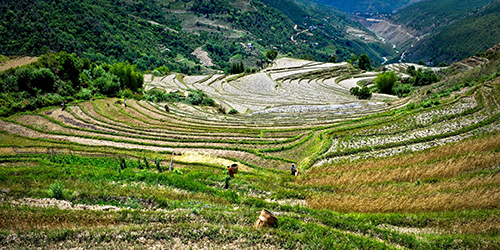
As Bhutan embarks on its ambitious 13th Five-Year Plan, the Asian Development Bank (ADB) has reaffirmed its commitment to revitalising the nation’s agrifood systems, viewing the sector as a cornerstone for achieving high-income status. Central to this effort is ADB’s strategy to catalyze private sector co-financing, positioning the bank as a catalyst for broader investment in the sector.
In a recent detailed update on the bank’s investment strategy, ADB officials highlighted a shift from traditional farming support to a comprehensive “farm-to-table” approach designed to bolster climate resilience, export potential, and private sector participation.
Aligning with National Goals
The ADB’s current roadmap is guided by its Country Partnership Strategy 2024-2028, which focuses on fostering inclusive and job-creating growth. The South Asia Director of the Agriculture, Food, Nature, and Rural Development (AFNR) Sector Office, Takeshi Ueda, explained that this strategy is meticulously aligned with the Royal Government of Bhutan’s own development priorities.
“ADB’s support to Bhutan’s agrifood and agricultural industry helps Bhutan achieve this growth,” Ueda stated, noting that the bank has been a partner in the sector since the 1980s.
While the government’s current programming request is focused mainly on energy and transport projects, ADB has made clear it stands ready to work closely with the government to catalyze co-financing, including from the private sector, to fill the gap. Ueda emphasized the economic necessity of this focus: “Scaling up the agrifood sector in value is imperative to transform Bhutan into a high-income country, given the high proportion of rural population”.
The Potato Blueprint and the AgriSustain Fund
Concrete steps are already being taken on the ground. In 2025, the ADB approved a USD 3 million grant, funded by the Japan trust fund, specifically to develop the potato value chain. This project serves as a litmus test. If successful, it could pave the way for scaling up similar investments and attracting new financing into the sector
The bank is also supporting innovative financing mechanisms. Following a visit to ADB headquarters in March 2026 by Prime Minister Dasho Tshering Tobgay, the bank began preparing a technical assistance project to support the establishment of the Bhutan AgriSustain Fund (BAF).
This fund is designed to mobilize funding for private businesses and primary producers to scale up commercialisation and promote high-value exports. Ueda suggested these products could be uniquely branded as coming from a “nature-positive and carbon-negative country”.
A Multi-Billion Dollar Regional Transformation
Bhutan’s agricultural evolution is part of a much larger regional movement. ADB President Kanda recently announced a USD 40 billion corporate-level commitment to transform agrifood systems across Asia and the Pacific between 2022 and 2030.
According to Ueda, this investment goes far beyond simply planting crops. “ADB’s investment in the agrifood sector is not limited to the traditional sense of agriculture,” he said. “It works as systems that encompass the entire agrifood value chains from farm to table, and natural resources and ecosystem that those activities depend on and also impact”.
The Way Forward
Looking toward the long term, ADB is moving away from country-specific, fragmented planning in favour of a regional “landscape approach”.
At the Food Systems Forum in March 2026, the bank introduced the “Resilient Livelihoods from Ridge-to-Reef Initiative (ReLIVE)”.
This initiative recognises Bhutan’s critical role as part of the Hindu Kush Himalaya, Asia’s “water tower”. This region provides fresh water to ten major river systems, sustaining billions of lives and vast ecosystems.
Ueda pointed out that as climate change intensifies, Bhutan’s management of these resources becomes a regional responsibility.
“ADB recognizes that Bhutan’s sustainable management of natural resources, particularly water resources and ecosystems that sustain them, will become increasingly important not only for Bhutan, but also for downstream countries such as India and Bangladesh,” he noted.
As part of this regional effort, the ADB continues to facilitate dialogues within the South Asia Subregional Economic Cooperation (SASEC) framework, ensuring that agrifood systems remain a top priority for collective regional growth.