The Bhutanese Leading the way.
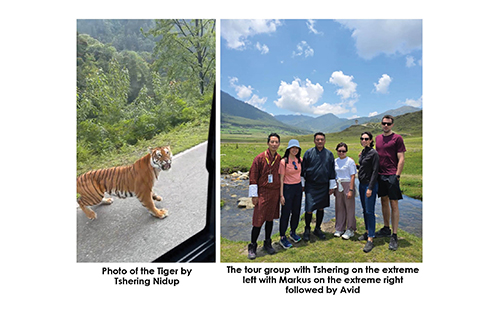
On 31st May at around 4 pm, a 33-year-old tour guide, Tshering Nidup, was travelling in a Toyota Hiace with four tourists and a driver from Bumthang to Phobjikha in Trongsa. About a five-minute drive from Chendebji Chorten, they encountered a tigress and her cub on the road.
A 38-year-old German tourist, Markus, who works in real estate said, “We drove past the stupa and down the road, and something jumped out of the jungle right on the road 100 meters in front of us. We thought it was some kind of monkey but when we got closer, we saw it was a tiger.”
“We saw it, and as we passed by it, the tiger got quite aggressive and it started roaring and charging at us. We got quite scared as we thought it would jump at the car, break through the window glass, and get in, and we quickly drove off to avoid making the tiger any angrier. It lasted around 10 to 15 seconds.”
Markus said the tiger was aggressive as it was a mother tiger defending her cub since Tshering saw a cub waiting above the road.
He said none of them had ever seen a tiger in the wild, and they had even asked among themselves whether anyone had seen one before.
“It was definitely quite different from a zoo experience and completely random,” added Markus.
Avid (41) originally from Iran and working in marketing in London said, “We came with friends to enjoy the beautiful valleys and scenery, and seeing the tiger was extra special. We thought it was a monkey jumping on the road from a distance but it was too big, and then we saw it was a tiger. The tiger was trying to go below the road and its cub hidden in the bushes above was supposed to follow. It saw us and got aggressive and we were all screaming in the vehicle.”
He added, “I was hoping to see a tiger, but it is very rare and people rarely ever get a chance, and so I am really happy we saw one. We had to run away in the car as the tiger was getting aggressive due to its cub,”
Tshering said that he saw the cub hidden in the bushes above the road as they passed by which explains the aggression of the tigress.
Tshering contacted the Wangdue forest office about the tiger sighting, and at the time he was advised to remove his viral video from online platforms as the fear was that possible poachers may come by. He did it but other had downloaded his video, and it so it still went viral.
A bus full of scouts also reported seeing a tiger and a cub around the same time period in the area.
A forest official, speaking on condition of anonymity, said that the area from Trongsa to Hongtsho in Thimphu falls within a tiger range.
He said tiger sightings are more frequent during this season, particularly in these areas, as tigresses train their cubs to hunt. During this period, they often seek easy prey, such as cattle grazing in the vicinity. The official said they frequent settlement areas hunting for cattle.
The forest official said the tour guide had been asked to remove the video because poachers could potentially identify the exact location and target the tiger for its skin, bones, whiskers, claws, and other body parts.
The official said Bhutan recorded 131 tigers in the most recent national tiger survey conducted in 2021–22, representing a 27 percent increase from the 103 tigers recorded in the 2015 survey.
Bhutan is considered an important country for tiger conservation because it supports a healthy breeding population of tigers across a wide range of habitats and elevations, from about 150 metres to more than 4,200 metres above sea level.
Male tigers in Bhutan typically occupy territories of around 500 square kilometres (sq km), while females generally have smaller territories of about 155 sq km. In prey-rich and well-forested habitats such as Royal Manas National Park, Jigme Singye Wangchuck National Park, Phibsoo Wildlife Sanctuary, and Jigme Dorji National Park, as well as the forest divisions of Bumthang, Dagana, and Zhemgang, tiger densities can be as high as two tigers per 100 sq km.