The Bhutanese Leading the way.
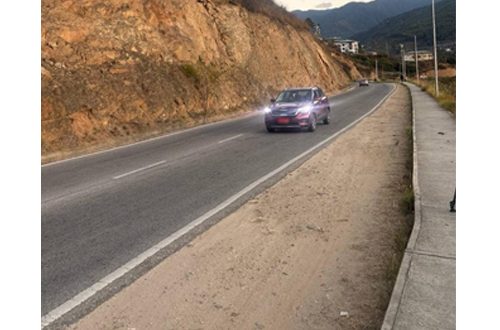
The main eyewitness in the death of 33-year-old detainee, Biren Kumar Kafley, is Pema Thinley (34) from Gelephu who had come to Thimphu for the Global Peace Prayer Festival (GPPF).
The Bhutanese revisited Pema Thinley again with more detailed questions as the last time around Pema was busy and distracted helping his friend and neighbor whose father had passed away in Gelephu.
Pema said he noticed that the speeding police van’s back door only had a single rod latch and that it was not secured by a lock.
He said he heard a loud bang noise and the door opened, and he said it is either possible that the detainee kicked the door and jumped out or fell out as the door opened.
The police have so far been saying that being a former convict, Biren had managed to open one of the handcuffs.
However, Pema remembers seeing the handcuff tied in both his hands, and he said the van was moving with such speed and wind must have also been a factor that Biren fell awkwardly right in the middle of the road with the back of his head and body landing on the road with his face facing upwards to the sky. Biren’s body rolled a few times on the street due to the force.
Pema said, “As soon as I saw the person land on the street I shouted Lopen, Lopen, four times but the escort guard was in the front with the window closed and busy in conversation with the driver not even realizing what happened in the back.”
Pema afraid that the motionless Biren would be run over by another car raised both his hands to alert cars to the body and also stop cars for help. Pema said that quite a few cars passed by without helping.
A Santro with some occupants finally stopped to help.
Pema said they lifted Biren and took him to the side of the road and he said Biren was in a bad state as he was vomiting, followed by bubbles from his mouth and then finally blood also poured out of his mouth.
Pema said that as they moved the body and placed it on the side it was only then that one of the handcuffs came out. He says it is likely that the force of the fall must have dislocated or loosened the handcuff.
It was only after a while that the police van was coming back with the escort guard running by its side to retrieve Biren.
Pema said that the fault of the police is that they did not lock the single rod latch and the escort guard was not sitting with the detainee and instead was in the front seat with the driver.
He said the detainee was wearing a white hook shirt and a black pant.
Pema had been tracked down a few days after the incident by the police who used CCTV footage near the Lungtenphu Viewpoint which showed him walking by moments before the incident.
Pema said he is willing to give his testimony anywhere including in court and he will honestly say what he saw and nothing more or less.
Pema is a resident of Gelephu.
According to a 35-year-old eyewitness, Dhan Gurung, the incident occurred on the afternoon of 14th November 2025 while he was travelling with four friends from the Lungtenphug viewpoint towards Semtokha after attending the GPPF at Changlimithang in Thimphu.
He said the vehicle they were travelling in, a Santro, was being driven by one of his friends, and that the road was heavily congested, with traffic moving in both directions.
“As we approached the area, I noticed a person lying motionless in the middle of the road. Vehicles were passing very close to him, almost hitting him, but none had stopped,” he said. “When our vehicle got closer, I asked my friend to stop, and two of us got out to check on him.”
He said that initially he thought the person might be intoxicated and unconscious. “However, when I looked more closely, I noticed that he was handcuffed on one side. We tried to wake him, but he did not respond,” he said.
Gurung further stated that an individual walking along the opposite footpath approached them and said that the man had jumped from a police van. The three of them then moved the man to the footpath and again attempted to wake him, but he remained unresponsive.
As the man was handcuffed and had reportedly jumped from a moving police van, the eyewitness said he was about to call the police emergency number, 113. However, before he could do so, policeman arrived at the scene and confirmed that the man had jumped from the van, prompting him to cancel the call.
“Soon after, a police van arrived, and two police personnel asked us to help lift the detainee into the vehicle. After we helped place him inside, the police van left immediately,” he said.
Mr Gurung said the entire sequence of events unfolded quickly. The man was moved to the footpath within about five minutes, and the police arrived shortly thereafter. As a result, he said he did not closely observe any injuries apart from a few scratches on the man’s hand. He added that he could not clearly recall which side of the handcuffs was secured, but remembered noticing what appeared to be foamy bubbles around the man’s lips.
Medical Expert on Traumatic Brain Injury Cases
Following the death of 33-year-old Biren Kumar Kafley, the immediate cause of death was declared as traumatic head injury due to blunt force trauma on 23rd November 2025. The forensic department of the Jigme Dorji Wangchuck National Referral Hospital (JDWNRH) conducted a postmortem examination and submitted its report to the Royal Bhutan Police (RBP).
However, both the RBP and the Ministry of Health (MoH) declined to share the postmortem findings. The RBP asked the reporter to seek the report from JDWNRH, while the hospital stated that permission would need to be granted by MoH, as the report had already been submitted to the police. MoH, in turn, directed the reporter back to the hospital. Hospital officials later stated that as the case is medico-legal in nature, the findings are confidential and can only be released upon legal request.
A medical expert, who requested anonymity, said that while traumatic head injury has been cited as the primary cause of death and is described as fatal in nature, such injuries cannot be conclusively attributed to a fall alone without corroborating evidence. The expert said that while a fall is one possible explanation, determining the most likely scenario requires careful assessment. In this context, the forensic team, along with police personnel, revisited the scene on 5th December 2025 to assess whether the injuries were consistent with a fall.
The medical expert explained that factors such as the posture of the individual at the time of impact, restricted movement, or restraints, including the presence of handcuffs, can significantly influence the nature and severity of injuries sustained. As a result, it becomes challenging to definitively link a head injury to a specific event without comprehensive supporting evidence.
The expert further noted that head injuries caused by blunt force trauma can also result from motor vehicle accidents or impact against a “broad surface,” which does not necessarily refer only to a roadway, but may include hard vertical or horizontal surfaces such as walls or other fixed structures.
Family members of the deceased had earlier stated that there were few visible external injuries on the body, apart from scratches on the knuckles and swelling above the left side of the ear. However, sources indicated that the postmortem examination revealed multiple internal injuries in addition to the head injury.
The medical expert explained that blunt force trauma does not always result in prominent external wounds, as the force of impact may be absorbed internally, particularly affecting the brain and internal organs.
In such cases, the expert said, forensic conclusions are often expressed in terms of probabilities rather than certainties. The role of the forensic report is to present the most medically plausible explanations based on available evidence. Establishing a definitive cause and sequence of events will depend on further investigation and how the forensic findings are assessed alongside other evidence gathered by the police.