The Bhutanese Leading the way.
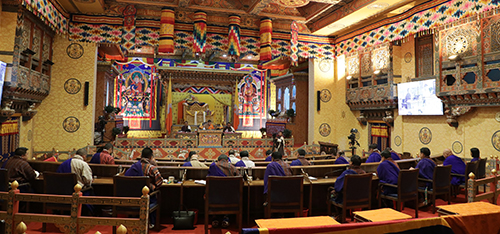
The National Council’s Business Plus Committee presented a review report of key economic sectors identified as having high potential to drive growth and employment in Bhutan.
Upholding the GMC vision and considering the prevailing economic situation, the committee said the National Council had established a Special Committee for Business Plus during the 16th Plenary in June 2025 to review key economic sectors that could propel growth and employment. Recognising trade as a powerful engine for economic growth, the committee identified three key sectors for review: the export sector, production and manufacturing (P&M) industry, and wholesale and retail trade.
The committee stated that from 2015 to 2023, the manufacturing sector accounted for an average of 7.2 percent of GDP, while retail and wholesale trade contributed 9.6 percent, and exports of commodities (excluding electricity) averaged 15.5 percent, together accounting for 32.3 percent of GDP.
Employment in manufacturing, production, and trade accounted for 16 percent, although employment related to exports is likely higher, as it cuts across agriculture, mining, forestry, and other sectors. The objectives of the review study, according to the committee, were to assess business opportunities and hurdles and to facilitate business growth through timely policy and legislative interventions. The report presents methodology, observations, challenges, and recommendations for deliberation.
The committee observed that doing business remains a significant hurdle in Bhutan. In the World Bank’s Doing Business Report 2020, Bhutan was ranked 89th out of 190 economies on ease of doing business, compared to 81st in the previous year, reflecting a drop of eight places. Bhutan has yet to optimize numerous market opportunities, particularly in India and Bangladesh, due to several bottlenecks.
To address this, the committee recommended reviewing trade routes through Golakganj and Sonarhut LCS to facilitate exports, especially to Bangladesh, given challenges in inland water transport due to port capacity and river draft limitations. It emphasized expediting railway connectivity via Haldibari and Chiliahati to alleviate congestion at Changrabandha and Fulbari LCS points and promote increased export activities, potentially allowing 500–600 trucks daily from Samtse and Phuentsholing.
The committee suggested expediting dialogue with the West Bengal Government to resolve Suvidha charges for Bhutanese consignments at Changrabandha and Fulbari, and exploring a standard charge per truck if a waiver is not feasible. It also called for resolving toll fee penalties for Bhutanese commuters without FASTag along the Assam and West Bengal Asian Highway and for expediting the signing of the Mutual Recognition Agreement between RGoB and GoI on conformity assessments to enhance regulatory cooperation and trade.
The committee highlighted the need to scale up timber supply to meet growing domestic demand, reduce imports of wood-based products, and increase timber exports, particularly to India. It noted that charcoal accounts for about 77 percent of total wood-related imports, averaging 120,000 MT or Nu 2.71 billion annually, and recommended enhancing domestic production and allowing units to operate near logging areas.
Institutional recommendations included reviewing the composition of ERA members to strengthen autonomy and private industry representation, ensuring future energy truing-up adheres to policy so the cheapest power is allocated first, and adjusting energy billing for differences between committed load and actual consumption due to outages or supply fluctuations.
The committee further emphasized upgrading facilities and infrastructure at ICP, MDP, and LCS with modern automation and technology to enhance efficiency and security, developing a single-window system at ICP and MDP to improve movement of people, vehicles, and goods, and exploring alternatives to mitigate traffic congestion and disaster-related hazards at ICPs near international borders.
It also recommended incentivizing financial institutions to relax loan requirements for CSIs and establish dedicated funds for low-interest loans for small-scale enterprises, as well as exploring alternative markets for agricultural products beyond FCBL auction yards to provide reliable markets and better prices for farmers.
The deliberations on the review report of the few key economic sectors will be continued from 8th December during the 8th sitting.