The Bhutanese Leading the way.
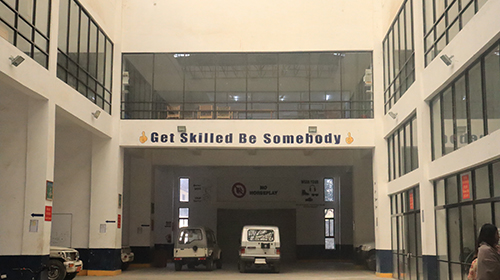
Technical Training Institutes (TTIs) in Samthang and Chumey, along with the Rural Development and Training Center (RDTC) in Zhemgang, are making leaps in improving infrastructure, skills development, curriculum, and other beneficial support.
This has been made possible through support from the Asian Development Bank (ADB) under its Pathways for Emerging Skills and Jobs Project (PESJP), which aims to fund developments within TTIs and the RDTC.
For TTI Samthang, Officiating Training Director Prakash said that the ADB has played a key role in building infrastructure at the institute. Currently, a dining hall and a reliable water source are under construction, among other projects.
A trainer in Samthang said that the TTI has had a water problem for a long time. The new water source and tank are expected to resolve the issue once construction is completed.
Alongside automotive and earthmoving courses, TTI Samthang is also focusing on creative arts, offering courses in Beauty and Hair, Videomaking, and Sound Technician training.
The institute soon plans to introduce Cosmetology as a course as well. “We were asked once by a foreigner whether we can make shampoos from our own natural resources. That’s when it struck us, and we asked, why not do it ourselves?” said Prakash.
This course is expected to be added to the curriculum in two to three years after proper exploration and research and development (R&D).
In the Electric Vehicle mechanics course, students have also built an Eco-drive ATV (All-Terrain Vehicle) as part of their project. It is a small, bike-like vehicle that runs on batteries, showing enthusiasm and promising potential from the students to capture in-demand future jobs.
TTI Chumey
TTI Chumey is an institute that specializes in construction-related training courses. Officiating Training Director Ghana Shyam said that the support has been of great help in funding equipment, curriculum development, and new infrastructure amounting to Nu 18 million.
Hostel facilities, staff quarters, a multipurpose hall, workshops, and classrooms are among the infrastructural projects being constructed at the institute. These are also insulated using foam to keep the students warm in Bumthang’s cold weather.
Classrooms are currently compact, and students regularly need to shift rooms or even work outside for practical classes.
“The support is definitely going to be helpful for the students since we have fewer classrooms, and sometimes students have to work outside in the cold weather due to a lack of workshops and classrooms,” said Ghana Shyam.
In addition to the existing 280-bed hostel, an additional 200-bed capacity will be built to house more students.
“As part of the vision of the Gelephu Mindfulness City (GMC), it will also support students in getting jobs in various companies,” said Ghana Shyam.
It is also encouraging to see that graduate students secure jobs at the companies where they complete their On-the-Job Training (OJT). “We are also glad to see that our students got jobs in companies such as Rigsar-Vajra Construction,” he said.
Going forward, the TTI plans to introduce courses in upholstery and solar heating systems as well.
Developments at RDTC
The RDTC serves as a crucial short-course training center for individuals residing in rural areas, particularly those on the periphery of Zhemgang.
The center currently offers courses in landscaping, food sciences, agro-processing, and floriculture, among others.
As a rural center, it currently has only 26 students in total. Its overall capacity is only 70, and the upcoming hostel infrastructure will add capacity for 200 more students. For teaching, a dedicated complex will be built for classes with upgraded technical equipment and technology.
New, in-demand courses in food processing technology, ornamental horticulture, landscape technology, and seed and nursery technology will also soon be introduced at the center to create more job-ready youths for the market.
Going forward, these facilities will undeniably help youths gain meaningful employment in companies and businesses. TTIs are also teaching students entrepreneurship and providing additional support so that those with ideas can step up and start ventures on their own.