The Bhutanese Leading the way.
Despite reporting progress in economic growth, infrastructure, education and healthcare, the government faces significant challenges in fulfilling the targets of the 13th Five-Year Plan (FYP), with rising youth unemployment, large-scale out-migration and declining fertility emerging as major national concerns.
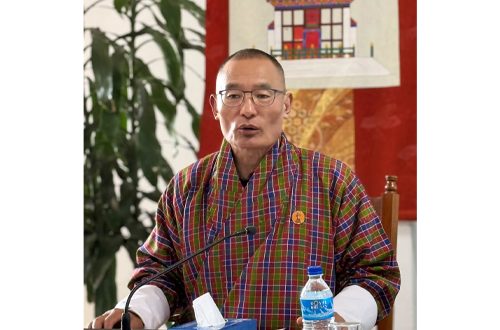
Presenting the findings of the Plan’s Mid-Term Review at the 33rd Meet-the-Press on 20th November, the government said significant progress had been made across its four clusters, but acknowledged that further efforts and adjustments would be necessary during the remaining years of the 13th FYP.
The Prime Minister Dasho Tshering Tobgay said that the overall progress of the 13th Five-Year Plan has been positive, with investments and development initiatives underway to ensure that people benefit from the planned programmes and projects.
With an overall budget of Nu 512 billion (bn), the 13th FYP aims to drive economic transformation, create employment, strengthen public services and improve the livelihoods of Bhutanese people.
One of the major concerns highlighted in the review is the continued departure of Bhutanese workers overseas. More than 71,000 Bhutanese are currently working abroad, most of them young, educated and skilled.
In addition, more than 72,000 young Bhutanese are studying and working outside the country, reflecting the scale of young people pursuing education and employment opportunities abroad. The trend raises concerns about the country’s ability to retain its young and skilled population and provide sufficient opportunities for them to contribute to the domestic economy.
Youth unemployment has also increased from 15.9 percent to 18.5 percent, despite an improvement in the overall employment rate from 94.1 percent to 96.55 percent.
The government also expressed concern over the declining fertility rate, which has fallen below the replacement level of 2.1. Annual births have declined by 26 percent over the past decade.
To address the demographic challenge, the government has launched the Third Child Plus Program (TCPP) and is finalising the Sustainable Population Development Plan.
Substance abuse among young people remains another concern. The government said it was intensifying efforts to enforce drug-free schools and had established a special school at Yonphula in Trashigang to provide targeted support to young people affected by substance abuse.
Economic growth and infrastructure progress
Despite these challenges, the government reported improvements in several economic indicators since the beginning of the 13th FYP.
Gross Domestic Product (GDP) increased from Nu 280 billion in 2023 to Nu. 364 billion, while hydropower generation capacity rose from 2,452 MW to 3,576 MW.
The increase in hydropower capacity follows the commissioning of the 1,020 MW Punatsangchhu-II project and three smaller hydropower projects: Yungichhu (32 MW), Burgangchhu (54 MW) and Suchhu (18 MW).
Non-hydropower exports also increased from 47 percent to 63 percent, while tourist arrivals rose from just over 103,000 in 2023 to nearly 210,000 in 2025.
The Government has also approved 35 new foreign direct investment projects worth Nu 226 bn, which it said would contribute to economic diversification and investment.
In agriculture, 290 chain-link fencing projects have been completed, protecting 45,724 acres of farmland and benefiting 20,440 households.
To improve farm access, 169 new farm roads have been constructed, 257 improved and 110 blacktopped.
Progress in education and healthcare
In the social sector, the government reported the establishment of 170 new Early Childhood Care and Development (ECCD) centers, bringing the national total to 713. Infrastructure improvements have also been initiated in 34 schools.
To improve children’s nutrition, the monthly school meal stipend was increased from Nu 1,500 to Nu 3,100. The government also introduced the One Egg per Student per Day initiative to support children’s nutrition and cognitive development.
Education reforms include aligning the national curriculum with the Cambridge framework and establishing an international school in partnership with Singapore-based EtonHouse International Group in August 2026.
More than 18,000 teachers have received professional development training, both within and outside the country.
In healthcare, three major hospitals in Mongar, Samtse and Gidakom have been completed, while new urban health centers have been established in Thimphu and Phuentsholing. Trashigang Hospital has also been renovated and expanded.
The government reported that 92 percent of patients are now served through the Electronic Patient Information System (ePIS), which is intended to improve access to patient information and the delivery of medical services.
It also reported achieving important public health milestones, including the elimination of measles, rubella, leprosy, neonatal tetanus and poliomyelitis.
Governance and security
The review also highlighted progress in governance, digital services and institutional reforms.
Bhutan ranks 18th out of 182 countries in the Global Corruption Perceptions Index and 21st out of 163 countries in the Global Peace Index, placing first in South Asia in both indices, according to the Government.
In line with His Majesty The King’s Royal Kasho on Civil Service Reform, the government has undertaken structural reforms and trained more than 700 civil servants under the Enlightened Entrepreneurial Bureaucracy program.
Technology-based initiatives, including the Border Management System, e-Customs Management System and Construction Approval System, are also being implemented to improve efficiency and transparency in public services.
The government said Bhutan continues to enjoy peace and stability while strengthening digital security through the National Digital Identity system and the Cyber Security Strategy. It is also preparing a National Energy Security Strategy to reduce dependence on imported fuel.
Investments in cultural and environmental conservation also remain part of the government’s efforts to protect national identity and strengthen long-term resilience.
Course corrections and accountability
To address implementation gaps, the government said it was undertaking mid-term adjustments to projects and activities, including aligning them with the Gelephu Mindfulness City (GMC) and the 21st Century Economic Roadmap.
For large investment projects, including those under the Government of India Project-Tied Assistance (GoI-PTA), written commitments have been sought from the heads of agencies to ensure timely completion within the Plan period.
The government has also reintroduced the Annual Performance Agreement (APA) beginning this fiscal year to strengthen the delivery of annual plans by government agencies and local governments.
The APA is linked to the Royal Civil Service Commission’s Executive Performance Dashboard to improve accountability, monitoring and evaluation.
The government said the remaining years of the 13th FYP would be critical to delivering its commitments, particularly in creating jobs, improving livelihoods, strengthening the economy and enhancing people’s well-being.
While the Mid-Term Review reports progress across key sectors, the rising youth unemployment rate, continued out-migration and declining fertility remain significant challenges. Addressing these issues will be crucial if the government is to translate the 13th FYP commitments into opportunities and improved living conditions for Bhutanese people before the end of its term.