The Bhutanese Leading the way.

New regulations, national standards and professional association expected to strengthen transparency, accountability and public confidence in property valuations
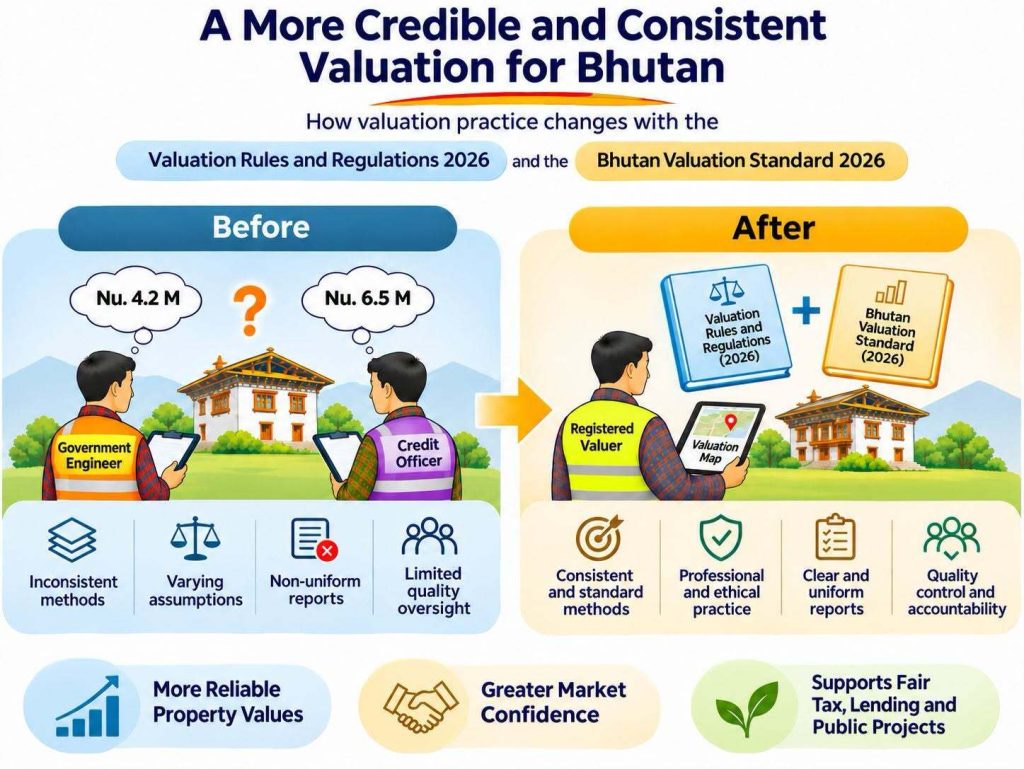
Bhutan is set to establish a more structured and accountable valuation profession with the introduction of its first national regulatory framework, which seeks to standardize valuation practices, strengthen professional competency and improve public confidence in property and asset valuations. The Ministry of Finance (MoF), through the Property Assessment and Valuation Agency (PAVA), launched the Valuation Rules and Regulations of Bhutan (VRR) 2026, the Bhutan Valuation Standard (BVS) 2026 and the Valuers Association of Bhutan (VAB) on 18th November 2026.
The three initiatives mark the country’s first dedicated regulatory framework, national valuation standard and professional body for the valuation sector. The VRR 2026 will establish requirements for registering individual valuers and valuation firms, professional competency, continuing professional development and handling complaints. It is expected to strengthen professional accountability and ensure that valuation practitioners meet recognized requirements. The BVS 2026, meanwhile, will provide a common national standard for conducting and reporting valuations, aligned with International Valuation Standards. It is expected to promote greater consistency, transparency and reliability in valuation practices across the country.
The newly launched Valuers Association of Bhutan will initially function as a professional body under the ministry’s initiative to support practitioners, promote ethical conduct and facilitate knowledge-sharing and professional learning. As the profession develops, the MoF intends to work towards establishing the association as a fully independent body. Valuation plays an important role in the country’s economic and financial activities, underpinning investment decisions, government compensation, bank lending and land transactions. However, the absence of a common national framework and recognized professional standards has the potential to affect the consistency, transparency and credibility of valuation practices.
With the new framework, the MoF aims to establish a more credible and accountable valuation system, where property and asset valuations are carried out using consistent professional standards. This is expected to support fairer and more defensible decisions, strengthen investor confidence, facilitate private sector growth and provide the government with a more reliable evidence base for policy formulation.
The VRR 2026 and BVS 2026 were developed with technical support from the World Bank and through consultations with relevant stakeholders, including the private sector. Both instruments were approved by the Cabinet on 30th October 2026. The two instruments will come into effect on 1st January 2027, following which the MoF is expected to focus on implementing the framework through a series of measures.
Currently, banks and financial institutions (FIs) have their own valuation guidelines, which valuers are required to follow. While building valuations are based on the Bhutan Schedule of Rates (BSR), land valuations were previously determined using rates developed internally by individual FIs. These assessments are generally carried out by in-house valuers, most of whom are civil engineers.
However, following encouragement from the Royal Monetary Authority (RMA), FIs began working towards adopting common land valuation rates in 2023 to ensure greater consistency in property valuations.
Ugyen Tenzin, an engineer with the Real Estate Unit who currently serves as Senior Valuer at Bhutan National Bank Limited (BNBL), said the BVS 2026 and VRR 2026 could establish a common framework to standardize valuation practices across financial institutions. He said the new framework would go beyond the uniform land rates previously adopted by FIs and formally recognize and regulate the valuation profession, potentially strengthening professionalism and accountability in the sector. However, he noted that the changes would need to be introduced in phases to ensure a smooth transition.
Under the proposed transition, the FIAB Land Rates 2025 are likely to be replaced by the National Comprehensive Land Reference Rates 2026, while building valuations are expected to continue using the Bhutan Schedule of Rates until market-based valuation methods can be adopted. Under the new regulations, banks will be required to engage only registered and certified valuers for valuation services.
“We are also exploring the registration of personnel already practicing valuation under the Associate Valuer category. They will be allowed to practice valuation under the supervision of a full-fledged member,” he said.
He also said the new framework is expected to help valuers arrive at more accurate property valuations and address both overvaluation and undervaluation of collateral. Although implementing the new regulations may involve additional costs for financial institutions, he said these costs were unlikely to be passed on to customers. Measures would also be taken to ensure that the turnaround time for valuation services remains at its current level.
He added that if the number of qualified valuers in the country proves insufficient to meet the requirements, financial institutions may consider training additional in-house personnel. Outsourcing selected valuation assignments will also remain an option.
As part of the implementation process, the MoF will undertake awareness and advocacy programs for stakeholders, establish an Independent Valuation Governance Board under the MoF, develop the competency and examination framework for valuers and certify the first cohort of professional valuers by June 2027.
The proposed governance board and formal competency and examination system are expected to provide the institutional and professional foundations for regulating the sector, and ensuring that practitioners possess the necessary qualifications and expertise. PAVA, under the MoF, is the government agency responsible for property assessment and valuation in Bhutan. The introduction of the three initiatives marks the beginning of a structured approach to developing the country’s valuation profession, with a focus on professional competence, standardized practices and greater accountability in property and asset valuation.