The Bhutanese Leading the way.
One unit of the Punatsangchu-II Hydropower Project has suffered a breakdown, and restoration works are underway, according to the Ministry of Energy and Natural Resources (MoENR).
The project is currently generating 934 MW, with attempts being made to maximize power generation depending on water availability. However, with the onset of the lean season, water levels are expected to drop, and inflows will become insufficient to sustain full capacity generation, according to MoENR.
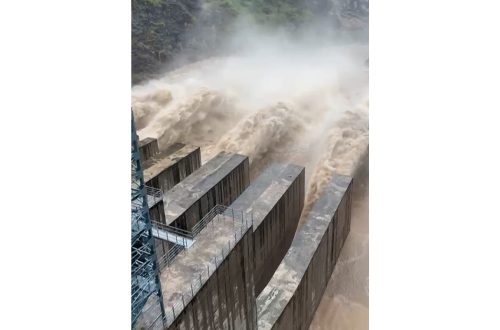
The confirmation comes in the wake of incessant rainfall and flash floods across the country on 4th and 5th October which caused inflows at the dam sites of both Punatsangchu-II and Tala hydropower projects to rise sharply. In accordance with dam operation protocol, the operators carried out the controlled opening of radial gates to manage reservoir levels. The increased inflows were accompanied by heavy siltation and debris, requiring continuous monitoring and coordinated operation to ensure dam safety and proper water discharge management.
Meteorological data shows how sharply conditions changed during the two days of rainfall. At Chukha, 285.0 mm of rain was recorded on 4th October while Punakha saw 75.2 mm, Paro 72.0 mm, Thimphu 57.0 mm, Gasa 65.8 mm, and Wangdue Phodrang 70.6 mm.
As a precaution, dam operational guidelines permitted lowering the water level by spilling water at a rate of one meter per hour to prevent reservoir rim failure.
On 5th October, with heavy silt deposition threatening to choke the intake and discharges from seven radial gates exceeding 2,300 m³/s, the PII undertook reservoir scouring after informing the local authority, the National Center for Hydrology and Meteorology (NCHM), and the Royal Bhutan Police (RBP).
Authorities confirmed that no damages were reported downstream. Impacts were largely avoided through public notification, coordination with dzongkhags, and communication with both national and Indian counterpart agencies.
MoENR stated that the structural integrity of the project had not been compromised by the opening of spillgates. All dams, they explained, are designed to withstand extreme loadings, including seismic events, and incorporate flood routing for Probable Maximum Floods (PMF) and Glacial Lake Outburst Floods (GLOF). For Punatsangchu-II, the design flood is 16,023 m³/s (PMF 11,723 m³/s and GLOF 4,300 m³/s). Its seven radial gates are each capable of discharging 2,432 m³/s, and during the October rainfall, the peak inflow observed was about 2,800 m³/s.
Reflecting on the recent incident, MoENR stated it reinforced the importance of proactive monitoring, timely response, and adaptive operational strategies. Lessons drawn include the continual assessment of hydrological and weather risks, strengthening flood management and emergency preparedness, and maintaining dam infrastructure according to international standards.