The Bhutanese Leading the way.
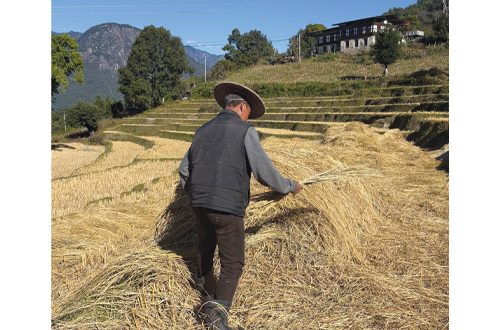
Radhi gewog in Trashigang, known as the rice bowl of Eastern Bhutan, is witnessing its golden paddy fields turn into parched fields.
Once a major contributor to Bhutan’s rice supply, the gewog is now struggling as climate change disrupts rainfall patterns and reduces water sources crucial for paddy rice cultivation. Its traditional rice fields, the backbone of eastern food security, are now at the mercy of a climate that no longer follows its historic rhythm.
When the monsoon arrives late, seedlings struggle, soil moisture drops, and the growing season shortens. The late and unpredictable rainfall is disrupting paddy cultivation.
Irrigation in Radhi is extremely difficult because most farmers rely on small mountain streams, which are now drying up. These changes are reflected in shrinking paddy fields and reduced harvests, showing how rising global temperatures and shifting monsoon patterns are directly affecting rice production in Radhi.
This reporter visited Radhi gewog, where most farmers struggle due to untimely rainfall and insufficient water for their paddy fields.
Yoenten Phuntsho (62), who has been cultivating rice since he was 15, noted that over the decades, the monsoon has become increasingly unpredictable.
When asked how the delayed rainfall affected his main source of income, he said, “Our gewog does not have a proper irrigation channel as there is no proper water source, and on top of that, there has not been a timely rainfall over the years, which eventually led to low production and low income.”
Yoenten Phuntsho said that his only source of income has been paddy cultivation, which over the years has been severely affected by climate change.
Another farmer, Karma (74), who has lived in Radhi gewog all his life, owns two acres of rice paddy fields. He shared that since the age of 10, he has been helping his family work in the fields.
He said that although the selling price of rice has increased over the years, one of the main challenges remains the rising wages that farmers must pay laborers. He said, “The price is like the difference between the sky and land, per person we have to give them Nu 600 with lunch served.”
For rice to grow, water is the main requirement. However, Karma said that when it is the right time for cultivation, there is often no rainfall. “When farmers like me struggle with no timely rainfall, we do not have other option as we do not have a proper source of water for irrigation.”
Karma also mentioned that in the past, rainfall was more timely compared to the present. He explained that there is a small water source at the top of the gewog’s mountain, but there is no pump, and the water is first used by the village in the upper gewog, known as Chaymang Kadam. Only after their needs are met is the water released to Karma’s village, Radhi Pangdang, located in the lower part of Radhi.
He said that the water is insufficient, and the situation is similar with laborers, priority is given to the upper village before the lower village receives anything.
Karma said that although they have been informed of a water project aimed at addressing the shortage and climate change, ensuring sufficient water for irrigation even during untimely rainfall, he hopes the project will begin soon, as, like other farmers, his rice field is his only source of income.
He further explained that rice production has declined over the years due to untimely rainfall, and on top of that, wild boars frequently invade the fields.
He urged the government to address this problem as well.
Karma noted that he has lived through every government’s term and observed that the water shortage has never been fully resolved. He said, “Starting from the first government’s time, we have been told that the water shortage will be soon addressed, however this has never been fully addressed.”
For farmers like Sonam Dem (50), who was also born and raised in Radhi gewog, paddy cultivation remains her main source of livelihood. She said, “I did not get the opportunity to join school; since I was 9 to 10 years old, I worked in the fields.”
Sonam added that, compared to the olden days, the selling price of Radhi’s rice has increased; however, laborers’ wages have risen as well. “I remember paying them Nu 200, however, now I have to pay them Nu 600.”
As the gewog already faces water shortages, for both fields and drinking water, Sonam pointed to climate change as a factor affecting timely rainfall. “There is no proper water source, and on top of that, without rainfall, we cannot irrigate the fields,” she said.
Her village, popularly known as Radhi Dekiling, once benefited from timely rainfall, resulting in higher rice production. “During those times, we also used to sell rice to other dzongkhags; however, now we can only sell it at our dzongkhag’s local market.”
Sonam further noted that they have been informed that a water channel will soon be constructed in her gewog, and that the farmers will need to contribute according to the size of their fields. she said, “I heard that the Desuups are going to help us channel the water.”
Just like Karma, she mentioned that villages closer to the water source use it first, and only when sufficient water is available do the lower fields receive it, which is often not enough, and she said, “The village above me is Tokshingma; they will first irrigate with the water.”
According to farmers, they prepare seedbeds early and begin transplanting seedlings into the paddy fields by late May or early June, depending on the arrival of the monsoon.
However, Karma and other farmers of Radhi gewog said that over the years, including this year, there has been no timely rainfall.
The Gewog Agriculture Extension Officer explained that this year, rainfall was delayed during the peak cultivation season, and without timely rains, irrigation was not possible.
He said, “Rice cultivation depends entirely on rainfall, as timely rains allow farmers to channel water from streams to irrigate their fields.” “Without rainfall, cultivation becomes impossible, leading to declines in both harvested area and output, which in turn affects local food security,” he added.
Yoenten Phuntsho said, “During my ten years in office (as a Gup), farmers had been repeatedly complaining about delayed rainfall.”
He also mentioned that a project will soon begin focusing on water shortages in the gewog, which could help address the challenges faced by farmers and the people of Radhi Gewog.
Rice is a staple in Bhutan, consumed by virtually all households, making its production essential for national food security.
However, Radhi gewog, once known as the rice bowl of Eastern Bhutan, now faces the harsh effects of climate variability. Unpredictable and delayed rainfall has disrupted planting schedules, reduced yields, and threatened farmers’ livelihoods and food self-sufficiency.
According to the World Integrated Trade Solution (WITS), Bhutan imported 31,512 tons of rice from India in 2024.
Moreover, the Food and Agriculture Organization of the United Nations (FAO) reports that domestic production of Bhutan meets only about two-thirds of national consumption, with cereal imports consisting mostly of rice.
This growing reliance on imports highlights the urgency of supporting local farmers to strengthen domestic production and build climate resilience.
This story was covered as a part of the media reporting grant funded by Australian Government through ABC International Development and JAB.