 The Bhutanese Leading the way.
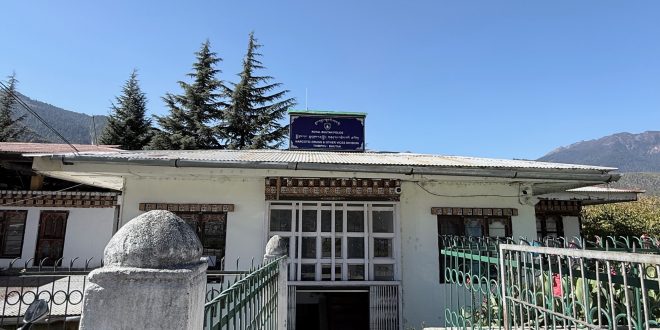
The Human Resource Committee of the Royal Bhutan Police (RBP) Headquarters on 21st January, 2025, completed its investigation into the custodial death of detainee Biren Kumar Kafley.
Following the inquiry, disciplinary action has been taken against three officers and five police personnel from the Narcotics, Drugs, and Other Vices Division (NDOVD).
The highest officer in NDOVD, a Superintendent of Police (SP), has been issued a severe warning for the incident that occurred.
A senior official of the HRC committee said that the SP, prior to the operation, had volunteered to assist in the crowd control and overall smooth functioning at the Global Peace Prayer Festival. Therefore, he had no direct involvement in the operation. However, keeping in mind that he should have known as the senior officer of the department, the warning was issued to indirectly remind him to be more vigilant in the future.
The Officer Commanding (OC) has been penalized with the loss of seniority for six months, which means that while his batchmates are upgraded, he will be behind by six months and will also face financial loss accordingly.
A senior official said that although the OC at the time was not aware of the operation as he was on leave, he was in Thimphu, and therefore the action was taken as a reminder that police personnel, despite being on leave, should always be ready for duty when needed.
The Investigating Officer has been penalized with the loss of seniority for one year.
The senior official said that the operation had been carried out by the officer during a government holiday, but with goodwill and the intent to catch drug dealers.
“Since both the senior officers were not on duty, the dedicated officer carried out the operation until the main incident. The officer, at the time of the incident, had gone to the hospital for personal reasons. However, the officer instructed the subordinates to carry out the operation with the intent to catch the drug dealer of the deceased,” the official said.
“The officer had not informed any of the senior officers nor postponed the operation, and unfortunately, it led to the incident. The officer was basically punished for his sincerity,” the official added.
Among the five police personnel, two were drivers.
The driver, a Drimpon in whose name the jail van was issued, received a one-year reprimand, mainly for not ensuring latch safety. However, before the incident, he had handed over the jail van to a colleague without following formal handover procedures and without informing the other driver about the condition of the van.
A one-year reprimand means that he will not be entitled to any promotions, trainings, or grants during that period.
Meanwhile, the other driver, also a Drimpon, who was operating the jail van at the time of the incident, has lost six months of seniority. The grounds for his punishment, apart from not thoroughly checking the van, were that despite being senior, he did not advise his junior police personnel to sit in the back of the jail van.
Of the remaining three police personnel, the one who was supposed to escort the detainee back to the office, a Drimpon, was issued a one-year reprimand. As a senior, it was his duty to escort the detainee; however, he instructed a Chuma, who was merely a clerk, to perform the task.
The Chuma who escorted the detainee lost one year of seniority, and although he sat for the promotion test and passed, his promotion was withheld following the incident.
Another Chuma, who was the detainee duty personnel, was issued a six-month reprimand. Instead of handcuffing the detainee at the back, he handcuffed him in the front, making it easier for the detainee to access or unlock the cuffs.
The senior official said that the initial phase of the inquiry into the custodial death was carried out by a five-member team from the RBP Headquarters. The team consisted of senior RBP officials selected from different departments, apart from the NDOVD, and also verified any conflict-of-interest relationships.
After the initial investigation, the findings were submitted to the HRC, which consists of four deputies. The four deputies are the Deputy Chief of Police (DCoP) Crime and Operations Department, DCoP Special Police Department, DCoP Investigation Bureau, and the DCoP Administration and Finance Department.
The HRC is a sub-committee of the Police Service Board led by the Additional Chief of Police (ACoP).
The HRC members are fixed, whereas the members in the initial phase change depending on the case.
The eight police personnel will be given the right to appeal to the Chief of Police, the highest authority of the RBP, within ten days if they are dissatisfied with the action taken.
A senior RBP official said that the unfortunate incident has taught them an important lesson, and they are now considering several recommendations accordingly.
Firstly, the committee has recommended that officers in all divisions ensure that jail vans in all respective police stations are secured and fully functional to prevent such incidents in the future.
Secondly, all police personnel should be trained in detainee handling, including escorting and handcuffing.
The senior official further said that he personally feels detainee protocols need to be made stricter, such as enforcing more restraints, as handcuffs alone are not safe since ex-convicts are already familiar with them.
Meanwhile, the deceased’s wife continues to demand justice.
“My husband died while he was in police custody. He went in alive and never came back.The police may deny torture or beating, but they themselves have admitted negligence and procedural lapses. That means they failed in their duty to protect him. When a person is in custody, their life is entirely the responsibility of the authorities.
“A death in custody is not an accident. It is a failure of the system. Internal inquiries and disciplinary actions are not justice for a lost life. I am not speaking out of anger alone, I am speaking as a wife whose husband will never come home, whose child will grow up without a father. My husband deserved dignity, care, and life. I will continue to demand a transparent, independent investigation and real accountability. Justice delayed or diluted is not justice. My husband’s life mattered.”
A lawyer this reporter spoke to said that although the RBP has taken administrative action, concerns remain.
“The deceased was under police custody, and they owed him a duty of care. But due to negligence, he died, for whatever reason. As far as I know, under such circumstances, it constitutes a criminal offence even from a prosecution perspective. As per the Penal Code of Bhutan, this falls under custodial death, so they should not be immune from prosecution and should be subject to conviction. This is in line with equality before the law. If they are not prosecuted for this offence, the very principle of equality is diluted,” the lawyer said.
The lawyer said that if such actions are not taken, it will give people the opportunity to question whether there are two kinds of laws.
On the question of criminal offence, a senior official said that based on their investigation findings, they have ruled out foul play, including allegations that the detainee’s death was caused by torture or being thrown out of the jail van.
The senior official said that the detainee, in an attempt to escape, succumbed to his injuries. Therefore, they did not observe any criminal intent and saw no need to charge-sheet the case in court. In case there had been criminal intent, they would have charge-sheeted the case not only for custodial death but also for murder. However, as no criminality was found, only administrative action was taken.
Further, the senior official said that all evidence, including CCTV footage and eyewitness accounts, has ruled out foul play.
The Bhutanese in November 2025 first brought out the case of Biren’s brain death and later death in custody sparking calls for an investigation and accountability.




A life is lost and responsible people just get warnings??