The Bhutanese Leading the way.
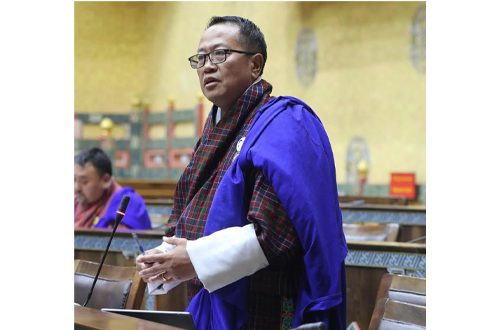
With the results of the Speaker election, where the ruling party nominee Lyonpo Tandin Wangchuk got only 23 votes against the Opposition candidate Tempa Dorji, who got 24, there has been much speculation about it being a confidence vote against the Government.
There has been much speculation that the ruling party has lost its majority on the floor of the House through the Speaker vote and so its strength should be tested on the floor of the House.
For there to be a no-confidence motion against the Government, one-third of the members of the National Assembly, which is 16 MPs, must move the motion under Article 17.6 of the Constitution.
Then, under Article 17.7, “A vote of no confidence against the Government, if passed by not less than two-thirds of the total number of members of the National Assembly, shall require the Government to be dismissed by the Druk Gyalpo.”
The assumption of many people is that the Government can fall if it loses a simple majority vote, but the Constitution is quite clear that it requires a two-thirds majority, which would be 32 MPs rounded up.
The above means that for the process to even start, it will require 16 MPs to bring the motion, and here the role of the Opposition party would be crucial.
Here, the Gangzur-Minjey MP, Loday Tsheten, from the Opposition said the Opposition has no plans to bring a no-confidence vote against the Government in the Parliament.
He said a no-confidence motion would only be moved when the Government fails miserably on some major issues or on national security. He said the Government is performing reasonably and there is money coming in and works are going on.
He said the Speaker vote is more an issue among PDP MPs and its leadership.
When asked if the Speaker results could affect the passing of the budget and legislation in the Parliament, MP Loday Tsheten said that it should not make a difference, as even before the Speaker elections the MPs did not vote on party lines in legislation.
He said the only bill where party lines came up was the Livestock ill.
So, with a no-confidence motion not on the cards from the Opposition party, the only other way to dissolve the National Assembly and call for early elections is by the Prime Minister recommending to His Majesty to do so.
Article 10, Section 24 says, “The National Assembly and the National Council shall continue for five years from the date of the first sitting of the respective Houses. While the National Council shall complete its five-year term, premature dissolution of the National Assembly may take place on the recommendation of the Prime Minister to the Druk Gyalpo or in the event of a motion of no confidence vote against the Government being passed in the National Assembly or in accordance with section 12 of Article 15.”
The Bhutanese sent questions to the Prime Minister on whether he has any plan to dissolve the National Assembly and call for early elections, but there was no response.
The paper talked to some other PDP MPs, and they said the Prime Minister would likely not do this, as it would be very disruptive for governance and also very expensive for the Government.
Truth be told, nobody in the National Assembly, be it from the Opposition or ruling party, would want an early election, as apart from the major national disruption and loss to the exchequer, there is no guarantee that either party will even come back to Parliament.
So, while the loss of the Speaker election is a major embarrassment for the ruling party and shows disunity in its ranks, it is not a no-confidence vote.
Another assumption quietly going around is that since the Speaker won the vote by a simple majority, he can be removed by a simple majority.
The Constitution is silent on the removal of the Speaker, but the National Assembly Rules of Procedure 2022 clearly lays out that a motion for the removal of the Speaker first has to be brought by one-third of the MPs and then it has to be passed by two-thirds, which is 32 MPs. PDP has only 31 MPs.
The Speaker is not only important in the Parliament, but is also an important Constitutional figure who plays an important role in the nomination of Constitutional post holders in the Anti-Corruption Commission, Election Commission of Bhutan, Royal Audit Authority and the Royal Civil Service Commission. His Majesty makes the appointment from the list given by the five.
A five-member committee consisting of the Prime Minister, Speaker, National Council Chairperson, Opposition Leader and the Chief Justice of the Supreme Court elects the Constitutional post holders.
In normal times, the ruling party has two of the five from its party in the form of the PM and the Speaker, but this advantage will now go to the Opposition party.