The Bhutanese Leading the way.
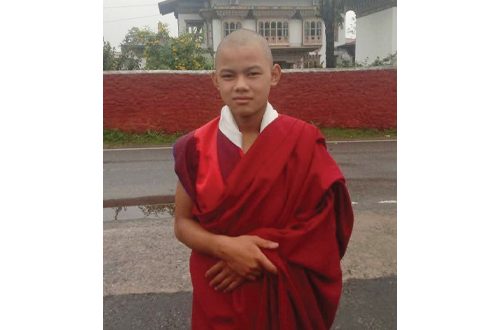
After taking her case through three levels of the judiciary without success, Sangay Dema, the mother of a 16-year-old monk who died by suicide last year, has appealed to the Supreme Court, alleging that the lower courts, including police, failed to properly investigate her claim that her son’s death was linked to an assault he suffered at his monastery.
Speaking about the case, Sangay Dema said she has spent the past year seeking justice for her son, Sonam Tshering, who was a monk at Tading Monastery in Sarpang.
According to Sangay Dema, the incident began when her son was allegedly beaten around 25 times on his buttocks by the monastery’s Kudrung, a senior monk.
She alleges the assault left him unable to walk properly and caused both physical injuries and psychological trauma.
She said medical records support her allegation that her son had sustained injuries consistent with the beating.
Following the alleged assault, Sonam Tshering was taken to Gelephu Hospital.
Sangay Dema said doctors informed the family that the matter had to be reported to the Royal Bhutan Police before treatment could proceed, in line with procedures for suspected cases of physical abuse.
She said the family lodged a police complaint while her son was still alive.
However, according to Sangay Dema, when she reported the matter to Gelephu Police Station, the investigating officer advised her to settle the matter privately with the Kudrung instead of pursuing criminal proceedings.
She said she agreed to sign the settlement because she is uneducated and believed she was following the advice of the police.
Looking back, she questions why police encouraged a private agreement in what she believes was a serious assault involving a minor.
After the settlement was signed, the deceased returned to the monastery.
Sangay Dema alleges that upon his return, the Kudrung publicly reprimanded and humiliated him in front of other monks, questioning why he had come back.
She believes the incident further affected her son’s emotional well-being.
Sometime later, Sonam Tshering died by suicide.
She said that the monastery informed the family of his death, after which his parents travelled there while police and medical procedures were carried out.
Following her son’s death, Sangay Dema said she returned to the police station and requested that the earlier settlement agreement be cancelled, arguing that the circumstances had fundamentally changed.
She alleges that her request was refused and that she was instead warned by police officers.
Sangay Dema further alleges that during the visit of a high authority to Gelephu, she wished to submit her grievance directly.
According to her, police officers told her they would escort her to the meeting but instead took her to the police station, where she claims she was detained for the entire day without being told the reason and without food or water.
She said that despite repeatedly asking why she was being held, no explanation was given.
Unsatisfied with the police investigation, Sangay Dema filed a case before the Dungkhag Court but did not receive a favourable ruling.
She subsequently appealed to the Sarpang Dzongkhag Court, where she said she submitted audio recordings on a pen drive as evidence. However, she alleges that the court did not review the recordings before delivering a judgment that upheld the earlier decision.
Determined to continue the case, Sangay Dema then appealed to the High Court in Thimphu.
She said she had to borrow money to cover legal and travel expenses.
However, she said the High Court also upheld the previous judgments and did not consider the audio evidence she had submitted.
Sangay Dema also raised concerns over compensation following her son’s death.
She said that under Dratshang norms, compensation is payable to the family of a deceased monk but alleges that no such compensation was ever provided.
According to her, money that had initially been given to her for conducting religious rituals was later described by the Kudrung as compensation.
She claims the monastery’s principal clarified to her that the money had been intended only for the performance of rituals and not as compensation for her son’s death.
Sangay Dema further alleged that lawyers representing the Kudrung later approached her with increasing monetary offers to settle the matter, with the offer reportedly reaching Nu 600,000.
She said she rejected each offer because she wanted the matter to be decided through the courts.
The case is now before the Supreme Court, which represents her final judicial avenue.
Beyond the court process, Sangay Dema said she also intends to submit a formal petition, together with copies of the court judgments, to the Office of Gyalpoi Zimpon.
She also questioned whether her case had been treated differently from a recent case in Paro in which a teacher was sentenced to two months’ imprisonment for assaulting a student, asking whether the standing of the accused had influenced the handling of her son’s case.
Despite the legal setbacks, Sangay Dema says she remains determined to continue pursuing the case.
“I am not fighting for money. I only want justice for my son. I will continue until I get justice,” Sangay Dema said.