 The Bhutanese Leading the way.
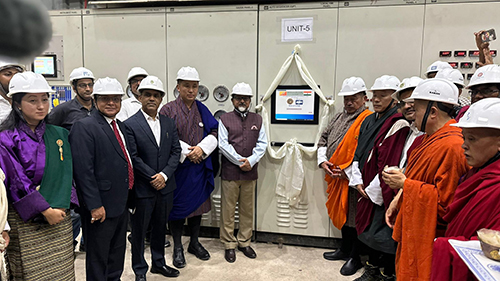
The sixth and final unit of the Punatsangchu II Hydroelectric Project (PHPA II) is scheduled to be commissioned by 27th August by which time, the project will be generating 1020 MW or even more, but none of the power can be exported to India.
This is because the two governments in Bhutan and India have been unable to arrive at a tariff rate for the PHPA II.
Even now, the PHPA II with its five units online is generating 850 MW plus, but all of that power is being used only within Bhutan at a temporary domestic tariff rate of Nu 3 per unit.
The PHPA II started generating with two units on 17th December 2024 and this year, it kept adding units with the third unit in March, fourth unit in May and the fifth unit on 17th July. Each unit is 170 MW.
There have been talks going on for a while between both sides, but there is no agreement yet on the tariff rate.
As per past reporting by this paper, the sticking point is not so much the current tariff rate but how future increases will happen.
The Indian side is amenable to a tariff rate of Nu 5 plus per unit, based on the cost plus basis, but the disagreement is on how it will increase in the future, with the Indian side wanting no increase for a long time or minimal increase, while the Bhutanese side wants a regular increase every few years factoring in inflation and other costs.
Without an agreed tariff rate the Power Purchase Agreement (PPA) with India is also unsigned, and this will not allow power exports.
It is understood that without a tariff and PPA in place, Bhutan cannot export the PHPA II power to India as every power exported from Bhutan would have to have a tariff rate and PPA, and so any additional power of even 1 MW outside this arrangement would be questioned.
This was not an issue in the winter months, as Bhutan needed power for domestic needs in December, January, February, March and a part of April, but it is now a major headache in the monsoon months of June, July and August compounded by the high generation of not only PHPA II but all other projects.
Currently, despite the high generation, the PHPA II power is being used in the country and the temporary domestic tariff rate of Nu 3 per unit is well below what PHPA II would require to pay its loan and be profitable.
The only saving grace is that PHPA II’s loan payment will kick in only two years after the full commissioning of the project.
It is hoped that the tariff can be decided soon between the countries, otherwise it will be a growing challenge for Bhutan.
The inability to export power at the hoped Nu 5 or Nu 5.25 per unit tariff rate also means that the PHPA II is already running in huge notional losses which will run into billions if the current situation is prolonged.
Apart from billions in losses, if PHPA II cannot export its power soon then it will also considerably complicate Bhutan’s domestic power tariff structure which is a blend of cheaper projects like Tala and Chukha, and more expensive ones like Mangdechu and P II.
It may lead to a major hike in domestic tariff rates affecting every household and industry in the country.
This is also the longest ever that the tariff for any project is undecided.

As of now supply current rate agreed by both the parties, meanwhile work out on future tariffs. In this way, present loss can be prevented while buying time to work out on future tariffs