The Bhutanese Leading the way.
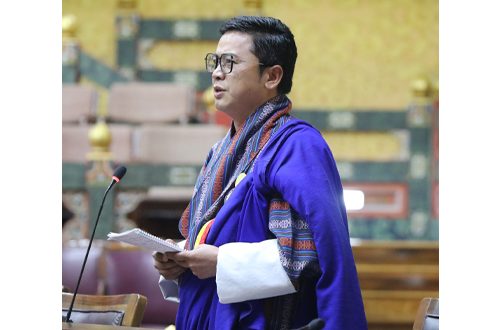
The issue of land tax on private farmland used for public infrastructure has resurfaced as a major concern following a formal submission in Parliament by the Member of Parliament from Sergithang-Tsirangtoe Constituency. The MP raised the matter in light of ongoing grievances from private landowners who are still required to pay land taxes on farmland that is no longer used for their personal or agricultural benefit. These lands, in many cases, have been appropriated for the construction of farm roads, which are now serving the broader public as a means of transportation.
This has led to rising concerns among landowners, particularly in rural areas, who feel that it is unjust to continue paying land tax on land they effectively no longer control or use for its original purpose. These concerns are not limited to one locality but reflect a wider rural challenge as Bhutan continues to expand rural infrastructure and connectivity through farm road development.
In its response, the Ministry of Finance (MoF) acknowledged the issue but explained that the property tax system currently in use, the Property Tax System (PTS) is not independently operated based on discretion. Instead, it functions in direct coordination with the Department of Human Settlements and the National Land Commission Secretariat (NLCS). The PTS relies on live data from these two agencies to compute property taxes: building data is sourced from the Department of Human Settlements, and land data is drawn from the NLCS through the digital eSakor system.
MoF emphasized that property tax on land is based strictly on the lag thram (official land ownership record) issued by the NLCS. Unless the lag thram is officially updated to reflect changes in land use, such as portions of land being used for public road infrastructure, the ministry has no legal or administrative authority to reduce or revise the tax amount imposed on the landowner. This legal constraint leaves landowners in a difficult position where their land continues to be taxed as if it were in full private use, despite its conversion into a public good.
To address this, MoF indicated that while it cannot directly alter tax obligations without updated land records, an interim measure in the form of tax refunds could be explored. If Local Governments (LGs) or relevant agencies can provide certified landholding data clearly showing the specific areas that have been used for farm road construction, then the ministry can process tax refunds for the affected landowners. However, this solution also presents significant logistical challenges.
According to MoF, verifying the data and processing the refunds would be an extremely burdensome administrative task, especially given the small amounts of money involved per case. With the property tax rate set at 0.1 percent of the land’s value based on the PAVA (Property Assessment and Valuation Agency) system, the potential refund amounts are minimal at the individual level. Nevertheless, the cumulative number of cases across the country would require substantial time and resources to process.
To illustrate, MoF provided refund estimates from various regions across Bhutan. In Haa’s Sangbey Gewog, the tax refund for 10 decimals of land used for a farm road would amount to Nu 36.1. In Mongar’s Drepong Gewog, the refund would be Nu 65.9. In Samtse’s Yoedseltse Gewog, landowners would receive Nu 28.6 for a similar land size, and in Zhemgang’s Shingkhar Gewog, the refund would be Nu 27.9. Though these amounts seem insignificant per individual, the total effort to collect, verify, and process thousands of such cases across the country presents a daunting task for the ministry.
Despite MoF’s explanation, the matter continues to raise questions of equity, fairness, and policy clarity. Many landowners feel they are unfairly burdened with tax responsibilities for land that is no longer privately usable. Furthermore, while the government’s drive to build and improve farm roads is widely supported for its economic and connectivity benefits, there appears to be a growing gap between infrastructure development and legal-taxation frameworks.
The issue calls for stronger inter-agency coordination, timely updating of land records, and a reevaluation of Bhutan’s property tax policies, particularly for cases where private land has transitioned into public use. As the debate gains momentum, all eyes are now on the Parliament and relevant agencies to determine whether reforms or targeted interventions can be introduced to address this persistent rural grievance in a fair and sustainable manner.